Colombian Specialty Coffee
Colombian Specialty Coffee
From Ancient Highlands to the World’s Cup
June 2026
Colombia: Where the World’s Best Coffee Begins
There is a moment that every serious coffee traveler eventually experiences: standing at altitude somewhere in the Colombian Andes, surrounded by an ocean of deep green coffee plants cascading down steep volcanic hillsides, the morning mist still clinging to the valleys below, and understanding with sudden, wordless certainty why this country produces what it produces. The geography of Colombia is not merely a backdrop to its coffee story — it is the story itself. The Andes mountain range, upon entering Colombia from the south, splits into three distinct cordilleras — the Western, Central, and Eastern — and in doing so creates thousands upon thousands of unique microclimates, each defined by its precise combination of altitude, rainfall, solar angle, soil composition, and ambient temperature. No two valleys are alike. No two farms, even neighboring ones, produce identical coffee. This structural diversity, embedded in the very geology of the nation, is the irreplaceable foundation of Colombian coffee’s extraordinary range.
The scale of Colombia’s coffee economy is staggering without being monolithic. The country consistently ranks among the world’s top three coffee producers, exporting approximately 12 to 14 million 60-kilogram bags annually — and virtually all of it is Arabica.3 Unlike Brazil, which produces large volumes of lower-grown Robusta alongside its Arabica, Colombia’s topography, culture, and institutional infrastructure have kept the country anchored to the higher-quality species across its entire production base. This national commitment to Arabica, sustained by the Federación Nacional de Cafeteros de Colombia (FNC) and the nation’s 540,000-plus smallholder farming families, gives Colombian coffee a quality floor that few origins can match.3 The country’s Denomination of Origin system formally recognizes 27 distinct coffee-growing departments, each eligible to be identified and marketed under its own geographic name — an acknowledgment, encoded in law, that Colombian coffee is not a single product but a living mosaic of regional identities.5
Perhaps the most operationally significant fact about Colombian coffee — one that roasters and buyers worldwide have quietly relied upon for generations — is that Colombia is the only coffee-producing country in the world that harvests coffee throughout the entire calendar year.4 Its equatorial position, straddling both hemispheres of the Andes, means that while the main harvest (cosecha principal) runs from approximately October through February, a secondary harvest known as the mitaca follows from April through July, staggered across different regions and altitudes.4 For specialty roasters who depend on fresh green coffee for their highest-quality offerings, Colombia’s perpetual harvest calendar makes it an indispensable supply chain partner. There is no long dead season. There is always something exceptional coming off the mountain.
“Colombia does not produce one coffee — it produces thousands, each shaped by the precise altitude, soil, microclimate, and hands of the farmer who grew it.”
The rolling hills of Colombia’s Eje Cafetero coffee region — terraced coffee plants stretch across volcanic Andean slopes at altitude, capturing the equatorial sunlight that defines the Colombian cup.
Credit: Kaveh Kazemi / Getty Images | Villa Carmen Plantation, Tribunas, Pereira, Colombia
A Brief History: From Jesuit Gardens to Global Powerhouse
The written record of coffee in Colombia begins not with a merchant or an agronomist but with a missionary. The Jesuit priest José Gumilla, documenting his extensive journeys through the northeastern reaches of what is now Colombia, included observations on coffee cultivation near the Meta and Orinoco rivers in his 1730 work El Orinoco Ilustrado — one of the earliest known written references to coffee on Colombian soil.1 That coffee arrived in Colombia through the hands of the Church is fitting: the plant would spend the next century moving quietly through ecclesiastical and agricultural networks before anyone imagined it could anchor a national economy.
The most irresistible story from coffee’s Colombian infancy belongs to a priest named Father Francisco Romero, who served the parish of Salazar de las Palmas in the Norte de Santander department in the early nineteenth century. According to a tale that has been repeated so many times it has taken on the comfortable authority of legend, Father Romero had an inspired — or perhaps cunningly pragmatic — approach to the confessional. For certain sins, his assigned penance was not prayer or fasting but something altogether more agrarian: the planting of coffee trees.2 Whether apocryphal or strictly historical, the story captures something true about how Colombian coffee took root — slowly, communally, embedded in the rhythms of small-town life rather than driven by plantation capital. Norte de Santander, the region of Father Romero’s ministry, became one of Colombia’s earliest significant coffee-producing areas, and the municipal archives of Salazar de las Palmas still honor the legend with civic pride.
The first documented commercial export of Colombian coffee occurred in 1808, when 100 bags — each weighing 60 kilograms — were shipped from the port of Cúcuta, crossing into Venezuela before reaching international markets.2 It was a modest beginning by any measure, but the direction of travel was set. Over the following decades, as global demand for coffee accelerated and Colombia’s high-altitude volcanic geography proved exceptionally well-suited to Arabica cultivation, the country’s coffee industry entered a period of rapid, if uneven, expansion.1 By the late nineteenth century, coffee had displaced tobacco, indigo, and quinine as Colombia’s dominant export commodity. Large haciendas in Cundinamarca and Santander controlled much of the early production, employing tenant farmers under arrangements that concentrated both land and profit at the top of the hierarchy.
Two catastrophic events at the turn of the twentieth century inadvertently reshaped Colombian coffee into the decentralized, smallholder-driven industry it remains today. The Thousand Days’ War (1899–1902), a brutal civil conflict that claimed tens of thousands of lives, and the subsequent shock of the Great Depression combined to bankrupt many of the large haciendas that had dominated production.2 As these estates collapsed or fragmented, land moved toward smaller family-operated farms — particularly in the western Andean departments of Caldas, Antioquia, Risaralda, and Quindío, where the geography itself discouraged plantation-scale monoculture. This structural shift, born of war and economic calamity, created the mosaic of smallholder plots that is today directly responsible for the extraordinary diversity of Colombian micro-lots and the resilience of the national coffee sector.
The institutional response to this fragmented landscape was the founding, in 1927, of the Federación Nacional de Cafeteros de Colombia — universally known as the FNC or Fedecafé.3 A non-profit organization representing what is now over 540,000 smallholder producer families, the FNC established the infrastructure, research capacity, quality standards, and international marketing apparatus that transformed Colombian coffee from a regional commodity into a globally recognized brand.3 The most famous expression of that branding arrived on January 6, 1960, when a full-page advertisement appeared in The New York Times introducing the world to Juan Valdez: a fictional Colombian coffee farmer, depicted alongside his mule Conchita, created to embody the human face of 100% Colombian coffee and distinguish it from the international blends that had diluted its identity on store shelves.3 The campaign was an extraordinary success. Juan Valdez became one of the most recognized advertising symbols in the history of food marketing, and “100% Colombian coffee” became a phrase that carried genuine commercial authority in North American and European supermarkets for decades.3
The modern era of Colombian coffee has been defined by a decisive pivot away from volume and toward value. Beginning in the late 1990s and accelerating through the 2000s, Colombia began investing in regional differentiation — moving from bulk commodity exports toward individually identified, regionally branded specialty lots that could command meaningful price premiums in an increasingly sophisticated global market. The third wave of specialty coffee, with its emphasis on single origins, traceability, and flavor transparency, found in Colombia an origin perfectly structured to meet its demands: a country of diverse microclimates, culturally embedded farming expertise, and an institutional framework capable of supporting the transition at scale.
A classic Willys jeep — the iconic vehicle of the Eje Cafetero — displays the symbols of Colombian coffee heritage at Valle de Cocora. For generations, mules and these rugged jeeps carried Colombia’s harvests down Andean mountain trails to market.
Credit: Kaveh Kazemi / Getty Images | Valle de Cocora, Colombia, August 2021
The Specialty Coffee Industry in Colombia Today
The transformation from commodity exporter to specialty powerhouse has not happened overnight, and it has not happened uniformly. But the direction is unmistakable. Across Colombia’s 27 coffee-growing departments, an increasing proportion of the annual harvest is now grown, processed, and marketed with the explicit goal of achieving specialty-grade quality — that is, earning a cupping score above 80 points on the Specialty Coffee Association’s 100-point scale, or ideally above 85 points to attract genuine premium pricing. This shift has been driven by the confluence of international market demand, the institutional support of the FNC and its research arm Cenicá, the emergence of direct trade relationships, and the genuine enthusiasm of a new generation of Colombian farmers who see quality not as a constraint but as an opportunity.
The human scale of this industry is almost impossible to fully absorb. Approximately 540,000 smallholder families cultivate coffee across Colombia’s 27 departments, with the vast majority farming plots of between one and five hectares.3,4 These are not industrial operations. They are family businesses, often multigenerational, where the harvest is picked by hand and critical decisions — when to pick, how long to ferment, how to dry — are made by individual farmers based on accumulated experience and increasingly on scientific guidance. The aggregate output of all these small decisions, made by half a million farming families across a country of staggering geographical diversity, is what the world calls “Colombian coffee.”
The economic stakes of the specialty transition are transformative at the farm level. Specialty coffee routinely commands prices two to four times above the commodity floor price, fundamentally altering the economics of individual farm households.4 At the apex of the specialty market, Cup of Excellence auction results have produced prices of $50 to more than $200 per pound for winning lots — numbers that would have seemed fictional to a Colombian coffee farmer a generation ago.11 These are not merely spectacular data points: they represent a fundamental revaluation of what smallholder coffee farming can be as an economic enterprise. When a farmer in Tolima earns $150 per pound for a ten-kilogram micro-lot, the ripple effects — on farm investment, varietal choices, processing infrastructure, and family life — are profound and lasting.
Underpinning Colombia’s specialty capacity is an institutional asset with no true parallel in the coffee world: Cenicá, the Centro Nacional de Investigaciones de Café, operated by the FNC.3 This national coffee research institute has spent decades developing disease-resistant, quality-focused varieties specifically adapted to Colombian growing conditions, providing farmers with technical training, and maintaining the export quality standards that have protected Colombia’s international reputation. The Castillo variety — now accounting for approximately 40% of national production — is among Cenicá’s most significant achievements: a hybrid engineered to combine disease resistance with genuine cup quality.3,8 No other coffee-producing nation has invested at this level in systematic agricultural research dedicated to the quality improvement of its national coffee crop.
The Rise of Direct Trade and Traceability
Alongside the institutional infrastructure of the FNC, a parallel revolution has reshaped how Colombian specialty coffee reaches international markets: the emergence of direct trade. In a direct trade relationship, a specialty roaster — typically based in Europe, North America, Japan, or South Korea — establishes a purchasing relationship with a specific Colombian farm or cooperative, agreeing on price and quality criteria in advance of the harvest and often visiting the farm in person to strengthen the relationship. The commodity broker and the export middleman are bypassed; the price premium paid for quality flows directly and efficiently to the producer. For Colombian farmers participating in direct trade, the financial and developmental benefits are substantial — and the accountability it creates on both sides of the relationship drives quality improvement at the farm level in ways that anonymous commodity trading structurally cannot.
The cooperative model has been an essential mechanism for extending these benefits to farmers who could not access direct trade relationships individually. ASORCAFE — the Asociación de Caficultores of the Inzá municipality in Cauca’s Macizo Colombiano plateau — was established in 2003 and has grown to encompass 290 member farms operating between 1,500 and 2,100 metres above sea level.9 Member farms cultivate a range of classic and emerging varieties including Caturra, Typica, Bourbon, and Castillo, with growing interest in Tabi and Pink Bourbon among producers seeking to capture specialty premiums.9 The cooperative provides access to centralized processing infrastructure, collective technical training, quality control protocols, and — critically — direct connections to specialty buyers in Europe and North America. Farmers receive immediate payment upon delivery, with a quality premium layered on top, creating a direct financial incentive for careful harvesting and processing decisions.
The traceability revolution that has accompanied the rise of direct trade has fundamentally changed what it means to buy Colombian coffee. Every meaningful specialty lot now comes with a detailed dossier: farm name, farmer’s name, municipality, department, altitude, specific varieties, processing method, harvest date, and cupping score — information that is commercially published and publicly accessible to any buyer or consumer who seeks it. This data infrastructure creates a chain of accountability that runs from the seed in the ground to the roaster’s receiving dock to the consumer’s cup. It is not merely a marketing exercise: it is a structural transformation that forces quality at every link in the chain, because everyone now knows exactly whose hands produced what is in the bag.
The lush, terraced hillsides of Risaralda, Colombia — part of the historic Eje Cafetero (Coffee Triangle) at the heart of Colombia’s coffee belt. The three cordilleras of the Andes create a coffee-growing zone of extraordinary altitudinal and climatic diversity stretching from north to south across the country.
Credit: Luis Acosta / AFP via Getty Images | Hacienda Villa Martha, La Gloria, Risaralda, Colombia
The Growing Regions: Colombia’s Flavor Map
To speak of Colombian coffee as a single origin is to speak of European wine as a single beverage. Colombia’s coffee belt stretches along the three Andean cordilleras from north to south, encompassing 27 departments and an altitudinal range of more than 1,500 metres from lowest to highest commercial cultivation. Each major region within this belt produces a recognizably distinct cup character — shaped by its latitude, elevation, rainfall pattern, soil geology, and the farming traditions of its people. Understanding these regional identities is the foundation of any serious engagement with Colombian specialty coffee.
Huila — Fruit-Forward Complexity
Situated in southwestern Colombia between the Central and Eastern Cordilleras, Huila has become Colombia’s most celebrated single-origin department, producing approximately 18% of the country’s total coffee output.5,6 Farms in Huila operate between 1,500 and 2,000 metres above sea level, in a landscape of deep river gorges, volcanic ridgelines, and relentless cloud cover that filters the equatorial sun to precisely the intensity that Arabica plants prefer. The resulting cup is immediately identifiable to experienced tasters: vibrant red cherry and raspberry acidity, stone fruit sweetness, bright notes of blackcurrant, and a malic acidity reminiscent of fresh-cut apple that lifts the cup with an almost electric energy.5,6 In recent years, Huila’s farmers have become pioneers of experimental processing — extended anaerobic fermentation, honey processing, and natural drying on raised beds — techniques that amplify the region’s inherent fruit complexity into something more exotic and stratospheric. Competition-winning lots from Huila are a fixture at international specialty auctions, regularly commanding prices that reflect the extraordinary quality density achievable in this specific geography.
Nariño — Volcanic Intensity at Extreme Altitude
Colombia’s southernmost coffee-growing department, Nariño, shares a border with Ecuador and produces coffees of singular, almost startling intensity.5,6 At altitudes between 1,800 and 2,300 metres above sea level, Nariño encompasses some of the highest commercial coffee cultivation on the planet.6 The physics that make this possible are counterintuitive: Nariño’s proximity to the equator provides intense solar radiation even at extreme altitudes, while cold Andean nights create dramatic diurnal temperature variation — sometimes a swing of 15 to 20 degrees Celsius between day and night — that slows cherry development, concentrates sugars, and builds an electric, crystalline acidity unlike anything produced at lower elevations.5 The flavor profile of Nariño coffee is the subject of near-reverence among specialty buyers: tropical fruit, bergamot, delicate florals, the rich sweetness of panela (raw unrefined cane sugar), and a sparkling, luminous quality in the cup that is immediately recognizable. The region’s volcanic soils contribute a mineral depth and structural complexity that provides the canvas on which these flavors play out.
Cauca — Balanced Elegance
The department of Cauca occupies the south-central Andes, anchored by the vast Macizo Colombiano plateau where the Andes mountain system converges and several of Colombia’s major rivers have their origins.5,6 Coffee farms here reach altitudes of up to 2,100 metres, and the department is home to dense smallholder farming communities — including the ASORCAFE cooperative in the Inzá municipality — where coffee has been cultivated for generations by Indigenous and mestizo communities alike.9 Cauca coffees are most accurately described as elegantly structured: they express the best of the classic Colombian cup profile — chocolate, walnut, bright citrus — with an added layer of altitude-derived complexity that gives them unusual finesse. Where Huila can sometimes be exuberantly fruity and Nariño can be intensely electric, Cauca sits in a sophisticated middle register: clean, balanced, and deeply satisfying to roasters who require a reliable performance across a wide range of roast profiles.
Antioquia and the Eje Cafetero — The Traditional Heartland
The Coffee Triangle — Eje Cafetero — encompassing Antioquia, Caldas, Risaralda, and Quindío, is the cultural and historic heart of Colombian coffee.5,6 The iconic imagery of Colombian coffee that the world has carried for a century was forged here: steep green hillsides laced with coffee rows, white-washed colonial towns surrounded by working haciendas, and generations of farming families for whom the coffee harvest is as fundamental to life as the seasons themselves. The Eje Cafetero operates at somewhat lower altitudes than the southern specialty regions — typically 1,200 to 1,800 metres — which produces a different expression: milk chocolate, brown sugar, balanced caramel sweetness, mild citrus acidity, and a smooth, clean body that is the very definition of the “approachable Colombian profile” that built Colombia’s global reputation.5 These coffees roast predictably, cup clean, and have served for decades as the dependable backbone of premium espresso blends worldwide. As specialty sourcing trends toward the dramatic and the exotic, the Eje Cafetero’s traditional heartland coffees remain quietly indispensable.
Ripe coffee cherries at peak maturity — the vivid red fruit that selective hand-pickers target during Colombia’s harvest. The precise moment of picking is among the most critical quality decisions on any specialty farm, as only fully ripe cherries deliver the sugar content required for exceptional cup scores.
Credit: Benjamin Lowy / Getty Images
Varieties and Micro-Lots: Colombia’s Living Laboratory
The Key Varieties
Colombia’s varietal landscape has never been more diverse or more exciting. Driven by a combination of Cenicá’s systematic breeding programs, the proliferation of specialty market incentives for rare and distinctive varieties, and the willingness of Colombian farmers to experiment with new genetics at altitude, the country now cultivates an extraordinary range of Arabica varieties — each with its own flavor signature, agronomic profile, and market positioning.7,8
Developed by Cenicá over two decades of selective breeding, Castillo is a hybrid that combines the compact growth habit of Caturra with the leaf rust disease resistance provided by Timor Hybrid genetics.8 Accounting for approximately 40% of Colombia’s total production, it is the most widely planted variety in the country.3 Early skepticism from specialty buyers — rooted in assumptions that disease-resistant hybrids trade cup quality for agronomic robustness — has been comprehensively and definitively overtaken by evidence. Well-grown Castillo, cultivated at altitude by skilled hands and processed with care, delivers cup profiles rich in caramel sweetness, red fruit, citrus brightness, and cocoa depth. The variety is Colombia’s pragmatic backbone: disease-resistant enough to protect smallholder livelihoods through the ongoing threat of la roya (coffee leaf rust), and quality-capable enough to compete in specialty markets.
A naturally occurring dwarf mutation of Bourbon, Caturra has been a cornerstone of Colombian coffee history since its widespread adoption in the mid-twentieth century.8 Its compact growth architecture allows for higher-density planting without sacrificing the sunlight and air circulation each plant requires, making it well-suited to Colombia’s steep hillside terrain. In the cup, washed Caturra is bright, clean, and elegant — notes of honey, stone fruit, and a fine acidity that expresses beautifully in light to medium roasts. Processed as a honey or natural lot, Caturra shifts into more expressive fruit-forward territory, capable of extraordinary complexity in the hands of a skilled processor.
Classic Bourbon — one of the foundational Arabica varieties descended from the original Yemeni population cultivated on the island of Réunion — delivers the rich sweetness and structural depth that make it beloved by specialty roasters worldwide.7,8 In Colombia, it thrives at altitude in a range of departments, producing coffees of genuine complexity and rounded body. Pink Bourbon, a rare mutation producing rose-pink cherries rather than the standard red or yellow, has become one of the most coveted varieties in the contemporary specialty market. At Colombian altitudes, Pink Bourbon produces extraordinary cups: intensely floral, with tropical fruit notes, a tea-like delicacy, and complexity that sustains tasting note exploration across multiple brews. Pink Bourbon lots appear with remarkable regularity in Cup of Excellence competition results, commanding some of the highest auction prices in the Colombian specialty sector.
Originally collected from the forests of western Ethiopia and introduced to Latin America via Panama’s Hacienda La Esmeralda — where it became a global sensation in 2004 — Geisha has established itself as Colombia’s prestige variety at extreme altitudes.7 The variety’s extraordinary aromatic profile is amplified by the combination of intense equatorial solar radiation and cold Andean nights: the resulting cups are intensely floral, jasmine-forward, with bergamot, tropical fruit, and a tea-like transparency of flavor that is unmistakable to any experienced taster. Geisha dominates the top ranks of Colombia’s Cup of Excellence results year after year, and the variety’s production at the highest Colombian altitudes represents the current commercial ceiling of the country’s specialty ambition.
A distinctly Colombian contribution to the world of Arabica genetics, Tabi was developed by Cenicá through a crossing of Typica, Bourbon, and Timor Hybrid — seeking to combine the cup elegance of the first two with the disease resistance of the third.8 The variety’s name comes from the Guambiano indigenous language and means “good” — an understated but appropriate description of its cup potential. Tabi produces coffees of complex florals, fruit sweetness, and good body, with a structural elegance that reflects its Typica and Bourbon heritage. As specialty buyers grow more familiar with its profile, Tabi is gaining meaningful traction in international markets as a variety that carries an authentically Colombian identity.
Among the most intriguing of Colombia’s emerging specialty varieties, Chiroso is a distinctive elongated Caturra-like variety found primarily in the high-altitude growing areas around the Urrao municipality in Antioquia.7,8 At elevation, Chiroso produces cups of extraordinary floral complexity — jasmine and bergamot forward, with tropical fruit notes and an intensity of aromatic expression that rivals Geisha in the hands of the best producers. The variety’s relative scarcity, regional specificity, and exceptional cup character have made it increasingly prized by specialty buyers seeking Colombian lots with a distinctive and traceable varietal identity. A Washed Chiroso lot from Pedro Miguel Echavarria of Finca La Palma in Antioquia earned an 89.39-point score at the 2023 Colombia Cup of Excellence — confirmation, at the highest level of international blind evaluation, that Chiroso belongs in the conversation alongside Geisha and Pink Bourbon.11
Micro-Lots — The Pinnacle of Colombian Coffee Production
A micro-lot, precisely defined, is a separately harvested, separately processed, and separately stored small batch of coffee demarcated from a specific block, row, or section of a single farm — often representing no more than 100 to 500 kilograms of finished green coffee. The concept is borrowed, in spirit, from the wine world’s tradition of single-vineyard and single-block bottlings: the idea that a specific, precisely delimited piece of earth, worked by a specific set of hands, produces something that cannot be replicated by blending it into a larger anonymous pool.
Why micro-lots matter is a question with both a philosophical and an economic answer. Philosophically, they allow the unique microclimate, varietal expression, and processing artistry of a precise location to be captured and transmitted intact to the buyer and, ultimately, the consumer. Economically, they allow the farmer who achieves extraordinary quality in a small section of their farm to be fully rewarded for that achievement, rather than having exceptional cherries averaged away in a larger cooperative pool. The alignment of these two rationales has driven the proliferation of micro-lot production across Colombia’s specialty sector over the past fifteen years.
Colombia is arguably the world’s most exciting micro-lot origin for reasons that are structural as much as geographical. The scale of Colombian farms — most between one and five hectares — means that the “micro-lot” is, in many cases, the natural unit of production. The widespread proliferation of on-farm wet mills, driven partly by FNC investment and partly by the economic incentives of specialty pricing, has given individual Colombian farmers the processing infrastructure to handle their own cherry from harvest through dried parchment. And the direct trade relationships that now connect thousands of Colombian farmers to international roasters have created the commercial channel through which these small, precise batches can find willing buyers at prices that justify the additional care required to produce them.
At the apex of the Colombian micro-lot market sits a farm that deserves its own chapter. Finca El Paraíso, operated by Diego Bermúdez in the Cauca department, offers specialty Geisha micro-lots at prices ranging from $24 to $75 per pound, with experimental “Antimaceration” and “Zeo” process lots reaching the very top of that range — placing these coffees among the most expensive commercially available specialty coffees in the world.13 These are not marketing numbers. They reflect genuine demand from roasters in Japan, South Korea, Germany, and the United States who have evaluated the lots blind and found them worthy of that investment. The El Paraíso model represents the maximum expression of what Colombian micro-lot production can achieve when agricultural excellence meets scientific precision.
“A micro-lot is not simply a small bag of coffee — it is the most precise possible record of a specific place, moment, and human decision.”
Collectives and Cooperatives: Strength in Community
The cooperative model is not a secondary feature of Colombian specialty coffee — it is the structural backbone without which the specialty sector as it currently exists would be impossible.10 The fundamental challenge facing Colombia’s 540,000-plus smallholder farming families is one of scale: an individual farmer cultivating two or three hectares simply cannot access the processing infrastructure, export licensing, quality control expertise, international market relationships, or negotiating leverage required to sell their coffee directly to a premium specialty buyer in Europe or Japan. The cooperative bridges this gap by aggregating the resources and market presence of dozens or hundreds of individual farmers into a single entity capable of competing at a commercially meaningful scale.
The mechanics of how cooperatives create value for Colombian coffee farmers are worth understanding in detail. Member farmers pool their harvests at collectively owned processing facilities — wet mills equipped with de-pulpers, fermentation tanks, washing channels, and raised drying beds — where their cherry is transformed into dried parchment coffee under consistent, supervised protocols.10 Collective technical training, often delivered with support from the FNC’s extension services, ensures that individual farmers understand the agronomic practices — selective picking, cherry sorting, controlled fermentation timing — that determine whether their coffee achieves commodity or specialty grade. And collective negotiation with international buyers gives cooperative lots the commercial credibility and volume predictability that individual micro-producers cannot offer unilaterally.
ASORCAFE in the Inzá municipality of Cauca provides one of the most instructive examples of cooperative success in the Colombian specialty sector. Established in 2003, the association now counts 290 member farms operating between 1,500 and 2,100 metres on the Macizo Colombiano plateau — one of the most geographically isolated and culturally distinct coffee-growing areas in the country.9 Member farmers receive immediate payment upon delivery of their cherry, with a quality premium added on top for lots that meet specialty-grade criteria. Beyond the immediate financial mechanism, ASORCAFE has succeeded in connecting the remote mountain farmers of Inzá with premium specialty roasters in Europe and North America — buyers who return season after season, paying prices that reflect the altitude, care, and traceability of the Inzá origin.9 For the farming families of Inzá, this connection to the global specialty market has been economically transformative in the most concrete possible terms.
The direct trade evolution that has developed alongside and beyond the traditional cooperative structure has added another layer of economic possibility for Colombian farmers at every scale. Individual producers who achieve consistently high cupping scores, build reputations through Cup of Excellence placements, or attract the attention of specialty buyers through exporter relationships now regularly participate in direct trade arrangements that deliver three to five times the commodity price for their highest-quality lots. The economic transformation this represents is not merely numerical: it is generational. Premium income flowing directly to farm households funds infrastructure improvements — better processing equipment, irrigation systems, shade trees — that improve quality further. It funds the education of farmers’ children and enables the next generation to approach coffee farming as a viable, dignified, and potentially prosperous career rather than an obligation of poverty. The virtuous cycle of quality investment and economic reward that the specialty market enables is, ultimately, Colombia’s most important coffee story.
Cup of Excellence: Colombia’s Greatest Stage
What the Cup of Excellence Is
The Cup of Excellence, operated by the Alliance for Coffee Excellence, is the most rigorous and most consequential coffee competition in the world.12 Each year in Colombia, thousands of submitted lots pass through a multi-stage evaluation process that begins with a national jury of approximately twelve qualified cuppers — experienced Colombian professionals who evaluate each submitted lot blind across multiple rounds — and culminates in an international jury panel of twenty to twenty-five expert evaluators drawn from the world’s leading specialty coffee markets: Japan, the United States, Germany, the United Kingdom, South Korea, Scandinavia, and beyond.12 The scale of the sensory work is staggering: a single competition with 300 submitted entries generates approximately 9,000 individually analyzed cups, and every coffee that reaches the top ten is cupped a minimum of 120 times before a final score is assigned.12 The result is a quality ranking of extraordinary statistical robustness — not the judgment of one expert, or even a panel of twelve, but the aggregate consensus of dozens of the world’s most experienced specialty coffee professionals, all evaluating the same coffees blind.
The threshold for earning the Cup of Excellence designation is a score above 87 points across all rounds of international jury evaluation — a bar that represents genuinely exceptional agricultural and processing achievement, not merely “good” coffee.12 Lots that achieve this threshold are then offered at a global online auction, open to registered specialty buyers worldwide, with the proceeds flowing directly and predominantly to the farmer who produced the lot. The auction premiums are significant: winning lots routinely achieve prices ten to thirty times the commodity market floor, and exceptional champions have sold for prices that would have been considered impossible in any previous era of the coffee trade.11 For a smallholder farmer in Tolima or Nariño with a farm of two hectares, a Cup of Excellence placement is not simply an honor — it is a life-changing economic event.
Colombia 2023 — A Year of Extraordinary Results
The 2023 Colombia Cup of Excellence competition produced results of exceptional quality that confirmed several important trends in the country’s specialty sector.11 At the summit of the competition stood Finca Montreal in the Tolima department, where farmer Duberney Cifuentes Fajardo earned the national championship with a score of 90.61 points for his Washed Geisha micro-lot — a result that placed his coffee among the highest-scoring lots in the history of the Colombian competition.11 Tolima, a department that has emerged with extraordinary speed as one of Colombia’s most exciting specialty origins over the past decade, provided the ideal canvas: significant altitude, volcanic soils, and increasingly sophisticated farming and processing practices. Finca Montreal’s champion lot exemplified what Colombian Geisha at its finest can deliver: intensely floral, transparent, and delicate, with an aromatic purity that left no doubt in the minds of the international jury.
The full top-five results of the 2023 competition underscored both the dominance of the Geisha variety at the highest scoring tiers and the growing rivalry between Tolima and Nariño as Colombia’s premier specialty departments. Second place went to Finca Santa Ana in Nariño (90.39 points, Washed Geisha, farmer Carlos Alberto Belalcazar), followed by Finca El Cedral in Tolima (90.33 points, Honey Geisha, farmer Ángel María Rojas Vásquez), Finca Los Aguacates in Tolima (90.06 points, Honey Geisha, farmer Doris Maria Cacais), and Finca La Bohemia in Nariño (89.78 points, Washed Geisha, farmer Raquel Lasso Muñoz).11 Beyond the Geisha-dominated top five, the competition demonstrated that Colombia’s indigenous varieties can compete at the highest level: Pedro Miguel Echavarria’s Finca La Palma in Antioquia earned 89.39 points for a Washed Chiroso lot, and Anayda Ximena Martinez Enriquez of Finca Juanambú in Nariño achieved 88.89 points for an Anaerobic Honey Caturra — a result that should dispel any remaining notion that only exotic imported varieties can achieve competition-grade scores in Colombia.11
Viewed as a regional analysis, the 2023 results told a clear story: Tolima and Nariño have arrived at the summit of Colombian specialty coffee, claiming the top five positions between them and demonstrating that the combination of extreme altitude, volcanic geology, and rapid producer skill development in these departments has reached a level capable of challenging any coffee origin in the world.11 Huila — Colombia’s long-established specialty flagship — appeared strongly in the mid-table results, with Bourbon, Bourbon Rosado, and Ají variety lots confirming that the department’s depth of quality remains formidable even as new regions have emerged to challenge its historical supremacy. The diversity of winning varieties across the full 28-lot result set — Geisha, Chiroso, Caturra, Bourbon, Pink Bourbon, Ají — is perhaps the most compelling proof of Colombia’s standing as the world’s most multidimensional specialty coffee origin.11
Success Stories: Lives Changed by the Cup
For a farmer like Duberney Cifuentes Fajardo of Finca Montreal, the 2023 Colombia Cup of Excellence championship represents something far more consequential than a trophy or a cupping score. A Cup of Excellence win is an economic transformation. The auction premium commanded by a champion lot can represent years of normal farm income compressed into a single transaction — and the global visibility generated by the competition connects a previously unknown smallholder farmer in a rural Tolima municipality directly with premium roasters in Japan, Germany, the United States, and South Korea, who compete fiercely at online auction for the privilege of offering that coffee to their own customers. The farmer who was unknown to the world on the day of harvest is, by the day of the auction, the subject of international specialty media coverage and buyer correspondence from multiple continents.
The downstream effects of Cup of Excellence success are generational in scope. Auction proceeds are reinvested into the farm: better processing equipment, improved drying infrastructure, the planting of additional Geisha or experimental variety trees, the construction of an on-farm wet mill to provide greater control over post-harvest processing. Producers who win or achieve top placements gain the commercial credibility to command sustained premiums in future harvests, because international buyers know the farm’s name, have evaluated its quality under blind conditions, and trust that the same care that produced a 90-point lot will continue to produce exceptional coffees season after season. This is the virtuous cycle — quality investment, recognition, premium revenue, reinvestment — that the Cup of Excellence uniquely enables, and that the commodity market structurally prevents. It is, quietly, one of the most powerful mechanisms for agricultural development and rural economic improvement operating anywhere in the world today.
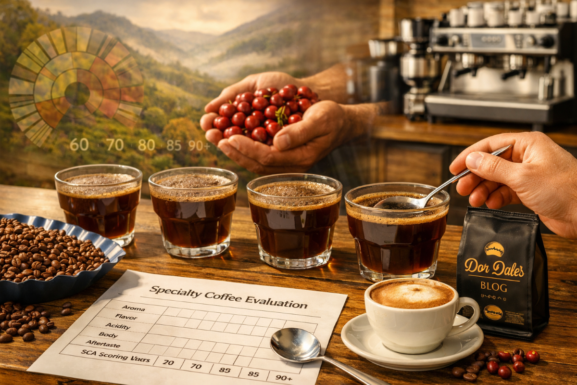
A professional cupping session in progress — the rigorous sensory evaluation protocol at the heart of the Cup of Excellence competition. Each Cup of Excellence entry is evaluated blind across multiple rounds by national and international jury panels; a competition with 300 entries generates approximately 9,000 individually assessed cups.
Credit: Liz Hafalia / San Francisco Chronicle via Getty Images
Finca El Paraíso: A Case Study in Colombian Coffee Innovation
Among the many extraordinary farms that have emerged from Colombia’s specialty sector over the past two decades, Finca El Paraíso occupies a category of its own. Located in the Cauca department, the farm is operated by Diego Bermúdez, who has built what is credibly described as the most scientifically advanced specialty coffee operation in the world — a working farm that combines traditional Colombian agricultural excellence with a fully equipped on-site microbiology laboratory, proprietary fermentation technology, and precision-controlled drying infrastructure.13 It is a place where coffee farming has been approached with the systematic rigor of pharmaceutical research and the flavor ambition of haute cuisine.
The scientific innovations at Finca El Paraíso are not experimental curiosities — they are production methods that have been developed, refined, and documented with the intention of achieving reproducible, commercially scalable results at the highest quality tier. The farm pioneered the “Thermal Shock” fermentation technique and developed a proprietary yeast-mediated biocatalysis process in which specific yeast strains are introduced to precisely control the fermentation environment of coffee cherries, developing targeted aromatic precursors within the bean that translate directly into defined flavor outcomes in the cup.13 The result is coffees of extraordinary complexity that are not merely discovered — they are, in a meaningful sense, designed. Each lot is profiled for a specific flavor destination, and the process is documented with the precision of a laboratory protocol rather than the intuition of a traditional farmer.
The commercial results of this approach are among the most remarkable in the global specialty coffee market. Finca El Paraíso’s Geisha micro-lots range from $24 to $75 per pound, with the farm’s experimental “Antimaceration” and “Zeo” process Geisha lots reaching the upper end of that range — prices that place them among the most expensive commercially available specialty coffees anywhere in the world.13 These are not boutique curiosities available only at auction: they are offered directly through the farm’s own commercial platform to international buyers who have evaluated them and returned, season after season, willing to pay prices that reflect an objective assessment of extraordinary cup quality.
El Paraíso’s influence extends far beyond the boundaries of the Cauca department. The farm’s success has catalyzed a broader movement across Colombia’s specialty sector: dozens of farms now operate on-farm wet mills, invest in controlled fermentation protocols, and pursue the kind of scientific precision that was, a decade ago, reserved for the wine industry and the pharmaceutical world. The question of whether coffee fermentation can be controlled, documented, and directed toward specific flavor outcomes — once considered an exotic fringe inquiry — is now the central research agenda of Colombia’s most ambitious specialty producers. In this sense, Finca El Paraíso is not merely a remarkable farm. It is a proof of concept that is reshaping how the entire industry thinks about what post-harvest processing can achieve, and Colombia is the country writing this next chapter of world coffee history.
The World Is Watching Colombia
Colombia’s specialty coffee story is, viewed across its full arc, one of the most remarkable agricultural transformations in modern history. A plant introduced by missionary priests in the eighteenth century, cultivated as acts of ecclesiastical penance in the early nineteenth, scaled into a national export commodity through the late nineteenth and early twentieth centuries by hundreds of thousands of smallholder farming families, and then methodically elevated — through institutional investment, scientific research, and generational commitment to quality — into the global epicenter of micro-lot innovation and competitive excellence in the twenty-first century. This trajectory did not happen by accident, and it was not delivered by any single institution or actor. It was built, farm by farm, harvest by harvest, by the accumulated decisions of half a million Colombian families who chose to take their coffee seriously.
The structural advantages that will sustain Colombia’s leadership in the specialty coffee world are not temporary or contingent. Year-round harvesting provides supply chain reliability that no seasonal origin can match. The extraordinary altitudinal diversity of the three cordilleras guarantees that Colombia will always be able to produce coffees across a flavor spectrum broad enough to satisfy every segment of the specialty market. The more than 540,000 smallholder families invested in coffee quality represent a human resource of agricultural expertise and cultural dedication that cannot be replicated in a generation. Cenicá’s world-class research institution continues to develop new varieties, combat disease threats, and generate the agronomic knowledge that keeps Colombian farms productive and competitive. And a new generation of Colombian coffee farmers — educated, internationally connected, scientifically literate, and deeply proud of their heritage — is embracing both the traditions of their parents and the precision tools of the twenty-first century with equal conviction.
“To drink a Colombian specialty coffee is to taste the specific altitude, soil, and season of a real place — and the pride of the specific family who chose, harvested, and processed every cherry by hand.”
For the buyers, roasters, and consumers who understand what they are holding when they open a bag of Colombian specialty coffee — who know that an 87 Q-Score represents a remarkable agricultural achievement, that a Cup of Excellence winner embodies the consensus of dozens of expert blind evaluations conducted with unimpeachable rigor, and that a farm name on a bag represents a traceable, accountable human story — Colombia remains the world’s most compelling coffee origin. Not the largest, not the cheapest, not the most easily sourced. The most compelling: the origin that continues, year after year, to produce the kinds of coffees that stop experienced tasters mid-sip and send them back to the cup to understand exactly what they are experiencing, and why it is so extraordinary.
Photo 1: Colombian Andes coffee fields at sunrise. Credit: ColombianSpecialtyCoffee.com / Don Dale (original photography).
Photo 2: Coffee harvest at Finca Costa Rica, Santa Maria, Huila, Colombia (June 22, 2025). Credit: Thomas O’Neill / NurPhoto via Getty Images.
Photo 3: Colombia’s coffee-growing regions. Credit: © OpenStreetMap contributors / Brewtorials.com (illustrative reference).
Photo 4: Ripe red coffee cherries on a coffee plant. Credit: ColombianSpecialtyCoffee.com / Don Dale (original photography).
Photo 5: Professional coffee cupping session. Credit: ColombianSpecialtyCoffee.com / Don Dale (original photography).
1. José Gumilla, El Orinoco Ilustrado (1730), referenced in ColombiaOne.com, “How Did Colombia Become a Global Coffee Powerhouse?” (January 25, 2026). https://colombiaone.com
2. Aaron, “The Bold Cup: A Journey Through the History of Colombian Coffee,” Bogotá Bound (July 19, 2025). https://bogotabound.com
3. “National Federation of Coffee Growers of Colombia,” Wikipedia. https://en.wikipedia.org/wiki/National_Federation_of_Coffee_Growers_of_Colombia
4. Colombia Coffee Origins, Brewtorials. https://brewtorials.com/origins/colombia
5. “Colombian Coffee Regions Explained: Terroir, Altitude & Flavor Profiles,” Vibez. https://vibez.com
6. “Colombian Coffee Regions: A Guide to Origin, Altitude, and Flavour,” Columbea (January 24, 2026). https://columbea.com
7. “A Guide to Colombian Coffee Varieties,” Colombian Coffee Shop Canada (May 7, 2026).
8. “Colombian Coffee Varieties: Castillo, Caturra, Tabi & Bourbon Explained,” Vibez. https://vibez.com
9. “Inzá / ASORCAFE Origin Description,” Olisipo Coffee Roasters. https://olisipocoffeeroasters.com
10. “Coffee with a Conscience: How Cooperatives & Direct Trade Shape Your Colombian Brew,” Vibez. https://vibez.com
11. “Colombia 2023 Competition Results,” Alliance for Coffee Excellence. https://allianceforcoffeeexcellence.org
12. “Cup of Excellence Competition Overview,” Alliance for Coffee Excellence. https://allianceforcoffeeexcellence.org/cup-of-excellence/
13. Finca El Paraíso, Products and Farm Overview. https://fincaelparaiso.com.co
All facts, statistics, and quoted figures in this article are sourced from the references listed in the footnotes above. All writing is original and composed for ColombianSpecialtyCoffee.com. No text has been reproduced verbatim from source materials.