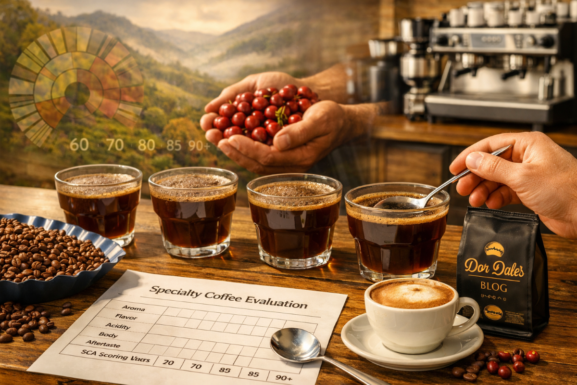
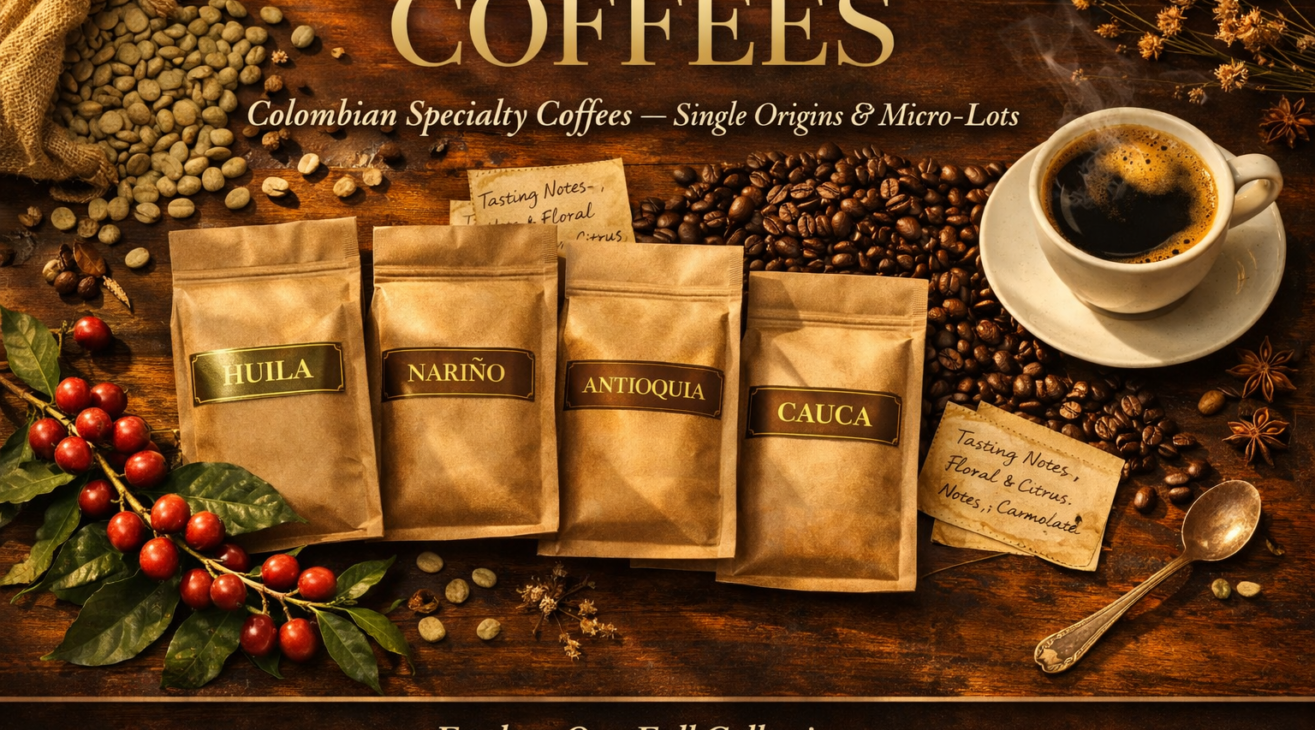
How to Choose a Colombian Specialty Coffee
A Practical Guide to Reading Labels, Understanding Regions, and Finding Your Perfect Cup
June 2026
Why Choosing Colombian Specialty Coffee Is Worth the Attention
Walk into any quality coffee shop or browse a well-curated online roaster, and you will quickly encounter a bewildering array of Colombian coffees. On one shelf sits a $12 bag labeled simply “Colombian Blend — Bold & Smooth.” A few inches away, a $45 bag announces itself as a “Huila, Finca La Palma — Pink Bourbon — Washed — Roasted April 28.” Both are Colombian. Both are coffee. But the gap between them — in sourcing transparency, in cup quality, in the story they carry — is enormous. For a curious buyer with no framework for understanding what separates them, the choice defaults to habit, price, or packaging design. That is a shame, because the information needed to make a genuinely great decision is almost always right there on the bag.
The first and most liberating thing to understand is that Colombia does not produce one coffee. It produces thousands. The country’s three Andean mountain ranges — the Western, Central, and Eastern Cordilleras — create an extraordinary patchwork of microclimates, elevations, soil types, and rainfall patterns. A coffee grown at 2,200 metres above sea level in the volcanic soils of Nariño near the Ecuadorian border has almost nothing in common, in terms of flavor, with a coffee grown at 1,400 metres in the humid valleys of Antioquia. The variety of coffee cherry planted, the decisions the farmer makes during harvest, the method used to remove the fruit from the bean, the care taken during drying — each of these variables layers additional complexity onto the cup. Understanding even a handful of them transforms a buyer from a passive consumer into an informed one capable of making choices that genuinely match their preferences.
This guide is built around that transformation. By the time you reach the final paragraph, you will know exactly how to read a specialty coffee bag and decode every meaningful field on its label. You will have a working mental map of Colombia’s most important growing regions and a clear sense of what each one tastes like. You will understand how processing method and roast level shape the cup — and how to match both to your brewing equipment. And you will have a practical roadmap for building your own palate, starting with the most accessible and rewarding entry points and progressing toward the remarkable complexity that Colombian specialty coffee is capable of delivering at its finest.
“Colombia does not produce one coffee — it produces thousands, each shaped by altitude, soil, microclimate, and the hands of the farmer who grew it.”
“The right Colombian specialty coffee begins with knowing what to look for on the bag.”
Credit: ColombianSpecialtyCoffee.com / Don Dale
Start With the Bag: How to Read a Specialty Coffee Label
The bag is the buyer’s first and most powerful tool. A genuine specialty coffee bag carries seven to ten distinct fields of information — each one a verifiable data point about the coffee’s journey from seed to cup. Most shoppers walk right past all of it, scanning instead for a familiar roaster logo or an appealing tasting note. Here is what each field actually means, why it matters, and what its presence — or absence — tells you about the coffee inside.1,2,3,4
1. The Roast Date — The Most Important Number on the Bag
The roast date is the single most critical piece of information on any specialty coffee bag. It tells you precisely when the green coffee was transformed into the roasted, aromatic product you are about to brew — and, by extension, exactly how fresh that coffee currently is at the moment you are considering buying it. Freshness is not a minor variable in specialty coffee; it is foundational to the entire value proposition. All of the complex aromatic compounds that make a high-scoring Colombian worth its premium price are volatile. They begin dissipating the moment roasting completes.2
The specialty coffee industry consensus is that roasted coffee is at peak quality between five and twenty-one days after the roast date. In the first few days after roasting, the beans are actively releasing carbon dioxide through a process called degassing. If you brew during this window, the escaping CO₂ can disrupt extraction and produce an uneven, gassy cup. But wait too long — past twenty-one days — and the delicate floral and fruit aromatics that define a fine Nariño or a bright Huila begin to oxidize. By forty-five to sixty days post-roast, even a coffee that has been stored carefully in an airtight container will taste noticeably flat, losing the brightness and complexity that justified the original purchase.2,3
The red flag to watch for: a bag that carries only a “best by” or “best before” date with no roast date visible. “Best by” dating is a convention borrowed from commodity food retail — it tells you when a coffee transitions from stale to very stale, not when it was at its vibrant best. Genuine specialty roasters print the roast date prominently and specifically because they want you to know it. Their freshness standards are a point of professional pride. When a roaster obscures or omits the roast date, it is almost always because the information would not reflect well on the product inside.2
2. Origin: Country, Region, Farm — How Specific Does It Get?
Seeing “Colombia” on a bag confirms the country of origin but communicates very little about what the coffee will actually taste like. Colombia’s three Andean Cordilleras produce radically different microclimates across a span of geography stretching from the Caribbean coast to the Ecuadorian border. A washed Caturra from Nariño grown at 2,100 metres above sea level and a natural Castillo from Antioquia grown at 1,400 metres will differ from one another in body, acidity, aroma, and sweetness as dramatically as a Burgundy differs from a Bordeaux. Country of origin, on its own, is a starting point — not a buying guide.1,3
Region-level specificity — “Colombia, Huila” or “Colombia, Nariño” — begins to carry real meaning. Each of Colombia’s major growing regions has a recognizable flavor identity driven by its characteristic altitude range, soil composition, and microclimate. At the gold standard of label transparency, a bag identifies not just the region but the specific farm or cooperative: “Colombia, Huila, Finca La Palma” or “Colombia, Cauca, ASORCAFE Cooperative, Inzá.” At this level of detail, the coffee is fully traceable — a buyer can identify exactly who grew it, where, and under what conditions.3,4
The principle worth internalizing is that specificity is a proxy for quality and accountability. Roasters who know exactly where their coffee originated — who can name the farmer, the harvest season, and the cooperative that processed it — almost universally care more about what ends up inside the bag. Vague origin statements are rarely a sign of vague information; they are more often a sign of a supply chain in which no one asked those questions at any stage.2
3. Variety (Cultivar) — The Genetics of Flavor
Coffee, like wine grapes or apple cultivars, comes in a remarkable number of distinct botanical varieties — and variety is one of the most powerful determinants of flavor potential before a single environmental or processing variable even enters the picture. Colombia’s specialty sector cultivates an increasingly diverse range of varieties: Geisha produces an intensely floral cup with jasmine, bergamot, and tropical fruit; Pink Bourbon delivers complex tea-like florals, red fruit, and extraordinary natural sweetness; Caturra offers elegant honey and stone fruit character in washed processing; Castillo expresses caramel, red fruit, cocoa, and citrus; Tabi contributes florals, fruit sweetness, and generous body; Chiroso echoes Geisha’s jasmine and bergamot with a distinctly Colombian tropical character.1,8
When a bag lists the variety, the roaster is signaling that it matters — and they are correct. Geisha commands a premium on labels worldwide because the variety genuinely produces a cup profile unlike almost anything else in the coffee world. But here is a piece of practical knowledge that can save a specialty buyer real money: a well-grown Castillo or Caturra from a skilled and attentive farmer at high altitude in Huila or Cauca can rival or surpass many mid-tier Geisha lots in terms of cup enjoyment, at a fraction of the price. Understanding variety prevents unnecessary overspending on famous names while also helping you recognize when the premium is genuinely warranted.1
4. Altitude — The Elevation of Quality
Altitude is typically listed in metres above sea level (masl) on specialty bags, and it is one of the most reliably predictive quality signals available to a buyer. The mechanism is straightforward: at higher elevations, cooler nighttime temperatures slow the maturation of the coffee cherry, extending the period during which sugars concentrate in the fruit and the seed develops density. Higher-density beans roast more evenly and carry more complex flavor compounds into the cup. As a practical benchmark: coffees grown above 1,500 masl consistently produce complex specialty-grade cups; above 1,800 masl is exceptional territory; Colombia’s highest-producing region, Nariño, regularly yields commercial crops at 2,100 to 2,300 masl — among the highest altitudes at which coffee is cultivated anywhere in the world.1,3
A bag that lists altitude is itself a positive signal. Knowing the altitude of a specific lot requires that the roaster have a direct or near-direct relationship with the farm — one in which information about growing conditions has been verified personally rather than assumed. When a roaster knows this detail and publishes it, it is usually because their sourcing practices are thorough enough to have generated it.
5. Processing Method — The Flavor Architecture of the Bean
The processing method describes how the coffee cherry’s outer fruit layer was removed from the coffee seed — the “bean” — after harvest. It is one of the most powerful flavor variables in the entire supply chain, and understanding it gives a buyer a reliable framework for predicting the general character of a coffee before the bag is ever opened. The processing decision belongs primarily to the farmer, which means it reflects their resources, their infrastructure, their philosophy, and their judgment about what the raw material they harvested is capable of producing.3,5
The washed (or wet) process removes the fruit mechanically immediately after harvest. The beans then ferment briefly in water before being dried on raised beds or patios. The result is a clean, transparent cup that allows the terroir of the specific farm — its altitude, soil, and microclimate — to speak as clearly as possible. Washed Colombian coffees typically express bright, defined acidity, delicate floral aromatics, and a crisp, clean finish. For buyers who want to understand what a specific region actually tastes like, a washed coffee is the clearest possible window.5,7
The natural (or dry) process leaves the whole cherry intact around the bean during an extended drying period of several weeks. During this time, the fruit’s sugars and the yeasts naturally present in the cherry deeply permeate the bean. The result is a cup with pronounced full body, intense berry and tropical fruit character, wine-like sweetness, and a richness that washed coffees do not produce. The honey process occupies the middle ground — some fruit is removed before drying, producing a sweet, syrupy, caramelized cup that bridges the clarity of washed and the richness of natural. Experimental fermented lots — those processed with anaerobic fermentation or carbonic maceration — push complexity further still, creating cups that can be extraordinary in their layered unconventionality.3,5
“A well-labeled specialty bag is a transparent record of the coffee’s entire journey.”
Credit: ColombianSpecialtyCoffee.com / Don Dale
Know Your Regions: Colombia’s Flavor Map
Once you understand how to read a label, the most powerful buying decision you can make is choosing by region. Colombia’s coffee belt is not a uniform growing environment — it is a mosaic of distinct terroirs, each shaped by a unique combination of altitude, geology, rainfall, and diurnal temperature variation. Spend some time understanding the five most important specialty regions, and you will have a reliable mental map that guides confident purchasing decisions for years to come.1,9
Huila — Colombia’s Most Celebrated Specialty Region
Grown at altitudes ranging from 1,500 to 2,000 metres above sea level in the southern Andean highlands, Huila is Colombia’s most consistently celebrated specialty origin. The region’s flavor signature is vivid and unmistakable: vibrant red cherry and raspberry-driven acidity, stone fruit sweetness, blackcurrant depth, and a bright, malic acidity that recalls a freshly sliced apple. Huila coffees are fruit-forward, complex, and animated in a way that distinguishes them immediately from the fuller-bodied, more chocolatey character of coffees from northern regions. They are exceptional in pour-over and filter brewing methods, which allow their layered acidity and floral top notes to express fully without the added pressure and extraction speed of espresso.1
Huila accounts for approximately 18 percent of Colombia’s total national coffee output and, year after year, produces more high-scoring competition lots than any other Colombian region. For a specialty buyer seeking a combination of wide availability, regional character, and reliable quality ceiling, Huila is the natural starting point — and for many experienced buyers, it remains a permanent fixture in their rotation.1
Nariño — Volcanic Intensity at Extreme Altitude
Located in Colombia’s southwestern corner near the Ecuadorian border, Nariño is the country’s most dramatically elevated coffee-growing region, with farms regularly situated between 1,800 and 2,300 metres above sea level. The flavor profile this altitude produces is unlike anything from lower elevations: tropical fruit sweetness, bergamot and floral top notes, a characteristic panela — raw cane sugar — sweetness in the body, and a sparkling, luminous acidity that specialty buyers often describe simply as “electric.” Nariño coffees seem to crackle with brightness in a way that even fine Huila lots rarely match.1
The scientific explanation for this intensity lies in the region’s unique geography. Nariño sits very close to the equator, which delivers intense solar radiation to the ripening cherries during daylight hours. But the extreme altitude simultaneously produces cold overnight temperatures, creating dramatic diurnal temperature swings — sometimes a range of twenty degrees Celsius or more between day and night. This combination concentrates sugars in the cherry and builds an acidity of exceptional structure and clarity. Nariño coffees are spectacular in pour-over and Chemex preparations and are among the finest filter coffees produced anywhere in the world.
Cauca — Balanced Elegance
Cultivated between 1,600 and 2,100 metres above sea level in the region surrounding the city of Popayán, Cauca occupies a flavor middle ground that makes it one of the most versatile and broadly appealing Colombian origins. The typical Cauca cup brings together milk chocolate depth, walnut nuttiness, clean citrus brightness, and a well-structured balance that neither leans strongly toward the bright, electric acidity of Nariño nor the concentrated fruit-forward character of Huila. The overall impression is one of composed elegance — a coffee that rewards attention without demanding it.1
Cauca is home to a dense network of smallholder farming communities and cooperatives, including the well-regarded ASORCAFE Cooperative in the Inzá municipality, whose members have won multiple national and international cupping competitions. For a buyer seeking a beautifully balanced everyday specialty coffee that performs equally well in filter and espresso preparation, Cauca is frequently the most consistently satisfying choice available.
Tolima — The Rising Star
Grown at altitudes between 1,400 and 2,000 metres in the central Andean range, Tolima has emerged as one of Colombian specialty coffee’s most exciting and rapidly ascending origins. The flavor profile is approachable and genuinely charming: sweet citrus brightness, clean caramel body, red fruit character, and an overall accessibility that makes it an ideal region for buyers who are expanding their Colombian palate beyond the established benchmark origins. The coffees are clean, well-structured, and carry a sweetness that lingers pleasantly.
The validation of Tolima’s quality arrived definitively in 2023, when the region claimed all three top placements in Colombia’s Cup of Excellence competition — a blind evaluation conducted by an international jury of expert cuppers. Sweeping the top three positions of a national competition is an extraordinary result, and it placed Tolima firmly on the global specialty coffee map. For buyers seeking exceptional quality-to-price value in an origin that is still building its reputation, Tolima represents one of the finest opportunities currently available in Colombian specialty coffee.10
Antioquia and the Eje Cafetero — The Classic Colombian
Grown at altitudes ranging from approximately 1,200 to 1,800 metres across the departments of Antioquia, Caldas, Risaralda, and Quindío, this cluster of regions constitutes the cultural and historical heartland of Colombian coffee. The iconic “Coffee Triangle” — the Eje Cafetero — is where most of the world’s popular image of Colombian coffee originates, and the flavor profile that image is built on is real and consistently delivered: milk chocolate sweetness, brown sugar body, rounded caramel character, clean smooth texture, and mild citrus acidity that balances without dominating.1,9
These are the most broadly approachable Colombian coffees — accessible to a wide range of palates and particularly well-suited to espresso preparation and milk-based drinks, where their sweetness and body integrate beautifully with steamed milk. For a buyer who wants the classic, reliable, crowd-pleasing Colombian cup that performs predictably across brewing methods and occasions, Antioquia and the Eje Cafetero remain the most dependable choice in the entire Colombian portfolio.
“Colombia’s coffee belt stretches across three Andean cordilleras, each producing a distinctly different cup character.”
Credit: Thomas O’Neill / NurPhoto via Getty Images
Match Roast Level to Your Brewing Method and Palate
Light Roast — Taste the Farm
Light roasts occupy a place of particular importance in the specialty coffee world because they preserve the maximum expression of the coffee’s origin character. At shorter roasting duration and lower final bean temperature, the natural terroir flavors that the altitude, soil, variety, and processing method have built into the green coffee are carried through to the cup with minimal alteration from the roasting process itself. This means that the jasmine and bergamot of a high-altitude Nariño Chiroso, the red cherry brightness of a Huila Caturra, and the tropical complexity of a well-processed Cauca Geisha all arrive in the cup largely as the farmer and the origin produced them, rather than as the roaster’s craft shaped them.5,6
Light roast Colombian specialty coffees are ideally suited to pour-over brewing methods — the Hario V60, Chemex, and Kalita Wave all emphasize clarity and allow the delicate aromatic layers to express without the muddying influence of heavier extraction or added pressure. AeroPress with a bypass technique also performs beautifully with light roast Colombian lots. If you are purchasing a Colombian micro-lot, a Q-scored specialty lot, or a competition-referenced coffee, a light roast is almost always the appropriate choice — it reveals what the farmer actually grew, rather than what happened to it afterward.5,6
Medium Roast — The Best of Both Worlds
Medium roasts strike a carefully managed balance between the preservation of origin character and the development of roast-created sweetness. Some of the farm’s terroir remains clearly audible in the cup, but the roaster’s craft also contributes caramelized sugars, rounded body, and a sweetness and accessibility that makes medium roast coffees broadly appealing across a wide range of palates. Colombia’s characteristic natural sweetness and caramel notes — particularly evident in Huila, Cauca, and Antioquia lots — express with particular warmth and generosity at the medium roast level.5
Medium roast Colombian coffees are the most versatile option in the entire spectrum. They perform beautifully in pour-over, drip, and AeroPress preparations while also serving as the most capable foundation for quality espresso and milk-based drinks such as cortados, flat whites, and cappuccinos. For most everyday specialty coffee drinkers who brew across multiple methods and want a Colombian coffee that reliably delivers at every occasion, a well-sourced medium roast from a named regional lot is the single most practical starting point available.6
Dark Roast — When to Choose It (and When Not To)
At dark roast temperatures, a coffee passes the point at which origin character is meaningfully preserved. The flavors that dominate a dark roast are roast-derived rather than terroir-derived: bitter chocolate, smokiness, charred wood, and a thick, heavy body that has little relationship to the altitude, variety, and processing that shaped the green coffee before it entered the roaster. For a premium Colombian specialty coffee — one that a farmer at 2,000 metres above sea level spent months carefully cultivating, selectively harvesting, and meticulously processing — a dark roast represents a significant trade-off, overwriting the farmer’s decisions with the roaster’s preference for a specific flavor profile.5,6
Dark roast Colombian coffee does make sense in specific contexts: when building a bold, high-extraction espresso blend designed to cut through significant volumes of steamed milk, or when a buyer’s taste has been shaped by years of dark roast preference and lighter profiles simply do not satisfy. But paying specialty prices for a dark roast Colombian is rarely the most efficient use of a premium budget. The origin complexity, terroir transparency, and varietal character that justify the price of a specialty lot are most fully present and most fully rewarding in the light and medium roast ranges — and that is where the investment most consistently pays off.
Five Practical Buying Tips from a Specialty Coffee Educator
Tip 1 — Buy From a Roaster Who Knows the Farm
The single most reliable quality signal available to a specialty coffee buyer is a roaster who can answer specific questions about their coffee with specific answers — not just “Colombia, Huila” but the individual farm or cooperative by name, the farmer or collective manager’s name, the harvest season, the altitude, and ideally the nature of their sourcing relationship. This level of supply chain knowledge does not come from purchasing commodity Colombian coffee through a broker; it comes from roasters who have built personal, ongoing relationships with their producers — attending cupping competitions in Colombia, visiting farms during harvest, and paying premiums that give farmers a sustained economic reason to maintain and improve quality.1
The practical way to assess this before buying: look for roasters who publish farm stories, farmer profiles, and detailed sourcing narratives on their website and on the bag itself. A roaster who has visited a farm in Cauca and can tell you about the farmer’s processing philosophy, the altitude of the specific lot, and the variety planted is a roaster who is deeply invested in what ends up in the bag. The narrative around a coffee is frequently the most reliable proxy for the quality of the relationship and the integrity of the supply chain behind it.
Tip 2 — Look for a Q Score or Competition Result
A Q Score is assigned by a licensed Q Grader — a certified professional who has completed the Specialty Coffee Association’s rigorous evaluation training and who scores green coffee against a standardized one-hundred-point cupping protocol. Any coffee scoring above 80 qualifies as specialty grade; a score above 84 is very good by any objective standard; 87 and above is exceptional and places a coffee in the top tier of specialty production globally. When a bag or a roaster’s website lists a Q Score, that number represents an independent, professionally verified, standardized evaluation of the coffee’s quality — the most trustworthy objective quality signal available to a consumer navigating a market full of marketing language and subjective tasting notes.8
Cup of Excellence results carry even greater weight. A Cup of Excellence winner has survived multiple sequential rounds of blind evaluation by a combined panel of national and international expert cuppers, with each round raising the bar. The final winning lots represent coffees with documented, internationally peer-reviewed, world-class quality — not a roaster’s assessment of their own product, but the consensus judgment of the most credentialed palates in the industry. If a roaster you are considering stocks a Colombian Cup of Excellence winner from a recent competition cycle, that is a coffee with a pedigree that can be objectively verified.10
Tip 3 — Match the Coffee to Your Brewing Method Before You Buy
Different brewing methods extract coffee at different speeds, pressures, and ratios — and a coffee that is transcendent in a Hario V60 pour-over may be unbalanced or flat in a French press, and vice versa. Making the brewing method decision before selecting the coffee leads to consistently better results. For pour-over and filter methods — V60, Chemex, Kalita Wave, drip — prioritize washed or honey process Colombian lots from high-altitude origins in Huila, Nariño, or Cauca. The clarity and precision of these brewing methods are ideally suited to showing off the terroir transparency and bright acidity that washed Colombian coffees produce. For espresso, a medium roast from Antioquia, Cauca, or the Eje Cafetero provides the sweetness, body, and structural balance needed to hold up confidently through the pressure of espresso extraction and the richness of steamed milk.1,6
For French press and other full-immersion methods, a natural or honey process Colombian with full body and forward fruit character is an exceptional pairing. The oils and richness that immersion brewing extracts complement the fermented fruit depth of the natural process beautifully, producing a cup that is lush, complex, and deeply satisfying in a way that washed coffees are not quite designed to deliver through this particular method.
Tip 4 — Start With Washed to Understand the Region, Then Explore
For buyers who are new to Colombian specialty coffee, beginning with a washed process lot from a clearly named region is the most efficient path to building a reliable palate framework. Washed coffees provide the clearest possible window into a region’s intrinsic terroir character, because the processing method does not add a significant fruit or fermentation layer over what the altitude, soil, and variety have already produced. Tasting a washed Huila alongside a washed Nariño is the quickest and most direct way to understand what actually separates these two origins in the cup — a comparison that becomes far harder to read when natural or honey process lots introduce their own powerful flavor contributions to the analysis.5,3
Once you have established a clear baseline understanding of your preferred region’s terroir character through washed processing, you can move into honey and natural process lots from the same region with genuine context. Instead of tasting an unfamiliar flavor in an unfamiliar origin, you are now experiencing the familiar terroir of Cauca or Huila augmented by the additional complexity that fruit fermentation contributes — a far richer and more instructive experience that allows you to understand both the origin and the processing method simultaneously.
Tip 5 — Ask Questions and Taste Before You Commit to Bulk
Specialty coffee is fundamentally a discovery process, and the best buyers approach it with the curiosity of a student rather than the certainty of someone who has already decided what they like. Most quality specialty roasters are genuinely enthusiastic about discussing their coffees — particularly for premium lots and micro-lots where they have a meaningful story to tell. Ask your roaster: Where exactly does this coffee come from? When was it harvested, and when was it roasted? What processing method was used and why did the farmer choose it? What brewing method do they personally recommend for this lot? A roaster who answers these questions confidently, specifically, and with evident enthusiasm is a roaster whose judgment about coffee quality you can extend trust to.1
Many quality specialty cafés also offer pour-over bar service, seasonal tasting flights, or cupping sessions that allow you to experience a coffee before committing to a full bag purchase. This is always the right approach when you are exploring a new region, a new variety, or an unfamiliar processing method for the first time. The few dollars spent on a pour-over at the bar before buying a 250-gram bag can save you the disappointment of discovering, at home with your first brew, that what sounded appealing on a label is not what your palate was actually looking for.
“The processing method — washed, honey, or natural — is one of the most powerful flavor variables in the bag.”
Credit: ColombianSpecialtyCoffee.com / Don Dale
Understanding Price: When to Pay More and When Not To
Specialty Colombian coffee spans a remarkably wide price range — from approximately $15 per 250-gram bag for a well-sourced regional lot from a reputable roaster, to $75 or more per 100 grams for a Cup of Excellence-winning Geisha micro-lot in limited release. Both ends of this range can represent genuine value or genuine overpricing depending on what is actually inside the bag. Understanding what legitimately drives price differences — and what does not — is the key to spending wisely in a market where premium packaging and aspirational language are not reliably correlated with premium quality.
There are specific circumstances in which paying a higher price for Colombian specialty coffee is fully justified and represents a sound purchasing decision. These include: a verifiably high Q Score at 87 or above; a Cup of Excellence placing or other documented national competition result; a named farm with a direct trade relationship confirmed by the roaster; a rare or high-demand variety such as Geisha, Pink Bourbon, or Chiroso where the genetic flavor potential is genuinely exceptional; experimental or innovative processing on excellent raw material where the additional labor and risk are real; and limited seasonal micro-lots from a single harvest of a single farm where the supply is genuinely small and the demand is documented.1,10
The sweet spot for most specialty buyers seeking the best combination of verified quality and reasonable investment falls in the $18 to $30 per 250-gram range. Within this price band, a buyer can typically find a Colombian lot from a named farm or cooperative in Huila, Nariño, Cauca, or Tolima, with a roast date within the past two weeks, a named variety, a specified processing method, and a flavor profile that delivers genuine specialty character without the competition premium that rare varieties and internationally awarded lots command. This is the zone where the Colombian specialty coffee sector most consistently over-delivers on its promise relative to what it costs.
The purchases that are almost never worth the price: any bag carrying specialty pricing — generally above $20 per 250 grams — that lacks a roast date, omits the farm or cooperative name, lists no altitude, and offers only vague tasting notes. The absence of information on a premium-priced specialty coffee bag is itself meaningful information. It reliably communicates that either the roaster does not know where the coffee originated, or they are not confident enough in the answer to publish it openly — neither of which is a quality signal worth paying a premium for.2,4
“The best way to refine your palate is to taste widely — asking your roaster questions is always a good start.”
Credit: Jeremy Horner / LightRocket via Getty Images
A Beginner’s Roadmap: Where to Start
If you are standing at the beginning of your Colombian specialty coffee journey — or helping someone else find their footing — the most useful thing this guide can offer is a concrete first step rather than an overwhelming menu of options. That first step is specific: look for a Colombia, Huila — Washed — Caturra or Castillo — Light or Medium Roast — with a roast date within the past fourteen days. This combination is the most accessible and reliably rewarding entry point into what Colombian specialty coffee is genuinely capable of producing. Huila’s vivid red fruit character and bright acidity, delivered through the terroir-transparent clarity of washed processing, in a familiar and widely available variety at a moderate price, gives you an honest and complete introduction to the category. Brew it as a pour-over or drip. Taste it slowly. The region’s character will be unmistakable.1,8
Once you have that baseline firmly in your palate’s memory, the expansion is natural and logical. Move into Nariño for the most luminous, electric acidity and the most intensely floral character you will encounter in any Colombian coffee — it is a genuine revelation if you have never experienced high-altitude equatorial coffee at its best. Then explore Cauca for its composed chocolate depth and structured balance, which offers a completely different kind of pleasure from Huila’s brightness. Venture into Tolima for an emerging origin whose competition credentials are now fully established and whose value-to-quality ratio is among the finest in Colombian specialty production today.
Once you have genuine confidence in your regional preferences and terroir vocabulary, the world of Colombian specialty coffee opens even further. Explore natural or honey process lots from your favorite region — the terroir you already understand, now augmented by a layer of fruit complexity from the processing method. Seek out Pink Bourbon and Chiroso varieties from roasters with documented direct farm relationships. And when the moment feels right, invest in a Geisha micro-lot from a Cup of Excellence-winning farm — understanding, by that point, the specific altitude, processing method, and varietal context that makes that cup the extraordinary experience it genuinely is when the right raw material meets the right roaster’s hands.
Coffee Worth Understanding
Choosing a Colombian specialty coffee well is, at its core, a skill — one built gradually through curiosity, attentiveness, and the willingness to read what is written on the bag and ask the questions that the label raises. It is not a skill that requires a professional background or a trained palate calibrated to industry standards. It requires only the decision to pay attention: to notice the roast date, to care about the region, to ask where the farm is, to choose a processing method deliberately, and to brew with the intention of tasting rather than simply consuming. That shift in approach — from habit to decision — is the entire transformation this guide is designed to support.
“When you know how to read the bag, every purchase becomes a decision — not just a habit.”
For every bag of Colombian coffee you buy knowing its region, its farm, its variety, its roast date, and its processing method, you are participating in something larger than a retail transaction. You are engaging with a supply chain built on transparency, traceability, and the shared conviction — held by farmers in Huila and Nariño, by cooperative managers in Cauca and Tolima, by Q Graders and competition jurors, and by specialty roasters on every continent — that coffee grown well, processed honestly, and sourced fairly deserves to be recognized and rewarded. Every informed purchase at the consumer end of that chain sends a signal backward through it, reinforcing the standards and the people that make Colombian specialty coffee the world-class agricultural product it genuinely is.
We invite you to continue the journey at ColombianSpecialtyCoffee.com — where you will find curated regional guides, farmer profiles, roaster recommendations, and expert buying advice from Don Dale matched to your brewing preferences and flavor profile. Colombian specialty coffee rewards everyone who takes the time to understand it. The time to start is right now.
Photo Credits
Photo 1: Colombian specialty coffee bags on retail display. Credit: ColombianSpecialtyCoffee.com / Don Dale (original photography).
Photo 2: Specialty coffee bag label detail. Credit: ColombianSpecialtyCoffee.com / Don Dale (original photography).
Photo 3: Colombian Andean coffee fields, Pereira, Colombia. Credit: Kaveh Kazemi / Getty Images.
Photo 4: Coffee processing — freshly harvested coffee beans on drying beds. Credit: Farm Images / Universal Images Group via Getty Images.
Photo 5: Coffee cupping and quality evaluation session. Credit: Astrid Riecken / The Washington Post via Getty Images.
Getty Images photographs are commercially licensed. All original ColombianSpecialtyCoffee.com photography is the property of Don Dale. All writing in this article is original and composed exclusively for ColombianSpecialtyCoffee.com. No text has been reproduced verbatim from any cited source. All facts and statistics are sourced from the references listed in the footnotes below.
Footnotes
1. Online Coffee Guide Editorial Team, “Colombian Coffee Guide: Flavor, Regions & Buying Tips,” OnlineCoffeeGuide.com, published March 21, 2025; updated March 15, 2026. https://onlinecoffeeguide.com
2. Pulled Editorial, “How to Read a Coffee Bag Label: Origin, Roast Date, Process, Tasting Notes,” PulledJournal.com, May 13, 2026. https://pulledjournal.com
3. Pure Earth Coffee Co., “How to Read a Coffee Bag: What the Labels Actually Mean,” PureEarthCoffee.com, May 9, 2026. https://pureearthcoffee.com
4. The Coffeecessory Team, “How to Read a Coffee Bag Label: What Everything Means,” Coffeecessory.com, February 23, 2026. https://coffeecessory.com
5. Achilles Coffee Roasters, “How Roast Profiles Influence Coffee Flavor: Light vs. Medium vs. Dark,” AchillesCoffeeRoasters.com, August 8, 2025. https://achillescoffeeroasters.com
6. Stumptown Coffee Roasters, “Coffee Roasts Explained: Light vs. Medium vs. Dark,” Stumptown.com, August 18, 2025. https://stumptowncoffee.com
7. Sasha Pavlovich, “Best Colombian Coffee Beans Reviews and Complete Buying Guide,” CoffeeHow.com, updated April 18, 2026. https://coffeehow.com
8. 1Zpresso, “The Ultimate Guide to Colombian Coffee: Origin, Grading, Processing,” 1Zpresso.com. https://1zpresso.com
9. “Colombian Coffee Regions Explained: Terroir, Altitude & Flavor Profiles,” Columbea.com, January 24, 2026. https://columbea.com
10. “Colombia 2023 Competition Results,” Alliance for Coffee Excellence. https://allianceforcoffeeexcellence.org/competition/colombia-2023/