
Introduction to Specialty Coffee
COLOMBIANSPECIALTYCOFFEE.COM | EDITORIAL SERIES
Introduction to Specialty Coffee
From Ancient Origins to the Art of Grading the Perfect Cup
By Don Dale — Specialty Coffee Educator | ColombianSpecialtyCoffee.com
June 2026
What Is Specialty Coffee?
.
If you have spent any time in the world of coffee — browsing café menus, reading the back of a beautifully designed bag, or listening to a passionate barista explain why the water temperature matters — you have almost certainly encountered the phrase specialty coffee. But what does it actually mean? Is it a marketing label? A lifestyle affectation? A premium tier invented to justify higher prices? The answer, emphatically, is none of the above. Specialty coffee is a precisely defined, institutionally governed quality classification with a rigorous, measurable standard at its core.
According to the Specialty Coffee Association (SCA), the global governing body of the industry, specialty coffee is defined as coffee that scores 80 points or above on a 100-point standardized cupping scale — a scoring protocol administered by licensed Q Graders under strict, reproducible conditions. That threshold is not arbitrary. It represents the point at which a coffee is reliably clean, balanced, complex, and free of significant defects. Below 80, a coffee may still be perfectly pleasant to drink, but it falls into the category of commercial or commodity grade — evaluated and traded on different terms entirely. The 80-point line is the dividing line between the mass market and the artisan tier of global coffee production.
What makes specialty coffee genuinely distinct, however, is not just the score — it is the philosophy of deliberate quality that must be sustained at every single link in the supply chain for that score to be achievable. The variety of seed planted matters. The altitude and microclimate of the farm matter. Whether the cherries were selectively hand-picked at peak ripeness or strip-harvested indiscriminately matters enormously. The post-harvest processing method — washed, natural, or honey — shapes the flavor profile that the green coffee will carry. The skill of the green coffee buyer who evaluates the lot and negotiates the purchase matters. The roaster’s judgment in developing the bean matters. And finally, the precision of the barista’s brew matters. Specialty coffee is not the product of a single brilliant decision; it is the cumulative result of dozens of correct decisions made by many skilled hands across many months, and sometimes across many countries.
Perhaps most importantly for the modern consumer, specialty coffee is traceable. This is its most radical departure from the commodity world. A specialty coffee is not merely “Colombian coffee” or “a medium roast blend.” It carries a verifiable identity: the specific farm, the farmer’s name, the growing region, the altitude, the harvest year, the coffee variety, and the processing method are all documented and disclosed. You can trace the coffee in your cup to a single hillside in Huila or a specific micro-lot at a farm in Nariño — information that is the polar opposite of the anonymous, blended commodity coffee that has dominated global trade for over a century.
| “Specialty coffee is not simply better coffee — it is coffee with a verifiable identity, a documented journey, and a measurable standard of excellence.” — Don Dale, Specialty Coffee Educator |
The First Wave: Coffee Becomes a Commodity
To understand specialty coffee, you must first understand what came before it — and why the specialty movement was, in many respects, a conscious rebellion against a century of industrialized mediocrity. The first wave of coffee, spanning roughly the mid-1800s through the 1960s, was defined by one overriding objective: make coffee available everywhere, cheaply, in the largest possible quantities. This was the era of mass commoditization, and it transformed coffee from an exotic, hand-prepared beverage into a shelf-stable pantry staple sold by the can.
The brands that came to define this era — Folgers, Maxwell House, Hills Bros. — competed almost exclusively on price and convenience. Pre-ground, vacuum-sealed, and engineered for indefinite shelf life, their products were built around the lowest common denominator of the global commodity market. Coffee was blended from multiple origins, often incorporating low-grade robusta beans, and the finished product was typically bitter, flat, and stripped of any distinctive character. This was not merely an accident of technology; it was a deliberate commercial strategy. When your product lacks inherent quality, you sell volume. When your customer notices the bitterness, you train them to mask it with sugar and cream. The phrase that defined first-wave coffee — “a cup of joe” — captures it perfectly: unremarkable, utilitarian, and utterly ubiquitous.
The apotheosis of the first wave was instant coffee. If pre-ground commodity coffee was a compromise, instant coffee was a surrender — the complete subordination of quality to convenience. And yet it worked, spectacularly, as a mass-market product. By the mid-twentieth century, supermarket shelves were lined with identically positioned commodity brands, and the average American consumer had no framework, vocabulary, or expectation for anything different. Coffee was fuel. The idea that it might also be a nuanced agricultural product worthy of careful attention — like wine, or olive oil, or cheese — was decades away.
The Second Wave: Coffee Becomes an Experience
The second wave of coffee — roughly the 1960s through the late 1990s and into the early 2000s — did something the first wave never attempted: it made coffee aspirational. The catalyst was Alfred Peet, a Dutch-born coffee importer who opened Peet’s Coffee in Berkeley, California in 1966 and introduced American consumers to something genuinely radical at the time: darkly roasted, freshly ground whole-bean coffee from specific origins, sold with care and presented as a quality product worth seeking out. Peet’s became the inspiration — and the training ground — for the founders of what would become the most influential coffee brand in history: Starbucks.
What Starbucks accomplished, scaled across thousands of locations and dozens of countries, was the transformation of coffee from a kitchen habit into a social destination. The café became a “third place” — neither home nor office, but a lifestyle environment defined by Italian-inflected names (Venti, Grande, Macchiato), dark roast profiles, and the seductive theater of espresso machine steam wands. Lattes, cappuccinos, and Frappuccinos introduced an enormous generation of consumers to beverages they had never previously encountered. Coffee moved out of the kitchen and into culture. It became, for the first time in the American context, an experience worth paying for.
And yet, for all its cultural power, the second wave had a profound blind spot: the bean itself. The origin of the coffee — the farm, the farmer, the variety, the terroir — was almost entirely invisible. A signature dark French roast, by design, obliterates the natural character of the green coffee beneath it; the roast becomes the flavor, not the farm. Commodity brokers assembled blends from whichever origins hit the cost targets that quarter, and consumers were never the wiser. Coffee had become an experience — a genuinely better one than the first wave had offered — but it was not yet a craft. The farmer who grew the beans remained, as ever, anonymous.

Professional baristas compete at the US Barista Championship — a hallmark institution of the third-wave specialty coffee movement, where brewing is elevated to an internationally judged craft discipline.
The Third Wave: Coffee Becomes a Craft
The Origins of the Third Wave
The term “third wave coffee” has a surprisingly precise point of origin. In 2002, Trish Rothgeb — then writing as Trish Skeie — used the phrase in an essay published in The Flamekeeper, the newsletter of the Roasters Guild. She was describing a shift she had already observed taking root in the late 1990s: a new generation of coffee professionals who approached the bean not as a commodity or a lifestyle prop, but as an artisan agricultural product deserving the same intellectual seriousness applied to fine wine, single-origin olive oil, or aged artisanal cheese.
The pioneers of this movement were a handful of independent roasters who shared a common conviction: that the quality latent in an exceptional green coffee deserved to be revealed rather than obscured. Stumptown Coffee Roasters, founded in Portland, Oregon in 1999, built direct relationships with coffee farmers in Ethiopia, Rwanda, and Colombia. Intelligentsia Coffee, founded in Chicago in 1995, pioneered what it called “direct trade” — a model that bypassed commodity brokers entirely and paid farmers directly at premium prices. Counter Culture Coffee, founded in Durham, North Carolina in 1995, built its identity around sustainability, transparency, and rigorous quality evaluation. These three companies were not simply selling better coffee. They were proposing a fundamentally different relationship between the consumer, the roaster, the green coffee buyer, and the farmer.
The Core Principles of Third Wave Coffee
The third wave is best understood not as a style but as a set of interlocking principles — each one a deliberate inversion of first- and second-wave norms.
1. Origin Transparency and Traceability. In the third wave, origin is not a vague country-of-origin label. It is a precise, layered identity disclosed on the bag and in the cup. Not merely “Colombian coffee,” but “Finca El Paraíso, Cauca, Colombia — Washed Pink Bourbon, 1,850 metres above sea level, Harvest 2025, Lot No. 7.” The farm, the farmer, the region, the altitude, the variety, and the processing method are named, celebrated, and used as primary selling points. This transparency serves a dual purpose: it holds the entire supply chain accountable, and it gives the consumer a meaningful story to connect with their cup.
2. Direct Trade and Farmer Relationships. Third-wave roasters systematically bypassed the traditional commodity brokerage system and built long-term, personal relationships with individual farmers and cooperatives. This shift was economically transformative. While the Fair Trade minimum price floor for coffee has historically hovered around $1.40 per pound of green coffee, direct trade premiums in the specialty sector routinely reach two to four times the commodity price — and for extraordinary micro-lots, sometimes far more. These premiums flow directly to the producers who grew and processed the coffee, creating a fundamentally different incentive structure than the commodity market, which rewards volume rather than quality.
3. Light Roasting as a Philosophy. Nothing more visibly distinguished the third wave from the second wave than the reversal of roast philosophy. Where the second wave celebrated dark roasts — espresso blends taken to the edge of charcoal, French roasts that produced a uniform bitter richness — the third wave embraced light and medium roasts as the appropriate canvas for showcasing fine green coffee. The logic is sound: a light roast preserves the natural chemistry of the bean, the terroir and variety characteristics that the farmer and the post-harvest processor worked to develop. A properly grown and processed Ethiopian Yirgacheffe, gently roasted, reveals extraordinary natural florals — jasmine, bergamot, Earl Grey tea — alongside fruit-forward notes of white peach and lemon curd. Applied to the same bean, a dark French roast would reduce all of that delicate complexity to a uniform, smoky bitterness. Light roasting demands better green coffee; it has nowhere to hide.
4. Brewing as a Precision Craft. The third wave elevated the act of brewing coffee from a domestic routine to a near-scientific discipline. Pour-over methods — the Hario V60, the Chemex, the Kalita Wave — became standard tools in specialty cafés, each one requiring careful attention to variables that first- and second-wave consumers had never considered. Water temperature (typically 92–96°C), grind size (freshly ground immediately before brewing), bloom time (allowing CO₂ to off-gas from fresh coffee for 30–45 seconds), pour rate, total brew time, and brew ratio (typically 1:15 to 1:17 coffee to water by weight) were all measured, calibrated, and optimized. Precision scales, temperature-controlled kettles, and refractometers — instruments that measure the dissolved solids in a brewed cup — became common café equipment. The message was clear: the quality of the green coffee matters, but only if the brewing process is precise enough to express it.
5. The Barista as a Skilled Professional. In the first and second waves, the barista was a service worker. In the third wave, the barista became a trained craft professional — an expert in sensory science, agricultural knowledge, brewing technique, and equipment calibration. The establishment of the World Barista Championship in the year 2000, followed by the World Brewers Cup and the World Coffee in Good Spirits Championship, created an international competitive framework that transformed barista skills into a globally recognized discipline. Elite baristas now study the agronomic conditions of the farms whose coffees they serve, cupping and evaluating green samples alongside the Q Graders who score them, and developing recipes for each origin that account for its specific density, moisture content, and flavor profile.
6. Sensory Language and Flavor Literacy. One of the third wave’s most lasting contributions is its development of a shared, precise vocabulary for describing coffee flavor. Where first-wave consumers described coffee as “strong” or “weak,” and second-wave consumers learned to say “bold” or “smooth,” third-wave culture introduced a far richer lexicon: “red currant acidity,” “brown sugar sweetness,” “cedar-wood finish,” “jasmine florals,” “bergamot citrus,” “dark chocolate body,” “green apple brightness.” The SCA’s Coffee Taster’s Flavor Wheel — substantially updated in 2016 in collaboration with World Coffee Research — became the industry’s shared reference document, organizing coffee descriptors into a hierarchical taxonomy of categories, sub-categories, and specific terms. This shared language serves a critical function: it allows growers, buyers, roasters, baristas, and consumers to communicate about flavor with precision, creating feedback loops that drive quality improvement across the entire chain.
The Third Wave’s Global Impact
The third wave did not remain a niche American phenomenon. Its values — traceability, quality, farmer respect, and craft — spread rapidly across the globe, igniting café cultures in Melbourne, London, Seoul, Tokyo, Copenhagen, São Paulo, and Bogotá. The economic impact in coffee-growing countries was significant: direct trade premiums began flowing meaningfully to farmers who had previously received only commodity prices, creating new incentives to invest in quality cultivation, selective harvesting, and careful processing. In Colombia, the third wave provided the market infrastructure for a transformation that has been nothing short of extraordinary — a shift from the nation’s historical identity as a producer of consistent, reliable commodity arabica toward the cultivation of specific, prized varieties at high-altitude micro-lot farms in regions like Huila, Nariño, Cauca, and Antioquia.
The Cup of Excellence program — founded in 1999 in Brazil and now operating in more than a dozen producing countries including Colombia — became one of the third wave’s most important institutions. By subjecting a single farm’s micro-lot to multiple sequential blind cupping rounds judged by panels of international experts, and then auctioning the top-scoring lots to global buyers at prices that routinely reach $20, $50, or even $100 per pound of green coffee, the Cup of Excellence created a transparent, competitive marketplace that proved definitively that quality has a quantifiable economic value. A Colombian farmer who produces a 90-point Cup of Excellence winner is not just earning a premium — they are being recognized as a world-class agricultural artisan, and their farm’s identity is permanently recorded in the global specialty coffee canon.
The Emerging Fourth Wave
Some industry observers now speak with increasing confidence about a “fourth wave” of coffee — defined by the application of food science, precision fermentation technology, and data-driven processing to create entirely new flavor profiles from the same green coffee. Experimental processing techniques — anaerobic fermentation, carbonic maceration, and extended controlled fermentation with specific yeast strains — are producing coffees with flavor complexity that was simply not achievable through traditional methods. Colombia sits at the very forefront of this emerging wave. Farms like Finca El Paraíso in Cauca, operated by Diego Samuel Bermúdez, have pioneered controlled fermentation environments with temperature regulation and precise microbiological management, producing coffees of extraordinary fruit-forward, wine-like complexity that have placed among the highest-scored coffees ever evaluated on Coffee Review. Whatever the fourth wave ultimately becomes, the core values of the third wave — traceability, measurable quality, and genuine farmer respect — remain the enduring foundation on which all further innovation must stand.

Coffee cherries ripening on the trees at a plantation near Pereira, Colombia. Selective hand-picking of only fully ripe cherries is one of the most critical quality gates in specialty coffee production.
How Specialty Coffee Is Graded: From Seed to Cup
Understanding how a coffee earns its specialty designation requires following the bean through its entire journey — from the soil of the farm to the cupper’s table. Grading is not a single event. It is a continuous, multi-stage process of evaluation, selection, and elimination that begins before the first cherry is picked and concludes only after the finished, roasted coffee is assessed by trained experts. At every stage, the ceiling of achievable quality is shaped — or permanently limited — by the decisions made at the stage before it.
Stage 1 — The Farm: Variety, Altitude & Terroir
The grading journey begins at the farm, with decisions that long precede any harvest. The variety of coffee plant matters profoundly. Arabica varieties suited to specialty production — Caturra, Bourbon, Typica, Gesha, Pink Bourbon, Tabi, Sidra — each carry distinct genetic potential for flavor complexity. The altitude of the farm is equally critical: specialty coffee is typically grown between 1,200 and 2,200 metres above sea level, where cooler temperatures slow the maturation of the cherry, allowing more complex sugars and acids to develop in the seed. The microclimate — patterns of rainfall, cloud cover, temperature variation, and morning mist — and the mineral composition of the volcanic or clay soil all contribute to the terroir that will ultimately express itself in the cup. These factors are carefully evaluated and documented by agronomists and experienced green coffee buyers during farm visits, often years before a commercial relationship is formalized. A farm with extraordinary terroir is a long-term investment; a farm with poor terroir, no matter how skillfully managed, has an inherent quality ceiling it can never exceed.
Stage 2 — The Harvest: Cherry Selection
Selective hand-picking is the first active quality gate — and one of the most labor-intensive. Only fully ripe coffee cherries, uniformly deep red or deep yellow depending on variety, are harvested on specialty farms. A single under-ripe cherry can introduce harsh astringency and vegetal off-notes; a single over-fermented cherry can impart a “Rio-y” or fermented flavor that contaminates an entire lot and may disqualify it from specialty grade entirely. On well-managed specialty farms, harvest teams pass through the same rows of trees every seven to ten days, selecting only the cherries that have reached peak ripeness at that visit. This selective harvesting practice — as opposed to strip-harvesting, where all cherries are removed from the branch simultaneously regardless of ripeness — dramatically increases labor costs. But it is non-negotiable for specialty production. You cannot compensate for a defective cherry at any downstream stage of the process.
Stage 3 — Post-Harvest Processing
Once the ripe cherries arrive at the processing station, the fruit surrounding the seed must be removed and the seed dried to the precise moisture content required for storage and export. The three primary processing methods each impart distinct flavor profiles and carry distinct quality risks. The washed (wet) process — in which the fruit is fully removed before drying — produces coffees of exceptional clarity, clean acidity, and clear terroir expression; it is the most forgiving method in terms of consistency, but fermentation control during the washing process is critical. The natural (dry) process — in which the whole cherry is dried intact around the seed for weeks — produces coffees with extraordinary full body and intense fruit character, often with notes of blueberry, strawberry jam, or tropical fruit; it requires meticulous attention to prevent over-fermentation. The honey process, which leaves varying amounts of fruit mucilage on the seed during drying, sits between the two extremes in both profile and complexity of execution. Across all methods, the quality of fermentation management, the consistency of drying conditions, and the precision of moisture monitoring at final milling are irreversible determinants of quality.
Stage 4 — Green Coffee Grading (Pre-Roast)
Once the coffee has been dried, hulled, and milled to its green state, it undergoes rigorous physical grading before any cupping evaluation takes place. Beans are sorted by size using calibrated sieves measured in sixty-fourths of an inch; size uniformity matters because inconsistent particle size produces uneven roasting. Density is evaluated using gravity tables, which separate denser, higher-grown beans — typically associated with higher quality and harder cell structure — from lower-density beans. Optical sorting machines identify and reject discolored beans that would not be detected by the human eye at speed. The SCA’s Green Coffee Classification protocol then requires a trained evaluator to count physical defects in a 350-gram sample. Category 1 defects — the most severe — include full black beans, full sour beans, dried cherry still in the hull, fungus-damaged beans, severe insect damage, and foreign matter. Category 2 defects are less severe but still significant: partial blacks, partial sours, floaters, shells, and chips. To qualify as specialty grade, a 350-gram sample must contain zero Category 1 defects and no more than five Category 2 defects. Any sample that fails this physical inspection is disqualified from specialty consideration before a single cup is ever brewed.
Stage 5 — The Q Grader Cupping Assessment
The definitive quality evaluation is conducted by a licensed Q Grader — a professional certified by the Coffee Quality Institute (CQI) after passing an intensive 22-examination certification program that tests sensory acuity, olfactory identification, triangulation discrimination, and mastery of the SCA cupping protocol. The Q Grader certification is widely regarded as the most rigorous sensory credential in the coffee industry, equivalent in its demands to a sommelier’s WSET Level 4 Diploma or a beer judge’s BJCP National rank.
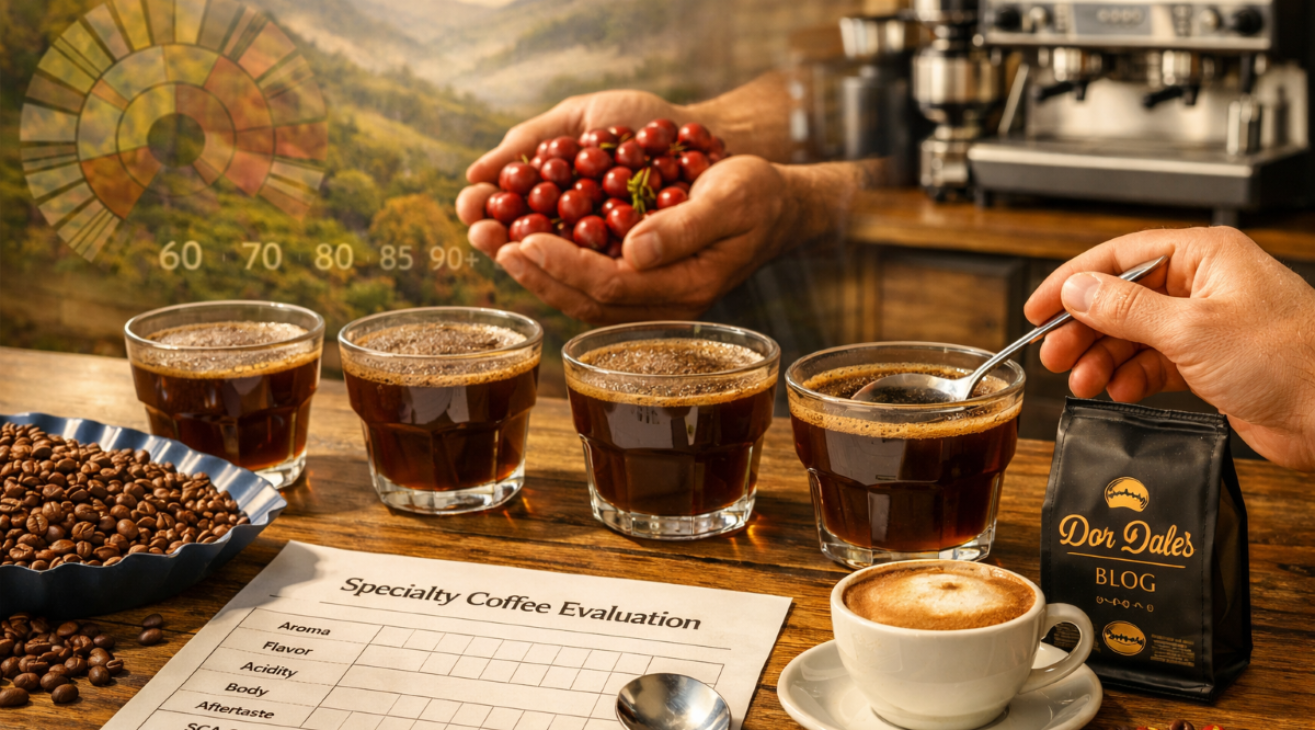
For the cupping evaluation, the Q Grader roasts the green coffee sample to a precise, standardized light profile — targeting an Agtron score of 58 on whole bean and 63 on ground coffee. This controlled, light roast is specifically designed to reveal the raw chemistry of the farm rather than reflecting any roaster’s stylistic influence. The coffee is then ground and cupped under strict SCA protocol: freshly ground into a standard cupping bowl, steeped in water at 93°C for four minutes, the crust broken at exactly four minutes and assessed for aroma, then skimmed and evaluated as the cup cools across a defined temperature range. The Q Grader evaluates the coffee across ten scored attributes:
- Fragrance/Aroma — dry fragrance of the grounds and wet aroma of the steeped cup
- Flavor — the primary taste impression across the full palate
- Aftertaste — the quality and duration of flavor that lingers after swallowing
- Acidity — the brightness, liveliness, and quality of acidity (not mere sourness)
- Body — the tactile weight and texture of the coffee in the mouth
- Balance — the harmonious integration of all flavor attributes
- Uniformity — consistency across five cups of the same sample
- Clean Cup — absence of any non-coffee taints or off-flavors in any of the five cups
- Sweetness — perceptible sweetness across all five cups
- Overall — the Q Grader’s holistic assessment of the coffee’s quality and complexity
Each attribute is scored on a sub-scale. Defects detected in any of the cups reduce the score through a penalty system. The aggregated score determines the coffee’s grade classification.
| ☕ The SCA Scoring Scale at a Glance Score Range Grade Classification What It Means Below 80 Commercial / Commodity Grade Does not meet the specialty threshold; traded on commodity markets 80 – 84.99 Specialty — Good Meets the specialty threshold; clean, sound quality; solid everyday drinking 85 – 86.99 Specialty — Very Good Well above average; notable complexity and terroir character 87 – 89.99 Specialty — Excellent Exceptional; actively sought by premium roasters; Cup of Excellence territory 90 – 94.99 Specialty — Outstanding World-class; extremely rare; commands top-tier auction prices globally 95 – 100 Specialty — Extraordinary Near-perfect; essentially never achieved in practice; theoretical upper limit Source: Specialty Coffee Association (SCA) Cupping Protocols & Q Grading Classification System. Coffees scoring 90+ represent less than 1% of the specialty market. |
Stage 6 — The Cup of Excellence: Peak Competitive Grading
For the finest micro-lots, the quality evaluation goes even further than standard Q Grader assessment. The Cup of Excellence — the most rigorous competitive grading program in the coffee world — subjects a single farm’s submitted lot to up to five sequential blind cupping rounds. Each round is evaluated by an expert jury: first a national jury of trained Colombian (or Brazilian, or Guatemalan, or Rwandan) cuppers, and then an international jury of buyers, roasters, and Q Graders from around the world. Only coffees that score above 87.00 in every round advance to the next. The final Cup of Excellence score represents the statistical consensus of potentially dozens of expert evaluations over multiple days, making it the most rigorously verified quality signal in the entire global coffee industry. Coffees that earn the Cup of Excellence designation are then auctioned to international buyers — and the transparency of the auction record creates a permanent, publicly verifiable quality benchmark attached to a specific farm, lot, and year.
Stage 7 — Roasting & the Consumer Score
There is one final scoring stage worth understanding: the evaluation of the roasted coffee as a finished consumer product. Platforms like Coffee Review, established by Kenneth Davids in 1997, evaluate commercially available roasted coffees under conditions that reflect the consumer experience rather than the controlled conditions of Q Grader assessment. This distinction matters: while green coffee scoring isolates the raw agricultural quality of the bean, roasted coffee scoring captures the combined achievement of great farming, great green coffee buying, and great roasting. A coffee that earned an 86 as a green lot — already an excellent score — can legitimately score a 93 or 94 on Coffee Review in the hands of a masterful roaster who understands how to develop that coffee’s specific flavor potential. The green score and the consumer score serve different audiences and answer different questions, but together they tell the complete story of a coffee’s journey from seed to exceptional cup.
Why It All Matters
Specialty coffee is not a trend. It is not a passing fascination of the urban professional class or an upscale marketing exercise waiting to be supplanted by the next food culture moment. It is a permanent, structural restructuring of how the world values, trades, and experiences one of the most widely consumed agricultural commodities on earth. The grading systems, the direct trade relationships, the cupping protocols, and the flavor vocabulary that the specialty movement has built over the past three decades are durable institutions — they have changed the economics of coffee farming and the expectations of coffee consumers in ways that are simply not reversible.
The implications of that grading system are most meaningful at the level of the individual farmer. When a grower in Huila, Colombia invests in selective harvesting, controlled fermentation, and careful drying — and a Q Grader subsequently assigns that lot an 88 Q Score — that score unlocks a price premium that can genuinely transform a family farm. It funds school fees, infrastructure repairs, the purchase of better processing equipment, and the generational sustainability of a small agricultural holding that might otherwise have been abandoned for lower-risk commodity production. When that same farmer’s lot wins a Cup of Excellence and achieves an international auction price of $40 per pound, it sends a signal to every neighboring farmer in the valley: quality pays. That signal, multiplied across thousands of farms in Colombia, Ethiopia, Rwanda, Guatemala, and Honduras, is how the specialty movement drives systemic agricultural improvement at scale.
For you as a consumer, understanding how specialty coffee is graded is the foundation for making genuinely informed choices. When you see an 87 Q Score on a bag tag, you now know what that means: a coffee that survived zero Category 1 physical defects, passed through the hands of a licensed Q Grader certified to detect any flaw across ten evaluated dimensions, and earned a score that places it in the top tier of the global specialty market. When you see a 94 on Coffee Review, you know it means a roaster executed brilliantly on exceptional raw material — two forms of excellence, combined. And when you see the name of the farm, the farmer, the altitude, and the harvest year printed on the bag, you know that this information is not marketing poetry. It is a record of provenance, a chain of documented quality decisions, and an invitation to connect your cup to the specific hillside, the specific family, and the specific season that produced it. Colombia, with its extraordinary diversity of growing regions, altitudes, microclimates, and innovative producers, stands at the forefront of that global specialty coffee story — and we are only beginning to discover the full depth of what this country’s coffee is capable of becoming.
| “When you understand how the score was earned, every cup tells a more meaningful story.” — Don Dale, Specialty Coffee Educator | ColombianSpecialtyCoffee.com |
| About the Author: Don Dale Don Dale is a specialty coffee educator and sourcing consultant based in La Vernia, Texas, with deep expertise in Colombian specialty coffee. Through ColombianSpecialtyCoffee.com, he works to connect North American consumers, roasters, and retailers with the exceptional coffees, farmers, and stories emerging from Colombia’s premier growing regions — from the high-altitude farms of Huila and Nariño to the pioneering fermentation laboratories of Cauca. Don’s work is guided by a single conviction: that when consumers understand what is in their cup and how it got there, they make better choices — and those choices matter, all the way back to the farm. |
© 2026 ColombianSpecialtyCoffee.com | All rights reserved | Written by Don Dale, Specialty Coffee Educator | June 2026


A WordPress Commenter
May 31, 2026 at 1:28 amHi, this is a comment.
To get started with moderating, editing, and deleting comments, please visit the Comments screen in the dashboard.
Commenter avatars come from Gravatar.