The Global History of Coffee: Origins, Diffusion, and Cultural Transformation
The Global History of Coffee: Origins, Diffusion, and Cultural Transformation
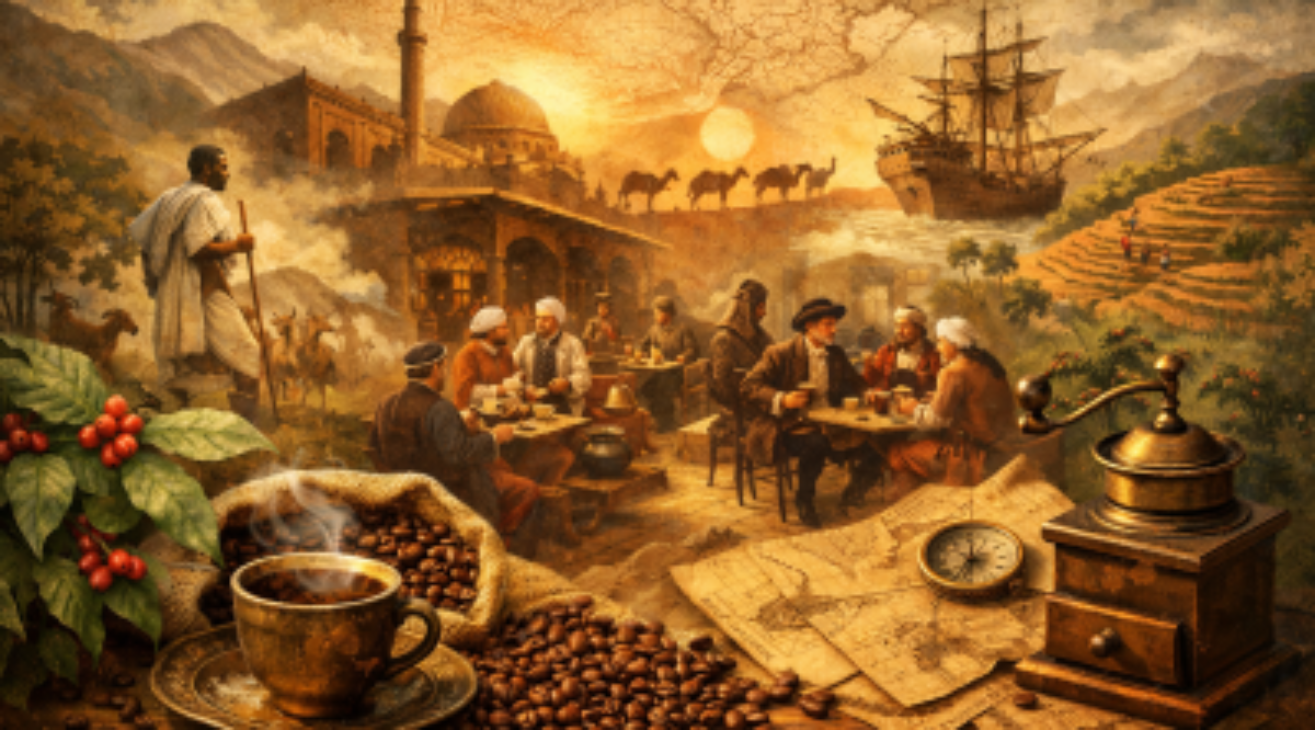
Coffee’s history is a long arc of ecology, trade, religion, and cultural exchange. Although its earliest development is wrapped in folklore, the most reliable evidence places the origin of Coffea arabica in the montane forests of southwestern Ethiopia. Genetic analyses conducted by Anthony et al. (2002) confirm that wild Arabica populations are indigenous to the Kaffa region, aligning with centuries of oral tradition from local communities.
From Ethiopian Forests to Yemeni Cultivation
By the 15th century, coffee had crossed the Red Sea into Yemen, where Sufi scholars incorporated the beverage into nightly devotional practices. Historian Ralph Hattox (1985) documents how Yemeni scholars described coffee as a tool for maintaining alertness during extended prayer. Yemen became the first society to cultivate coffee intentionally, transforming a wild Ethiopian plant into a structured agricultural commodity. The port of Mocha soon emerged as the world’s earliest commercial hub for coffee distribution.
Coffeehouses and Intellectual Life in the Islamic World
As coffee spread through the Arabian Peninsula and the Ottoman Empire, it gave rise to a new kind of public space: the coffeehouse. By the early 16th century, cities such as Cairo, Damascus, and Constantinople had established qahveh khaneh—venues where poetry, music, political discussion, and storytelling flourished. Ottoman legal records show periodic attempts to restrict or ban coffeehouses, not because of the beverage itself, but because these spaces encouraged open debate and social organization.
European Adoption and the Colonial Coffee Economy
Coffee entered Europe through Venetian merchants in the early 1600s. Within decades, coffeehouses appeared in London, Oxford, Paris, and Amsterdam. These establishments became known as “penny universities,” offering access to conversation, printed news, and intellectual exchange for the price of a single cup.
As European demand surged, colonial powers sought to break the Arab monopoly on coffee cultivation. The Dutch succeeded first, establishing plantations in Java by the 1690s. The French followed, transporting seedlings to the Caribbean. Pendergrast (2010) notes that a single plant brought to Martinique in 1720 is believed—though not conclusively—to have produced millions of descendants across Latin America.
Coffee in the Americas
By the late 18th century, coffee cultivation had spread throughout the Caribbean and into Central and South America. Haiti briefly became the world’s leading producer until the Haitian Revolution disrupted plantation systems. Brazil rose to global dominance in the 19th century, leveraging vast land resources and coerced labor systems to scale production.
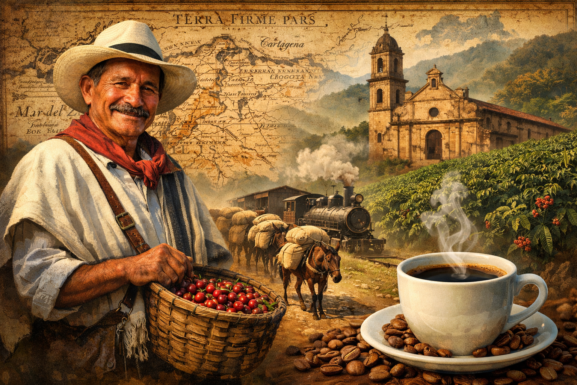
Colombia’s ascent came later. In the late 19th and early 20th centuries, smallholder farmers in the Andean highlands began cultivating high‑quality Arabica. The creation of the Federación Nacional de Cafeteros in 1927 standardized quality, improved infrastructure, and promoted Colombia internationally. This institutional framework helped establish Colombia as one of the world’s most respected origins for specialty coffee.
Industrialization and the Rise of Specialty Coffee
The 20th century introduced major technological shifts: vacuum‑sealed packaging (1900), instant coffee (1901), and mass‑market soluble coffee (1906). These innovations expanded global access but also distanced consumers from origin‑specific flavor and craftsmanship.
The late 20th‑century specialty coffee movement reversed that trend. Organizations such as the Specialty Coffee Association emphasized sensory evaluation, traceability, and sustainable farming. Producers in Colombia, Ethiopia, Rwanda, and Panama became central to this shift, offering coffees defined by terroir, processing method, and varietal distinction.
Today, coffee is one of the world’s most traded agricultural commodities and a cultural touchstone across continents. Its journey—from Ethiopian forests to Yemeni monasteries, from Ottoman coffeehouses to European salons, and from colonial plantations to modern specialty roasters—reflects a global story of adaptation, innovation, and human connection.
Sources
- Anthony, F., et al. “Genetic Diversity of Coffea arabica and the Origin of Arabica Coffee.” Theoretical and Applied Genetics, 2002.
- Hattox, Ralph. Coffee and Coffeehouses: The Origins of a Social Beverage in the Medieval Near East. University of Washington Press, 1985.
- Pendergrast, Mark. Uncommon Grounds: The History of Coffee and How It Transformed Our World. Basic Books, 2010.
- Topik, Steven. “The Integration of the World Coffee Market.” Latin American Research Review, 2003.
- National Coffee Association (NCA). “History of Coffee.”
- Specialty Coffee Association (SCA). “Foundations of Specialty Coffee.”