History of Coffee in Colombia
A Comprehensive History
From Jesuit Penance to Global Phenomenon
A History of Coffee in Colombia
A Comprehensive Cultural, Economic, and Political History for the General Reader
Don Dale
June 2026
Abstract
This article traces the full arc of coffee in Colombia — from its legendary introduction by Jesuit missionaries in 1723 through its transformation into a UNESCO-inscribed cultural heritage landscape and a globally celebrated specialty product. Drawing on the scholarship of Marco Palacios, Charles Bergquist, and the institutional history of the Federación Nacional de Cafeteros de Colombia (FNC), it argues that Colombian coffee history is inseparable from the nation’s colonial legacy, civil conflicts, economic structures, and extraordinary institutional creativity. The article surveys the hacienda system and its decline, the founding of the FNC in 1927, the creation of the Juan Valdez brand in 1960, the coffee crisis of the 1990s, and the subsequent specialty revolution, concluding with a geographical portrait of Colombia’s principal producing regions.
1. Introduction
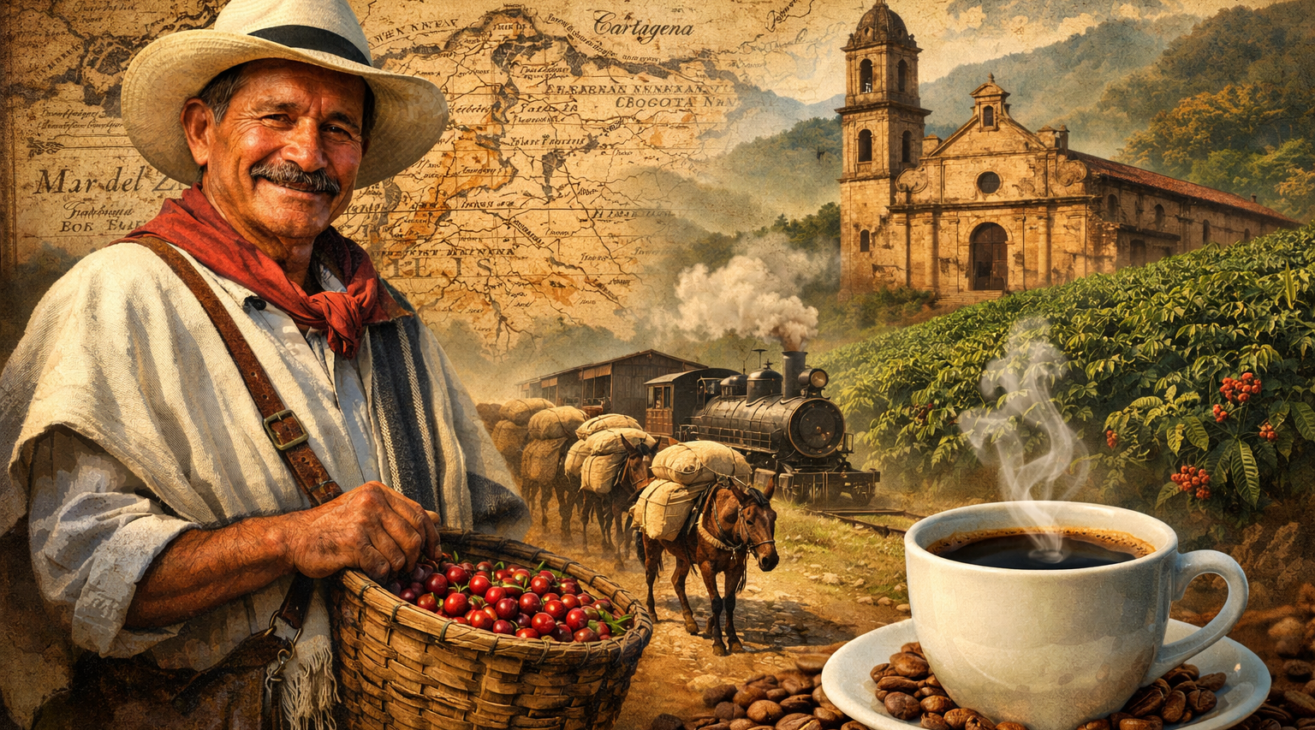
Before the sun has fully cleared the eastern ridgeline, the hand-pickers are already moving through the rows. The air at two thousand meters above sea level carries a quality of light peculiar to the Colombian Andes — pellucid, cool, faintly perfumed with the ripening sweetness of coffee cherries, that paradoxical fruit which is at once an agricultural commodity and a civilizational obsession. On the terraced hillsides of Huila, Nariño, and the storied departments of the Eje Cafetero, the gesture is the same as it has been for generations: a cupped hand drawing ripe red cherries from the branch, fingers trained by decades of muscle memory to leave the unripe ones untouched. It is a scene of extraordinary patience, and it is the foundation of one of the most consequential agricultural histories in the modern world.
Colombia is today the world’s third-largest coffee producer by volume and the largest producer of exclusively hand-harvested, 100% Arabica coffee on the planet.1 More than 550,000 smallholder farming families cultivate the crop across nineteen producing departments, most of them working plots of fewer than three hectares, their livelihoods bound to a global market of extraordinary volatility and a national institution of extraordinary reach. To understand Colombian coffee is not merely to understand an agricultural commodity. It is to trace the sinews of a nation — its colonial inheritance, its recurring civil violence, its merchant oligarchies and populist federations, its genius for branding and its vulnerability to economic shock.
The thesis of this article is straightforward, if the history is not: Colombian coffee cannot be separated from the Colombian nation. From the moment Jesuit missionaries pressed the first seeds into the volcanic soils of Nueva Granada in the early eighteenth century, coffee has served as a vehicle for colonization, a currency of social conflict, an engine of institutional innovation, and — in the era of specialty coffee and global coffeehouse chains — a medium of cultural projection. What follows is an attempt to tell that story whole: from penance to prosperity, from anonymous commodity to UNESCO heritage, from the Andean hillside to the global cup.
2. Global Origins: Coffee Before Colombia
The plant that would come to define a nation arrived in South America by a long and improbable route. The story of coffee’s origins, as fixed in legend if not always in verifiable fact, begins in the Ethiopian highlands — in the imagined ninth century, where the goat-herder Kaldi is said to have observed his flock growing agitated after browsing on the red berries of an unfamiliar shrub. Whether or not Kaldi existed, the linguistic and botanical evidence firmly places the origin of Coffea arabica in the highland forests of present-day Ethiopia and Sudan. By the fifteenth century, coffee had migrated across the Red Sea to the Yemen port of Mocha, where Sufi mystics found in the brew a reliable prophylactic against sleep during nocturnal devotional exercises.2
From Yemen the beverage spread with striking speed along the arteries of Ottoman trade. The qahveh khaneh — the coffeehouse — emerged in Constantinople, Cairo, and Mecca as a new institution of sociability and intellectual exchange. By the mid-seventeenth century, coffee had crossed into Europe, arriving in Venice in 1615 and London by 1652, where coffeehouses became the informal clearing-houses of commerce, politics, and journalism that would underwrite the early modern public sphere. The Dutch, preeminent in both commerce and colonial agriculture, were the first to cultivate coffee outside Arabia: seedlings planted in Java circa 1690 established a productive colony, and seeds were subsequently dispatched to Surinam in 1718, to French Guiana, and thence — in the famous episode involving the French naval officer Gabriel de Clieu — to Martinique in 1723, from which cultivation spread across the French Caribbean and, in time, to the continental landmass of South America.3
It was this Caribbean corridor — not direct importation from Arabia or Asia — that brought coffee to the Spanish viceroyalty of Nueva Granada. The plant arrived in a New World already reshaped by two centuries of colonial extraction, carrying with it both its promise of energizing stimulation and its capacity to organize and exploit labor on an industrial scale.
3. Colonial Roots: The Arrival of Coffee in Nueva Granada (c. 1723–1800)
The oldest written testimony to the presence of coffee in the territory that would become Colombia belongs to the Jesuit priest José Gumilla. In his 1730 work El Orinoco Ilustrado, Gumilla recorded coffee cultivation at the mission of Saint Teresa of Tabajé, near the confluence of the Meta and Orinoco rivers — a detail that places the plant in the northeastern reaches of Nueva Granada by the late 1720s, broadly consistent with the date of circa 1723 most commonly cited by the Federación Nacional de Cafeteros for its introduction.4 Later corroboration appears in a report by Archbishop-Viceroy Caballero y Góngora (1787), who noted coffee’s presence in Girón (Santander) and Muzo (Boyacá). These early plantings were almost certainly experimental, tended as garden crops for local consumption rather than as commercial ventures.
What transformed coffee from curiosity to crop is the subject of one of Colombian history’s most durable legends. In the early nineteenth century — the exact date is uncertain but the legend clusters around the town of Salazar de las Palmas in the northeastern department of Norte de Santander — a Jesuit priest named Francisco Romero is said to have found an ingenious solution to his parishioners’ reluctance to plant coffee seedlings. The farmers’ objections were not frivolous: a coffee tree requires several years of growth before it bears a harvestable crop, and subsistence cultivators operating on annual cycles could not afford the patience. Father Romero, confronted with this resistance during the confessional, took an unusual pastoral step. He assigned the planting of a specified number of coffee trees as penance for sins confessed. The penitential coffee garden, tended in a spirit of spiritual obligation rather than commercial calculation, gradually became a productive one. Legend further holds that the Archbishop of Colombia, impressed by the results, authorized the practice across the diocese — transforming the confessional into a rudimentary extension service for tropical agriculture.5
The legend of the penitential seedling — charming, improbable, and stubbornly persistent in the historiography — encapsulates something essential about the early diffusion of coffee through colonial Colombian society. The Church was not merely a spiritual institution in Nueva Granada; it was a principal agent of colonization, land management, and social discipline. That coffee should have been propagated through its pastoral mechanisms, whether or not Father Romero’s penance was literally administered, is entirely consonant with the institutional landscape of the late colonial period.
The transition from subsistence planting to commercial export was slow and modest. The first documented commercial export of Colombian coffee — one hundred green bags, each of sixty kilograms — left the port of Cúcuta near the Venezuelan border in 1808, shipped to foreign markets along the same routes that carried colonial Venezuela’s cacao and hides.6 The quantity was negligible by later standards, but the precedent was set: the Andean highlands possessed the altitude, the volcanic soils, the rainfall regime, and the temperature variation required for the cultivation of superior Arabica coffee, and someone had finally found a buyer.
4. Coffee and the Nineteenth-Century Export Economy (1808–1886)
The wars of independence that dismantled Spanish colonial rule between 1810 and 1824, culminating in Simón Bolívar’s campaigns and the proclamation of Gran Colombia in 1819, did not immediately transform the economic structures of the former viceroyalty. The great export-commodity systems — gold, cacao, tobacco — continued under new national ownership, and the merchant families of Bogotá and the regional cities retained the commercial networks that had sustained them under the Crown. Coffee was, in the first decades of the republic, one commodity among several competing for the attention of landowning elites who were looking for a reliable vehicle for integration into the expanding North Atlantic economy.
The decisive early advocate for coffee as a commercial crop in the Andean interior was Mariano Ospina Rodríguez, a Conservative politician and future president who in 1835 published a systematic argument for the expansion of coffee cultivation in the department of Antioquia. Ospina Rodríguez had studied the crop’s performance in neighboring Venezuela and the Caribbean and identified in Antioquia’s mountainous topography an ideal environment for Arabica production. His advocacy was part of a broader effort among Colombian elites to identify the export commodity that could give the young republic a stable position in global trade. In the event, he was correct, but the consolidation of coffee’s primacy took several more decades and was not accomplished without competition from tobacco and quinine, both of which enjoyed boom-and-bust cycles in the middle decades of the century before proving structurally fragile as export bases.7
By the 1850s, coffee was beginning its ascent toward commercial dominance. The mechanisms of that ascent are analyzed in Marco Palacios’s foundational study, Coffee in Colombia, 1850–1970, which traces what he describes, with characteristic precision, as the making of an oligarchy — the consolidation of buying, exporting, and eventually growing power in the hands of the great merchant families of Bogotá, Medellín, and the regional capitals.8 These families did not simply respond to existing production; they shaped it, by extending credit to smallholder growers, controlling access to the export infrastructure of mule trains and river boats, and establishing the commercial relationships with North American and European importing houses that gave Colombian coffee its first reliable foreign markets. The trade was, in this sense, merchant-led long before it was farmer-led, and the asymmetry of power between the merchant houses and the individual cultivator would persist as a structural feature of the Colombian coffee economy for much of its subsequent history.
The figures for production growth in this period, though imprecise, convey the scale of the transformation. From the modest 100 bags exported from Cúcuta in 1808, Colombian coffee production grew to something on the order of 60,000 sixty-kilogram bags annually by the mid-1860s, and surpassed 600,000 bags by the close of the century.9 This growth was driven by demand — the United States had by the 1870s emerged as the world’s largest consumer of coffee — and by the expansion of cultivation into new Andean frontiers, as farmers pushed into the highlands of Cundinamarca, Santander, and, increasingly, the western ranges of Antioquia. Colombia had not yet found its institutional voice, but it had found its commodity.
5. Haciendas, Colonization, and the Smallholder Revolution (1870–1927)
By the final quarter of the nineteenth century, two distinct models of coffee production had emerged in Colombia, each reflecting a different social history and a different vision of how the country’s most valuable crop should be organized. In the older producing departments of Cundinamarca and the eastern Santanders, production was concentrated on large estates — haciendas — owned by the same merchant-landowning families who controlled the export trade. Labor on these estates was performed by aparceros, tenant cultivators who held usufructuary rights over small plots in exchange for a share of their harvest and periodic labor obligations to the landowner. The system was a colonial inheritance adapted to the coffee economy, and it carried within it the tensions that would eventually destroy it: the aparcero‘s interest in maximizing the autonomy of his plot was in permanent tension with the landowner’s interest in maximizing the flow of cheap labor to the export-grade rows.
In Antioquia and the frontier departments to its south and southwest — the region that would come to be called the Eje Cafetero or Coffee Triangle — a different story was unfolding. The Antioquian colonization, one of the great internal migrations of nineteenth-century Latin America, sent thousands of small settler families (colonos) south and west into the unoccupied or thinly occupied highland ridges of what are now the departments of Caldas, Quindío, and Risaralda. These colonos arrived not as tenant laborers but as independent smallholders, clearing their own land, planting their own coffee alongside plantains and maize, and marketing their harvest through the commercial networks of the Antioquian merchant houses. Their farms were small — rarely exceeding a few hectares — and their labor force was the family, not the contracted peon.10
The contest between these two models was decided, ultimately, not by ideology or policy but by economics and geography. The hacienda system carried structural costs that the smallholder model did not: the resident labor force had to be fed, housed, and managed year-round, generating fixed costs that were especially punishing in years of low prices. The family farm, by contrast, could absorb price shocks through the subsistence production of its food plots and the elastic deployment of family labor — working harder when prices justified it and retreating to subsistence when they did not. The western highlands of the Eje Cafetero, moreover, proved exceptionally well suited to Arabica cultivation: their altitude (typically between 1,400 and 1,800 meters), their volcanic soils, their reliable bimodal rainfall pattern, and the shelter from frost provided by the mountain topography created conditions of unusual productivity. The hacienda system, dominant through the 1880s, entered a long decline from which it would not recover. Charles Bergquist’s detailed study of the political economy of this transition demonstrates how the instabilities of the export system translated directly into the political conflicts of the period.11
The Thousand Days War of 1899–1902, the most devastating civil conflict in Colombian history, briefly arrested the expansion of coffee production. The war — a conflict between the Liberal and Conservative parties that left an estimated 100,000 dead and the national economy in ruins — bankrupted many of the remaining haciendas in the older producing zones, accelerated the fragmentation of large estates into smallholder parcels, and demonstrated with brutal clarity the costs of attaching a monoculture export economy to the volatility of partisan warfare. Yet the war also, paradoxically, cleared institutional ground for the coffee prosperity that followed. With the large haciendas weakened, the smallholder model became the de facto architecture of Colombian coffee, and in the decade after 1903, production surged as the colonization frontier continued to advance through the western Andes. By the 1910s and 1920s — the era of the so-called coffee prosperity, la prosperidad a debe — coffee had become, decisively and durably, the foundation of the Colombian economy.
6. The Federación Nacional de Cafeteros: Statecraft Through Coffee (1927–1959)
In 1927, confronted with a booming but institutionally unprotected coffee sector, Colombian coffee growers did something that no major producing country had managed before: they organized. The Federación Nacional de Cafeteros de Colombia (FNC), founded that year at a congress of growers in Medellín, was established as a non-profit business organization representing the interests of coffee producers at every scale, from the great commercial farms of Cundinamarca to the smallholder plots of Caldas. Its founding mandate was stated in three objectives that would prove remarkably durable over the following century: to protect the industry, to study its problems, and to further its interests.12
The financial architecture that made the FNC’s ambitions feasible was established in Law 76 of 1927, which created the contribución cafetera — a mandatory per-bag export tax levied on every bag of green coffee leaving Colombian ports. The revenues of this tax flowed into the Fondo Nacional del Café, the National Coffee Fund, which became the financial engine of the FNC’s extraordinary range of activities. Controlled jointly by the FNC and the Colombian government, the Fund allowed the Federation to act as a price stabilizer (buying coffee in the domestic market when prices fell), a quality enforcer (setting export standards), a research patron (funding the Cenicafé research center, which became one of the world’s leading institutions for coffee agronomy), and a provider of rural social infrastructure — building schools, roads, hospitals, and potable water systems in the coffee zones that the Colombian state could not or would not reach.13
The result was an institution of extraordinary reach and legitimacy. To the smallholder farmers of the Eje Cafetero and the surrounding departments, the FNC was not merely an industry association; it was the entity that built the rural school their children attended, paved the road that connected their farm to the market town, and guaranteed a floor price for their harvest. This combination of economic function and social provision created a bond of institutional loyalty that was deeply unusual in a Colombian society where state legitimacy was, historically, thin and contested. Marco Palacios has described the FNC as a “state within a state,” a characterization that, while slightly polemical, captures something essential about the institution’s scope.14
By the 1940s and 1950s, the FNC was negotiating on Colombia’s behalf in the international coffee diplomacy that would eventually produce the International Coffee Agreement. Colombia had by then consolidated its place among the world’s three largest producers, behind only Brazil and, in some years, competing with a resurgent Kenyan and Central American sector. The Federation also drove important agronomic change: the promotion in the 1950s of the Caturra variety — a natural dwarf mutation of the Bourbon cultivar, offering significantly higher yields per hectare without sacrificing the clean, bright flavor profile that distinguished Colombian Arabica — began a process of varietal intensification that would, over the following decades, transform the productive landscape of the Andean coffee zones.
7. Juan Valdez and the Art of Nation Branding (1960–1989)
By the late 1950s, the FNC faced a problem that was simultaneously commercial and existential. Colombian coffee — then among the two largest volumes entering the American market — was being bought by the major U.S. importing houses and blended, without attribution, into the great undifferentiated cans of Folgers, Maxwell House, and Hills Brothers. The country of origin was invisible to the consumer. Survey data commissioned by the FNC in the late 1950s revealed the depth of the problem: only four percent of American consumers could identify Colombia as a coffee-producing country, let alone as a source of premium Arabica.15 If Colombian coffee could not be distinguished from Brazilian robusta in the consumer’s mind, there was no mechanism by which the premium quality of Colombian production could command a premium price — and no institutional future for the FNC’s strategy of quality leadership over volume competition.
The solution the FNC devised was unprecedented in the history of commodity marketing. Rather than competing through price, or through the conventional channels of trade promotion, the Federation decided to give Colombia’s coffee a face. It commissioned the New York advertising agency Doyle Dane Bernbach — the same agency that had recently revolutionized American advertising with the Volkswagen “Think Small” campaign — to create a character who would embody the hand-crafted authenticity and geographic specificity of Colombian Arabica.
The character Doyle Dane Bernbach created was Juan Valdez: a fictional Andean campesino in a traditional sombrero, accompanied by a mule named Conchita, standing against a backdrop of Andean hillsides dense with coffee trees. On January 6, 1960, Juan Valdez made his debut in a full-page advertisement in the Sunday edition of The New York Times. The advertisement said nothing about price, nothing about availability, nothing about the mechanics of the coffee trade. It said, in effect: this coffee was grown by a man who knows each plant by name, on a hillside that has been tended for generations, in a country that takes its coffee seriously. It was, in the vocabulary of a later era, a story — and it was a story that American consumers in the age of mass production and anonymous supermarket goods were primed to receive.16
The results exceeded the expectations of even the campaign’s architects. Within five months of the January 1960 launch, independent consumer surveys found that American identification of Colombian coffee as “the world’s finest” had risen by three hundred percent. The “100% Colombian” seal — a mark of geographic origin that the FNC had the legal standing to award to blends containing exclusively Colombian beans — became one of the most recognized food-origin marks in American retail history. By 1964, the General Foods corporation’s Yuban brand had switched to 100% Colombian beans and trumpeted the fact in its advertising — the first major American brand to make Colombian origin a premium selling point rather than a blending secret.17
The Juan Valdez campaign was more than a marketing triumph. It was a conceptual breakthrough: the demonstration that a producing country — not a corporation, not a brand, but a sovereign nation acting through a producer federation — could insert itself into the consumer’s decision at the point of purchase. The “100% Colombian” seal was the first successful country-of-origin mark for a commodity in advertising history, a model that would eventually be emulated by Café de Colombia’s EU Protected Designation of Origin status (granted 2007) and by country-of-origin programs from Jamaica, Hawaii, and Ethiopia.18
The International Coffee Agreement of 1962, in which Colombia was a charter member, created a quota system that stabilized prices across much of the 1960s and 1970s, giving the FNC and its member farmers a period of relative price security that allowed investment in quality infrastructure and rural social programs. Production during this era expanded steadily, reaching a peak of over 15 million sixty-kilogram bags in the mid-1980s — a figure that remains, as of this writing, the high-water mark of Colombian coffee output. The character of Juan Valdez, meanwhile, became something rarer than a successful advertising mascot: he became a genuine piece of American popular culture, a face on a mug in a way that no other commodity country had achieved.
8. Crisis, Collapse, and Reinvention: The Post-ICA Era (1989–2002)
In July 1989, the United States — the world’s largest coffee importer — withdrew from the International Coffee Agreement, citing disagreement over quota allocation and the diversion of quota coffee to non-member markets. The withdrawal triggered the collapse of the ICA quota system that had stabilized world coffee prices for nearly three decades. The consequences for producing countries were swift and severe. World coffee prices, which had traded in a relatively stable band under the quota system, fell by nearly fifty percent within months of the ICA’s effective demise. For Colombian smallholder farmers, whose financial planning had been predicated on a relatively predictable income stream, the price collapse was catastrophic.19
The crisis deepened through the 1990s as the structural forces driving overproduction became clear. The most significant new entrant to the world coffee market was Vietnam, which had planted coffee — almost entirely the high-yielding but flavor-inferior Robusta species — at industrial scale during the 1980s under a state-directed agricultural program. Vietnam’s exports grew from approximately three million sixty-kilogram bags in 1990 to over fourteen million by the end of the decade, flooding the market with low-cost Robusta that drove global prices to levels not seen since the 1970s in real terms. Colombia, producing premium Arabica at much higher cost-per-bag, could not compete on price alone.20
The human cost in Colombia’s coffee zones was severe. Smallholder family incomes in the Eje Cafetero and Huila collapsed, in some cases by seventy percent or more in real terms. Rural unemployment rose sharply. Some regions experienced a drift toward illicit crop production — particularly coca — as desperate farming families sought any commodity that could generate a living income. The FNC, which had funded its extensive social infrastructure from the revenues of the Fondo Nacional del Café, found itself squeezed between declining revenues and rising demands for rural support. For the first time in the Federation’s history, organized groups of disgruntled coffee growers — the cafeteros who had always been the FNC’s core constituency — held political demonstrations against the institution’s leadership, demanding better prices and greater transparency in fund management.21
The Colombian government and the FNC responded with a series of structural adjustments that, while painful, planted important seeds for the era that would follow. Subsidies were reformed and in some cases eliminated. The FNC began to reduce its direct commercial activities and to focus its resources on research, quality promotion, and origin differentiation. Most consequentially, the crisis forced a reckoning with the fundamental question of Colombian coffee’s competitive position: if volume could not be the strategy — if Colombia could not outproduce Vietnam or Brazil — then quality and differentiation would have to be. The specialty coffee sector, which had been a marginal curiosity through most of the 1980s, was now revealed as a potential lifeline. The crisis, as Jairo Tocancipa-Falla and other scholars have observed, created the conditions for the specialty revolution that would define the next chapter of Colombian coffee.22
9. The Juan Valdez Café and the Specialty Revolution (2002–Present)
On December 14, 2002, at the international departure terminal of El Dorado Airport in Bogotá, the first Juan Valdez Café opened its doors. The occasion was more than the launch of a coffeehouse. It was the moment at which Juan Valdez — for forty-two years a fictional presence in American living rooms — became a physical one. The fictional campesino had become a brand, and the brand was becoming a business.23
The institutional vehicle for this transition was Procafecol S.A., a corporation established by the FNC in 2002 to develop and manage the Juan Valdez retail chain. The ownership structure of the enterprise was remarkable and, in the global coffeehouse landscape, without precedent: the Juan Valdez trademark, registered and protected by the Fondo Nacional del Café, was effectively owned by the more than half a million coffee farmers who contributed to the Fund through their export levies. A coffeehouse chain — competing directly with Starbucks in multiple markets — whose ultimate shareholders were Andean smallholders tending plots of fewer than three hectares. By the 2020s, the chain had grown to more than 630 stores across some forty international markets, with a significant presence in the United States, Chile, Ecuador, and Spain, as well as domestic expansion throughout Colombia’s principal cities and airports.24
Simultaneously with the birth of Juan Valdez Café, the global specialty coffee movement — the so-called Third Wave — was reaching Colombia with transformative effects. Third Wave roasters in the United States, Scandinavia, Japan, and Australia were actively seeking single-origin, traceable micro-lots from exceptional farms at specific altitudes and with identifiable flavor profiles. For Colombian coffee, this represented an alignment of market opportunity with geographical reality. The country’s extraordinary topographical diversity — nineteen producing departments across three Andean ranges, with altitudes from 1,200 to over 2,200 meters — gave it a flavor range that no single-origin country could match. Huila’s fruit-forward brightness, Nariño’s high-altitude sweetness, Antioquia’s balanced caramel clarity: each department could tell a different story to the specialty buyer, and each story commanded a premium that the commodity market could never approach.
The key enabling technology was the micro-beneficio — the small farm-level or cooperative-level wet-processing mill that allowed individual farmers to control the post-harvest treatment of their own coffee, establishing the traceability that specialty buyers required. As micro-beneficios spread through Huila, Nariño, and the Eje Cafetero through the 2000s and 2010s, the supply chain connecting individual farmers to international specialty roasters shortened dramatically. Farmers who had previously sold cherry or parchment to anonymous intermediaries were now sending washed, honey-processed, and natural-processed lots to roasters in Oslo, Tokyo, and Portland under their own farm names and with their own quality scores from the Specialty Coffee Association’s one-hundred-point scale.
The fermentation revolution of the late 2010s added further complexity to this picture. Colombian producers, often in collaboration with international Q-graders and competition consultants, began experimenting with extended anaerobic fermentation, carbonic maceration, and exotic yeast inoculation — processing techniques borrowed from winemaking and applied to coffee post-harvest with startling results. Competition lots from Huila and Nariño began appearing on World Barista Championship and Cup of Excellence podiums with flavors — tropical fruit, wine-like fermented complexity, jasmine florality — that had never previously been associated with Colombian coffee’s classic profile.
The symbolic capstone of Colombian coffee’s cultural ascent came in June 2011, when UNESCO inscribed the “Coffee Cultural Landscape of Colombia” on the World Heritage List.25 The inscribed area encompasses six unique urban-rural landscapes across the departments of Caldas, Quindío, Risaralda, and Valle del Cauca — the heart of the Eje Cafetero — distinguished by their steep hillsides of coffee cultivation, their traditional bahareque vernacular architecture in white-washed towns, their patterns of shade-tree management, and the centuries of cultural continuity that have shaped the landscape’s appearance. It was the first time a coffee-producing landscape had received World Heritage recognition, and it formalized what Colombian farmers and historians had long understood: that in the Eje Cafetero, coffee was not merely an economic activity but a civilization.
10. The Geography of Flavor: Colombia’s Principal Coffee Regions
To speak of “Colombian coffee” as a single flavor profile is, in the specialty era, a category error of roughly the same order as speaking of “French wine.” Colombia grows coffee across nineteen producing departments distributed among the three cordilleras of the Colombian Andes — the Occidental, Central, and Oriental ranges — at altitudes ranging from 1,200 to over 2,200 meters above sea level. Every kilogram of it is hand-picked Arabica; beyond that, the similarities between a Nariño washed at 2,100 meters and an Antioquia natural at 1,400 meters may be less than the similarities between either of those and an Ethiopian Yirgacheffe. The geography of Colombian coffee is, ultimately, a geography of flavor, and three producing regions merit extended attention.26
Huila: The Specialty Powerhouse
Huila, located in the upper Magdalena River valley of southwestern Colombia, has emerged over the past two decades as the country’s most celebrated specialty producing department, consistently winning the highest number of Cup of Excellence awards and commanding some of the most significant premiums from international specialty buyers. The department’s coffee grows at altitudes between 1,400 and 2,000 meters on the mineral-rich volcanic soils derived from the San Agustín archaeological zone and the surrounding Andean plateau. The combination of altitude, volcanic nutrition, and a bimodal rainy season that allows two distinct harvests per year — the principal (cosecha) and the auxiliary (mitaca) — produces coffees of intense sweetness and fruit-forward complexity.
The classic Huila profile is built around red and black fruit: red cherry, raspberry, blackcurrant, and plum, carried on a bright malic acidity with a clean finish that lingers. Since the late 2010s, natural and honey processing has amplified these fruit characteristics to dramatic effect, and Huila producers have been among the most willing experimenters with extended fermentation — producing anaerobic naturals and carbonic maceration lots that score in the specialty sector’s upper percentiles. The municipalities of San Agustín, Palestina, and Pitalito are among the most watched micro-origins within the department, each associated with specific altitude bands, microclimate conditions, and processing traditions.27
Nariño: The High-Altitude Marvel
At the far southern tip of Colombia, bordering Ecuador and rising to some of the highest commercial coffee elevations in the world, lies the department of Nariño. Here, farms routinely operate above 2,000 meters, and in municipalities such as La Unión, Buesaco, and El Tambo, coffee trees are cultivated at altitudes exceeding 2,200 meters — a height at which few other Arabica-producing regions on earth operate at commercial scale. The geography of high-altitude Nariño produces a set of conditions that directly shape the flavor of its coffee: the intense equatorial sun of the daytime — Nariño sits within one degree of the equator — drives photosynthesis and sugar development in the coffee cherry with unusual efficiency, while the cold nights that descend from the surrounding páramo slow the ripening process, allowing flavor compounds to concentrate over a longer maturation period.
The result is a profile of exceptional sweetness and stone-fruit character: peach, apricot, and nectarine are the notes most consistently reported by professional tasters, set against a gentle acidity and a silky body that reflects the slow, even development of the cherry. The volcanic soils of Nariño also contribute a mineral complexity — a subtle earthiness and salinity in the finish — that distinguishes the department’s cups from the more purely fruit-driven profiles of Huila. Historically, Nariño’s geographic isolation and poor road infrastructure made it one of Colombia’s least-known producing regions; the specialty revolution reversed this entirely, and Nariño coffees now command premium prices that rival or exceed those of any other Colombian origin.28
The Eje Cafetero: The Cultural Heartland
The Coffee Triangle — the departments of Caldas, Quindío, and Risaralda, along with the southern cone of Antioquia — is the spiritual and historical center of Colombian coffee culture. This is the landscape that the Antioquian colonos carved out of the western Andes in the nineteenth century, the territory that the FNC was founded to protect, and the region that UNESCO recognized in 2011 as a cultural heritage of exceptional universal value. Its white-washed towns — Armenia, Manizales, Pereira, Salento — its rural vernacular architecture in the bahareque style, its steep hillsides of shade-grown coffee under banana and guamo trees, and its distinctive cultural traditions of hospitality and agrarian identity have made it the archetype of the Colombian coffee experience for domestic and international visitors alike.
The flavor of Eje Cafetero coffee is, in the specialty vocabulary, “classic Colombian”: a balanced, medium-bodied cup of clean caramel sweetness, mild citrus acidity, and a smooth, approachable finish that has defined the international image of Colombian Arabica since the Juan Valdez era. It is not the most dramatically scored of Colombia’s regional profiles — it does not reach the fruit-forward heights of a competition-grade Huila lot or the high-altitude sweetness of a Nariño micro-lot — but it is the most consistent and the most broadly appreciated, carrying the flavor memory that four generations of consumers have associated with the phrase “100% Colombian.”29
| Region | Key Departments | Altitude Range | Flavor Profile | Notable Distinction |
|---|---|---|---|---|
| Huila | Huila | 1,400–2,000 m | Red cherry, raspberry, blackcurrant; bright malic acidity | Colombia’s top Cup of Excellence department; experimentation hub |
| Nariño | Nariño | 1,700–2,200+ m | Peach, apricot, nectarine; silky body; mineral finish | Among the highest commercial coffee farms on earth |
| Eje Cafetero | Caldas, Quindío, Risaralda, S. Antioquia | 1,400–1,800 m | Caramel, mild citrus, smooth finish; balanced medium body | UNESCO World Heritage landscape; historic and cultural heartland |
11. Conclusion
Three centuries separate the moment when, by legend, a Jesuit priest in the northeastern Andes pressed his first penitential coffee seedlings into the earth, from the moment when a barista at a Juan Valdez Café in Miami or Seoul draws espresso from those same Andean hillsides into a branded ceramic cup. The distance between these two images measures not only time but a transformation in the organization of the global economy, the structures of commodity agriculture, the nature of brand identity, and the relationship between a producing nation and the consumers who sustain it.
Colombian coffee history is, in the fullest sense, a mirror of Colombian national history. The colonial pattern of extraction and religious legitimation is visible in the Jesuit penance legend. The post-independence struggle to find a commodity anchor for a fragile national economy runs through the nineteenth-century export boom. The contest between oligarchic hacienda and smallholder colonization encodes the deeper conflict between concentrated and distributed power that has shaped Colombian political life across two centuries. The FNC’s remarkable institution-building in the twentieth century demonstrates how producer nations can, under the right conditions, add value, protect growers, and build global brand equity rather than simply surrendering commodity rents to importing intermediaries. The crisis of the 1990s reveals the structural vulnerability of any economy organized around a single export commodity in a deregulated global market. And the specialty revolution of the 2000s and 2010s shows how crisis can, when met with institutional creativity and agricultural talent, become reinvention.30
The challenges of the coming decades are formidable. Climate change is advancing the altitude at which viable coffee cultivation is possible, threatening the lower-elevation farms that have historically provided volume, and compressing the zones of optimal growing conditions toward peaks that may eventually be too small to sustain commercial production. The generational succession of smallholder farms — as the children of cafeteros leave for cities, drawn by education and opportunity — poses a structural demographic challenge for an agricultural system that depends on family labor. And the specialty premium, however real in the current market, is available to only a fraction of the 550,000 families who grow Colombian coffee; the majority remain price-takers in a commodity system as volatile today as it was in 1989.
Yet the view from the Andean hillside at dawn has not fundamentally changed. The hand moves along the row, the ripe cherry gives to the cupped palm, the bag on the hip grows heavy with the morning’s work. It is the same gesture that Antioquian colonos made on their first cleared slopes in 1870, the same gesture that filled the sacks carried by mule train to the port of Cúcuta in 1808, the same gesture that, carried forward into a global market of extraordinary complexity, still shapes the flavor in the cup. Colombian coffee’s history is, in the end, a history of that gesture — patient, skilled, irreplaceable, and stubbornly human — meeting the world.
Notes
1. Federación Nacional de Cafeteros de Colombia (FNC), About the FNC (Bogotá: FNC, 2024), https://federaciondecafeteros.org. Colombia is consistently ranked as the world’s third-largest coffee producer by volume (after Brazil and Vietnam) and is the only major producer to mandate 100% hand harvesting of exclusively Arabica varieties at the institutional level.
2. William H. Ukers, All About Coffee (New York: Tea and Coffee Trade Journal Company, 1922), chs. 1–3; Mark Pendergrast, Uncommon Grounds: The History of Coffee and How It Transformed Our World (New York: Basic Books, 1999), 1–22. The attribution of coffee’s origins to Ethiopian goat-herder “Kaldi” is first recorded in writing in 1671 and is almost certainly legendary.
3. Wikipedia, “National Federation of Coffee Growers of Colombia,” last modified 2024, https://en.wikipedia.org/wiki/National_Federation_of_Coffee_Growers_of_Colombia. The Wikipedia entry’s section on the arrival of coffee in Colombia follows the FNC’s own institutional history in tracing the Dutch colonial corridor from East Indies to Surinam to French Guiana and the Caribbean.
4. Moro Coffee Roasters, “Colombia — Coffee History,” May 8, 2024, https://morocoffeeroasters.com. The Gumilla reference in El Orinoco Ilustrado (1730) is the oldest known written reference to coffee cultivation in what is today Colombia.
5. Coffee with the Queen, “Colombian Coffee, from Penance to Excellence and Preservation,” https://coffeewiththeQueen.com; Moro Coffee Roasters, “Colombia — Coffee History.” The legend of Francisco Romero and penitential coffee planting is widely cited in the popular and institutional historiography of Colombian coffee but is not corroborated by primary documentation.
6. Moro Coffee Roasters, “Colombia — Coffee History.” The 1808 export of 100 bags (60 kg each) from Cúcuta to foreign markets is the first commercially documented export of Colombian green coffee.
7. José Antonio Ocampo, Historia Económica de Colombia (Bogotá: Planeta, 2007), chs. 3–4.
8. Marco Palacios, Coffee in Colombia, 1850–1970: An Economic, Social, and Political History (Cambridge: Cambridge University Press, 1980), part 1.
9. Palacios, Coffee in Colombia, 45–78; Mariana Saenz, Diego Alvarez, and Gregory Brock, “Lessons from Long-Run (1975–2017) Structural Change in Colombia’s Coffee Production,” Agricultural and Resource Economics Review 50, no. 2 (August 2021): 201–225.
10. Palacios, Coffee in Colombia, chs. 4–6; Marco Palacios and Frank Safford, Colombia: País Fragmentado, Sociedad Dividida (Bogotá: Norma, 2002).
11. Charles W. Bergquist, Coffee and Conflict in Colombia, 1886–1910 (Durham: Duke University Press, 1986).
12. Wikipedia, “National Federation of Coffee Growers of Colombia.”
13. Karim León and Juan Carlos López, eds., Federación Nacional de Cafeteros de Colombia, 1927–2017: 90 Años. Vivir el Café y Sembrar el Futuro (Medellín: FNC and Editorial EAFIT, 2017), chs. 2–4.
14. Palacios, Coffee in Colombia, 200–215.
15. JayArr Coffee, “Juan Valdez and the FNC: How Colombia Branded Its Coffee (1927–2026),” May 10, 2026, https://jayarrcoffee.com.
16. Wikipedia, “National Federation of Coffee Growers of Colombia”; JayArr Coffee, “Juan Valdez and the FNC.”
17. JayArr Coffee, “Juan Valdez and the FNC.”
18. Federación Nacional de Cafeteros de Colombia, About the FNC (2024); Coffee with the Queen, “Colombian Coffee, from Penance to Excellence.”
19. Laura Elizabeth Boudon, “World Coffee Markets and National Coffee Parastatals since 1989: A Comparative Study of Colombia and Côte d’Ivoire” (PhD dissertation, Florida International University, 2000), chs. 2–3.
20. Boudon, “World Coffee Markets,” 88–115; Saenz, Alvarez, and Brock, “Lessons from Long-Run Structural Change,” 205–208.
21. Jairo Tocancipa-Falla, “A Report on ‘Understanding the Coffee Crisis: Perspectives and Challenges,'” Cambridge Anthropology 25, no. 1 (2005): 70–75.
22. Tocancipa-Falla, “Understanding the Coffee Crisis,” 73–74.
23. LegalClarity, “Who Owns Juan Valdez Coffee? Procafecol & the FNC,” June 11, 2026, https://legalclarity.com.
24. LegalClarity, “Who Owns Juan Valdez Coffee?”; JayArr Coffee, “Juan Valdez and the FNC.”
25. UNESCO, “Coffee Cultural Landscape of Colombia,” World Heritage List, https://whc.unesco.org/en/list/1121.
26. Sean Brennan, “The History of Coffee in Colombia: Origins, Flavors & More!” Corner Coffee Store, May 30, 2026; expertcafe.be, “Colombian Coffee Guide: Huila, Nariño, Antioquia,” updated April 2026; Nordic Approach, “Complete Guide to Colombian Specialty Coffee.”
27. expertcafe.be, “Colombian Coffee Guide.”
28. Nordic Approach, “Complete Guide to Colombian Specialty Coffee”; expertcafe.be, “Colombian Coffee Guide.”
29. expertcafe.be, “Colombian Coffee Guide”; Brennan, “History of Coffee in Colombia.”
30. Saenz, Alvarez, and Brock, “Lessons from Long-Run (1975–2017) Structural Change in Colombia’s Coffee Production,” Agricultural and Resource Economics Review 50, no. 2 (August 2021): 201–225.
Bibliography
Aaron. “The Bold Cup: A Journey Through the History of Colombian Coffee.” Bogotá Bound, July 19, 2025. https://bogotabound.com.
Bergquist, Charles W. Coffee and Conflict in Colombia, 1886–1910. Durham: Duke University Press, 1986.
Boudon, Laura Elizabeth. “World Coffee Markets and National Coffee Parastatals since 1989: A Comparative Study of Colombia and Côte d’Ivoire.” PhD dissertation, Florida International University, 2000.
Brennan, Sean. “The History of Coffee in Colombia: Origins, Flavors & More!” Corner Coffee Store, May 30, 2026. https://cornercoffeestore.com.
Coffee with the Queen. “Colombian Coffee, from Penance to Excellence and Preservation.” https://coffeewiththeQueen.com. Accessed June 2026.
expertcafe.be. “Colombian Coffee Guide: Huila, Nariño, Antioquia.” Updated April 2026. https://expertcafe.be.
Federación Nacional de Cafeteros de Colombia. About the FNC. Bogotá: FNC, 2024. https://federaciondecafeteros.org.
JayArr Coffee. “Juan Valdez and the FNC: How Colombia Branded Its Coffee (1927–2026).” May 10, 2026. https://jayarrcoffee.com.
LegalClarity. “Who Owns Juan Valdez Coffee? Procafecol & the FNC.” June 11, 2026. https://legalclarity.com.
León, Karim, and Juan Carlos López, eds. Federación Nacional de Cafeteros de Colombia, 1927–2017: 90 Años. Vivir el Café y Sembrar el Futuro. Medellín: FNC and Editorial EAFIT, 2017.
Moro Coffee Roasters. “Colombia — Coffee History.” May 8, 2024. https://morocoffeeroasters.com.
Nordic Approach. “Complete Guide to Colombian Specialty Coffee.” https://nordicapproach.no. Accessed June 2026.
Ocampo, José Antonio. Historia Económica de Colombia. Bogotá: Planeta, 2007.
Palacios, Marco. Coffee in Colombia, 1850–1970: An Economic, Social, and Political History. Cambridge: Cambridge University Press, 1980.
Palacios, Marco, and Frank Safford. Colombia: País Fragmentado, Sociedad Dividida. Bogotá: Norma, 2002.
Pendergrast, Mark. Uncommon Grounds: The History of Coffee and How It Transformed Our World. New York: Basic Books, 1999.
Saenz, Mariana, Diego Alvarez, and Gregory Brock. “Lessons from Long-Run (1975–2017) Structural Change in Colombia’s Coffee Production.” Agricultural and Resource Economics Review 50, no. 2 (August 2021): 201–225.
Tocancipa-Falla, Jairo. “A Report on ‘Understanding the Coffee Crisis: Perspectives and Challenges.'” Cambridge Anthropology 25, no. 1 (2005): 70–75.
UNESCO. “Coffee Cultural Landscape of Colombia.” World Heritage List. https://whc.unesco.org/en/list/1121. Accessed June 2026.
Ukers, William H. All About Coffee. New York: Tea and Coffee Trade Journal Company, 1922.
Wikipedia. “National Federation of Coffee Growers of Colombia.” Last modified 2024. https://en.wikipedia.org/wiki/National_Federation_of_Coffee_Growers_of_Colombia.
b