Faith, Fire, and Foam: Father Marco d’Aviano and the Catholic Origins of the Cappuccino
Faith, Fire, and Foam: Father Marco d’Aviano and the Catholic Origins of the Cappuccino
In the autumn of 1683, the city of Vienna stood as the last bulwark of Christian Europe. The Ottoman Empire’s vast army had surrounded the city, intent on breaking through and advancing deep into the continent. Inside the walls, fear and hunger reigned. Outside, the banners of Islam fluttered in the wind. The world seemed poised for a decisive clash between faiths.
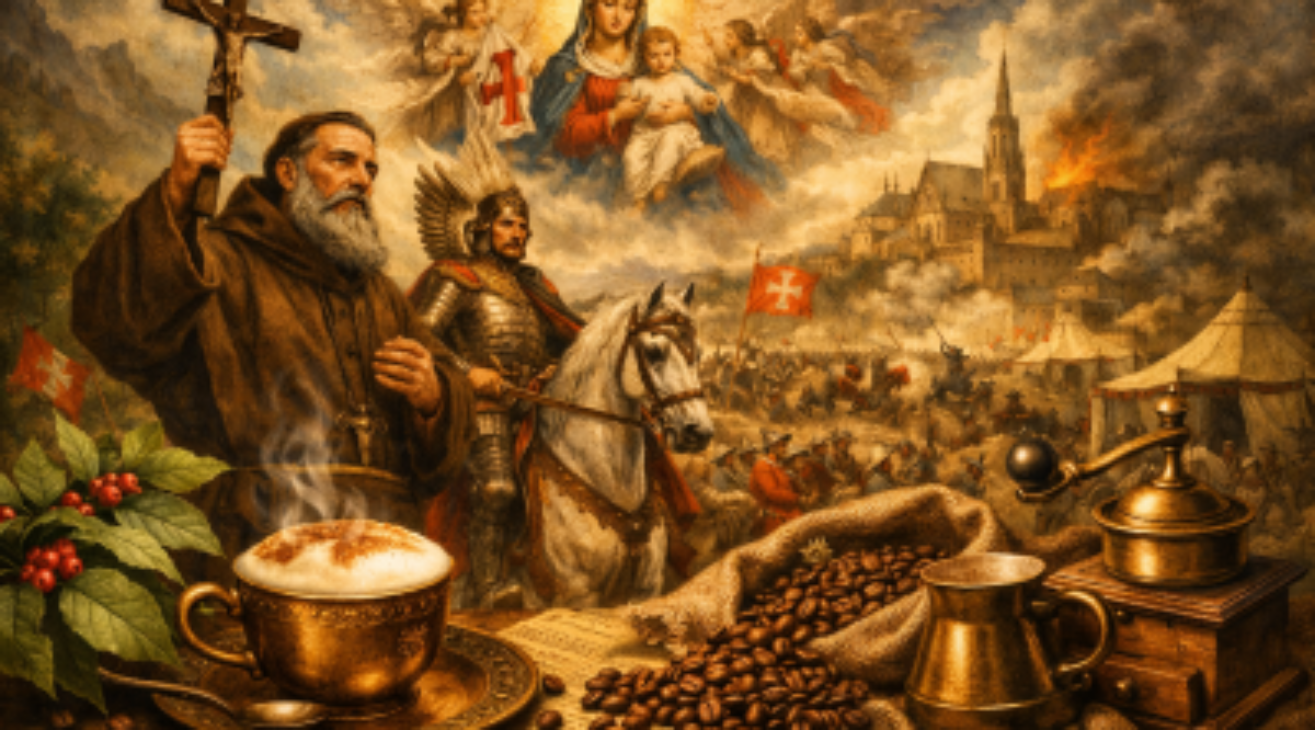
At the heart of the Christian defense stood Father Marco d’Aviano, a humble Capuchin friar whose courage and conviction would inspire kings and soldiers alike. Sent by Pope Innocent XI as a spiritual advisor, Father Marco became the soul of the Holy League — a coalition of Catholic forces led by King Jan III Sobieski of Poland. Before the battle, he celebrated Mass, heard confessions, and blessed the troops, urging them to fight not for conquest, but for the preservation of Christendom. His words, filled with faith and fire, echoed across the camp: “God wills it — and with His help, victory shall be ours.”
The Miracle at Vienna
On September 12, 1683, the Christian army charged down the hills toward the besieged city. Sobieski’s cavalry — the legendary Winged Hussars — smashed through Ottoman lines in one of the largest cavalry charges in history. By evening, the siege was broken, and Vienna was saved. Father Marco d’Aviano led prayers of thanksgiving, giving glory to God and the Blessed Virgin Mary for the victory. The triumph was seen not merely as a military success, but as divine intervention — a moment when faith had turned the tide of history.
Coffee and the Capuchin Legacy
When the Ottoman forces fled, they left behind sacks of strange, dark beans. The Viennese, unfamiliar with coffee, were puzzled. A Polish officer, Jerzy Franciszek Kulczycki, who had lived among the Turks, recognized the beans and began brewing them. Yet the bitter taste was too harsh for local palates. To soften it, he added milk and honey — creating a smoother, more balanced drink that quickly became popular in Vienna’s coffeehouses.
The new beverage’s warm brown color reminded the Viennese of the robes worn by the Capuchin friars, whose courage and prayers had guided the victory. In tribute, they named the drink “Kapuziner” — later Italianized as “cappuccino.” Thus, the cappuccino became not just a culinary creation, but a symbol of Catholic triumph and gratitude — a humble nod to the friars whose faith had fortified Europe.
Father Marco’s Enduring Influence
Father Marco d’Aviano continued his ministry after the battle, serving as a peacemaker and counselor to emperors. His holiness and humility earned him deep respect across Europe. In 2003, Pope John Paul II beatified him, recognizing his life of heroic virtue and his role in defending the faith during one of its darkest hours.
Today, every cup of cappuccino carries a trace of that history — a blend of courage, devotion, and culture. It is a drink born from victory, sanctified by faith, and named for the friars who stood firm when the world trembled.
A Toast to Faith and Heritage
The story of Father Marco d’Aviano reminds us that faith can move nations, and even the simplest pleasures — like a morning cup of coffee — can carry centuries of meaning. The cappuccino is more than foam and espresso; it is a quiet tribute to the Catholic spirit that defended Vienna, preserved Europe, and gave the world a taste of grace.
Sources:
- John Stoye, The Siege of Vienna: The Last Great Trial Between Cross and Crescent, 2000.
- Vatican Archives, Beatification of Marco d’Aviano, 2003.
- Mark Pendergrast, Uncommon Grounds: The History of Coffee and How It Transformed Our World, 2010.
- National Coffee Association, “Coffee History Overview.”
- Capuchin Order Historical Records, Rome.