
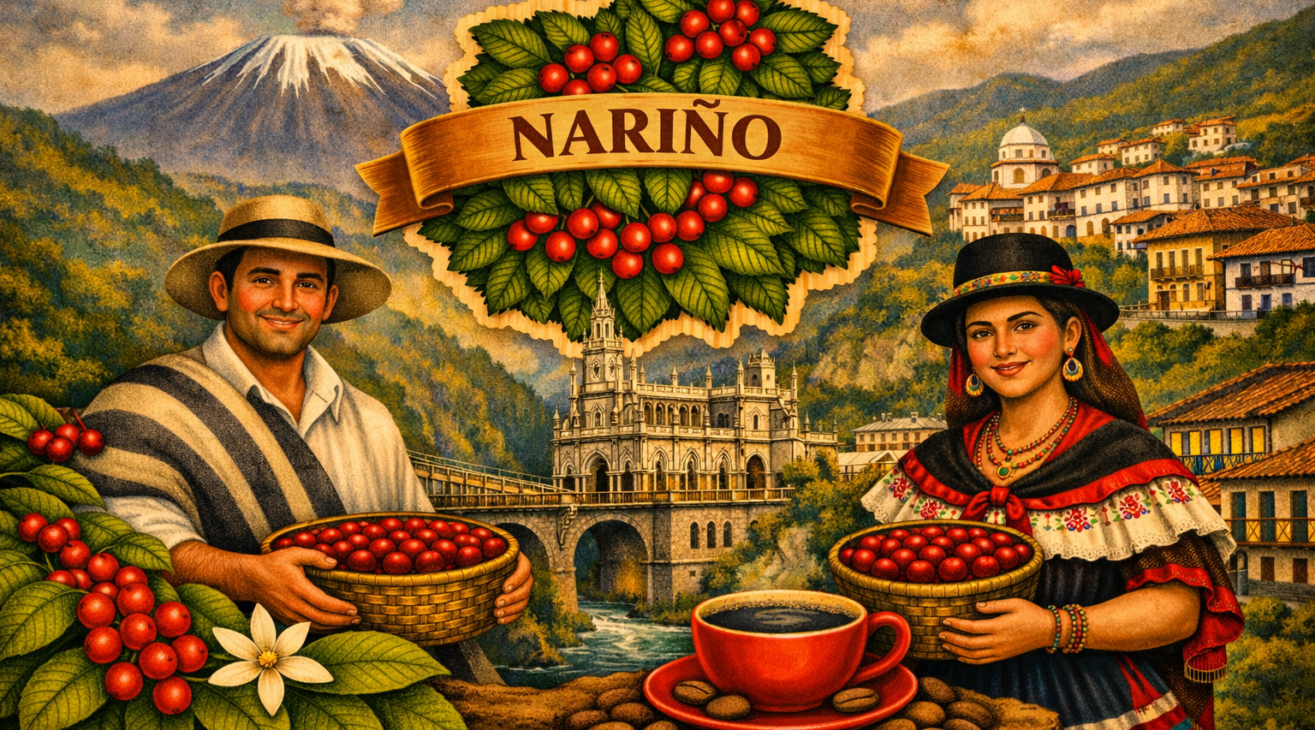
Narino
Region 02 of 13
Southern Zone
Nariño
High-Altitude Excellence on Volcanic Slopes — Where Colombia Meets Ecuador
Overview
Nariño grows coffee at elevations between 1,500 and 2,300 meters — among the highest coffee-growing altitudes in all of Colombia and among the highest in the world for commercial Arabica cultivation. Situated in Colombia’s southwestern corner against the Ecuadorian border, this remote and rugged department produces coffees of extraordinary clarity, brightness, and sweetness. The active stratovolcano Galeras towers over the landscape, enriching its slopes with mineral-laden ash soils. Dramatic diurnal temperature swings — warm days driven by warm Caribbean air currents from the north, cool nights from Andean altitude — slow the maturation of coffee cherries, concentrating sugars and building exceptional complexity.
Coffee History
Coffee cultivation in Nariño was pioneered by the region’s indigenous communities — the Quillacingas, Pastos, and Awa peoples — who integrated coffee into existing agroforestry systems alongside traditional crops. The extreme altitude and steep volcanic terrain that deterred large-scale commercial agriculture paradoxically preserved small-farm culture. The Quillacingas in particular cultivated terraces along the Galeras volcanic slopes, developing farming practices adapted to intense UV radiation, thin air, and dramatically variable microclimates. Commercial coffee exports from Nariño expanded significantly in the late 20th century as the FNC improved road infrastructure and organized producer associations. The region’s international profile exploded in the 2000s when Nordic roasters — prizing its extraordinary acidity and brightness — began competing with U.S. specialty buyers for its limited production.
Climate & Geography
| Altitude | 1,500 – 2,300 m above sea level (among Colombia’s highest) |
| Temperature | 12°C – 18°C (53°F – 64°F); extreme diurnal variation |
| Rainfall | 1,800 – 2,200 mm/year; bimodal |
| Soil | Volcanic ash loam from Galeras; mineral-rich, well-draining |
| Harvest seasons | Main: November – February; Mitaca: May – July |
| Key municipalities | Buesaco, La Unión, Belén, El Tablón, Sandoná, Consacá |
| Capital | Pasto (2,527 m) — one of Colombia’s highest-altitude capitals |
Galeras volcano, rising to 4,276 m and considered one of South America’s most active stratovolcanoes, is the defining geographic feature of Nariño’s coffee landscape. Its periodic ashfall continuously enriches soils with phosphorus, potassium, and trace minerals that contribute to the region’s distinctive cup character. The Andean Massif here is compressed and steep — smallholder farms often occupy terraced slopes where mechanization is impossible, requiring complete hand-harvest. Warm air currents from the Pacific and Caribbean coasts prevent frost despite extraordinary altitude, allowing Arabica to thrive where cold would otherwise make cultivation impossible.
Coffee Varieties
- Typica — Heirloom variety; wide genetic diversity; produces exceptional cup quality at these altitudes
- Caturra — Compact Bourbon mutation; well-adapted to steep terrain; excellent brightness
- Castillo — FNC rust-resistant hybrid; increasingly common in newer plantings
The extreme altitude and volcanic soils of Nariño express themselves most clearly through Typica, whose genetic diversity and thin-walled cherry produce the luminous acidity for which the region is renowned. Caturra at 2,000+ meters achieves a balance of sweetness and structure rarely found at lower elevations. The region remains predominantly washed-process, with the clean water from Andean streams historically facilitating traditional wet-milling infrastructure.
Major Farms & Collectives
- ASPRONAR (Asociación de Productores de Café de Nariño) — Regional producer association coordinating quality standards, export logistics, and technical support for hundreds of smallholder members
- Indigenous community farms — Buesaco — Quillacinga-heritage farms at 2,100–2,300 m; some of the world’s highest commercial coffee plots
- Indigenous community farms — La Unión and Belén — Pasto and Awa community farms; often shade-grown under native forest canopy
- Cooperativa de Caficultores de Nariño — FNC-affiliated departmental cooperative; manages wet mills and export protocols
Notable Associated Brands
- Blue Bottle Coffee (Oakland, CA) — Features Nariño as a flagship single-origin; has published detailed producer stories
- Verve Coffee Roasters (Santa Cruz, CA) — Sources Nariño for filter and espresso offerings
- Intelligentsia Coffee (Chicago, IL) — Long-standing Nariño direct-trade relationships
- Nordic specialty roasters — Multiple Swedish, Norwegian, and Danish roasters (Tim Wendelboe, Koppi, April Coffee) actively source Nariño for its brightness
Flavor Profile
Tasting Notes — Nariño
Primary notes: Vibrant citrus (bergamot, lime, tangerine), red berries (raspberry, red currant)
Secondary notes: Rich dark chocolate, warm nuttiness, panela, honey
Body: Smooth, velvety, medium-full
Acidity: Bright, clean, intensely citric; the defining characteristic
Finish: Long, sweet, clean
Processing: Washed (dominant); some natural microlots emerging
Characteristic: The ultra-high altitude produces one of the most vibrant yet balanced cups in Colombia
Photo
Sources: Nawalee Coffee; Coffee Geography Magazine; Orange Brown Imports; Blue Bottle Coffee origin notes; FNC Departmental Coffee Profiles.