Huila
Region 01 of 13
Southern Zone
Huila
The Specialty Crown of Colombia — Denomination of Origin, 2013
Overview
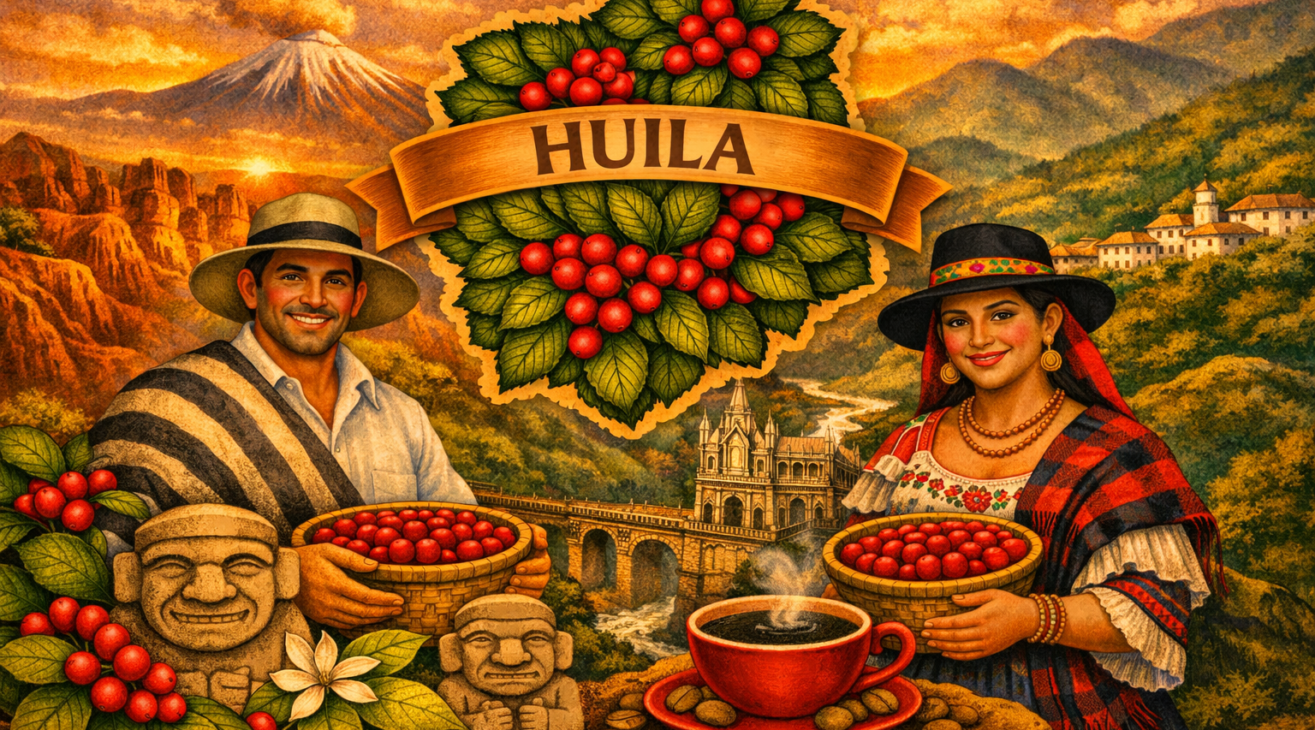
Huila is Colombia’s most celebrated specialty coffee origin and, by many measures, the most recognized Colombian terroir on the global specialty market. Situated in the southwestern Andes where the Magdalena River Valley meets the Andean Massif, the department’s extraordinary altitude range, dual harvests, and culture of quality-focused smallholder farming have produced a consistent stream of award-winning microlots. Over 83,000 families cultivate coffee across its landscapes, from Pitalito’s renowned sub-region — widely known as the “Coffee Capital of Huila” — to the archaeologically rich surroundings of San Agustín and the remote heights of Acevedo. Huila earned Colombia’s first-ever Denomination of Origin for coffee in 2013, a legal recognition of its unique geographic identity.
Coffee History
Coffee arrived in Huila in the late 19th century, carried south by paisa migrants and Franciscan missionaries following the Magdalena River corridor. The department’s rugged geography — deep ravines, steep slopes, limited road access — paradoxically preserved a culture of meticulous hand-cultivation and selective cherry picking long after industrialization reshaped flatter regions. By the 1980s, Huila was already identified by the Federación Nacional de Cafeteros (FNC) as a priority zone for quality upgrading. The third-wave specialty revolution of the 2000s and 2010s brought international roasters directly to Huila’s farms, creating direct-trade relationships that fundamentally changed the economics for local producers. The 2013 Denomination of Origin designation — modeled on European appellation systems — legally codified Café del Huila as a geographically protected product, reinforcing international recognition.
Climate & Geography
| Altitude | 1,200 – 2,200 m above sea level |
| Temperature | 14°C – 22°C (57°F – 72°F) |
| Rainfall | 1,500 – 2,500 mm/year; bimodal distribution |
| Soil | Volcanic loam and clay loam; high organic matter |
| Harvest seasons | Main: October – January; Mitaca: April – June |
| Key sub-regions | Pitalito, San Agustín, Acevedo, La Argentina, Palestina |
| Designations | Denomination of Origin: Café del Huila (2013) |
Huila sits at the junction of three mountain ranges — the western, central, and eastern branches of the Andes — creating a mosaic of microclimates. The Magdalena River originates in the southern highlands of the department, and its upper valley provides warm air drainage that moderates temperatures at high elevation. The bimodal rainfall pattern delivers consistent cherry development without the waterlogging risks of single-season rainfall regions. Volcanic and clay-rich soils retain moisture while draining excess water rapidly, contributing to the department’s characteristically clean, bright cup profile.
Coffee Varieties
- Castillo — FNC-developed rust-resistant hybrid; dominates production volume
- Caturra — High-yielding Bourbon dwarf mutation; prized for brightness
- Tabi — FNC hybrid of Typica, Bourbon, and Timor; tall, large-beaned, complex
- Bourbon — Heirloom variety; microlot producers grow for nuance and sweetness
- Gesha (Geisha) — Rare microlots; grown at premium altitudes for competitions and direct trade
- Colombia variety — FNC rust-resistant hybrid used in transitional farms
Huila’s altitude range supports a spectrum from high-volume Castillo production at lower elevations to precious Gesha and Bourbon microlots above 1,800 m. Producers at the highest altitudes — particularly in Acevedo and San Agustín — have increasingly experimented with exotic varieties and anaerobic fermentation processing to access premium competition markets.
Major Farms & Collectives
- Finca Costa Rica — Santa María municipality; owned by Faver Ninco Borbon and family; 10 hectares at 2,005 m; known for precise washed and natural-process microlots scored above 87 SCA
- COSURCO (Cooperativa del Sur de Colombia) — Large regional cooperative aggregating hundreds of smallholder lots; exporter and quality-control hub
- APROCASUR — Association of coffee producers in southern Huila; specialty-focused; direct-trade partner with U.S. roasters
- Amurcafé — Women-led cooperative with farms across Pitalito and San Agustín; recognized for gender equity in coffee supply chains
- Cuatro Vientos Siete Soles Drying Complex, Acevedo — Centralized raised-bed drying infrastructure shared by cooperative members; enables consistent natural and honey processing
Notable Associated Brands
- Intelligentsia Coffee (Chicago, IL) — One of the earliest direct-trade buyers in Huila; long-term relationships with multiple farms
- Counter Culture Coffee (Durham, NC) — Deep-rooted Huila sourcing; annual Sustainability Report cites Huila prominently
- Onyx Coffee Lab (Rogers, AR) — Regularly features Huila microlots as competition and filter offerings
- Stumptown Coffee Roasters (Portland, OR) — Huila among its cornerstone Colombian origins
- George Howell Coffee (Acton, MA) — Sources high-altitude Huila lots; published detailed farm profiles
Flavor Profile
Tasting Notes — Café del Huila
Primary notes: Citrus (lemon, orange zest), ripe cherry, red apple, jasmine, rose
Secondary notes: Caramel, brown sugar, panela, dark chocolate
Body: Medium; clean and well-structured
Acidity: Bright, vibrant, malic and citric
Finish: Long, clean, sweet
Processing: Washed (dominant); natural and honey processing emerging in microlots
SCA scores: Specialty lots routinely 84–90+; competition Gesha lots above 90
Photo
Sources: Acquired Coffee; Marca País Colombia; Cafe Colombian Roast; Federación Nacional de Cafeteros (FNC); Onyx Coffee Lab origin notes; Counter Culture Coffee Sustainability Report.