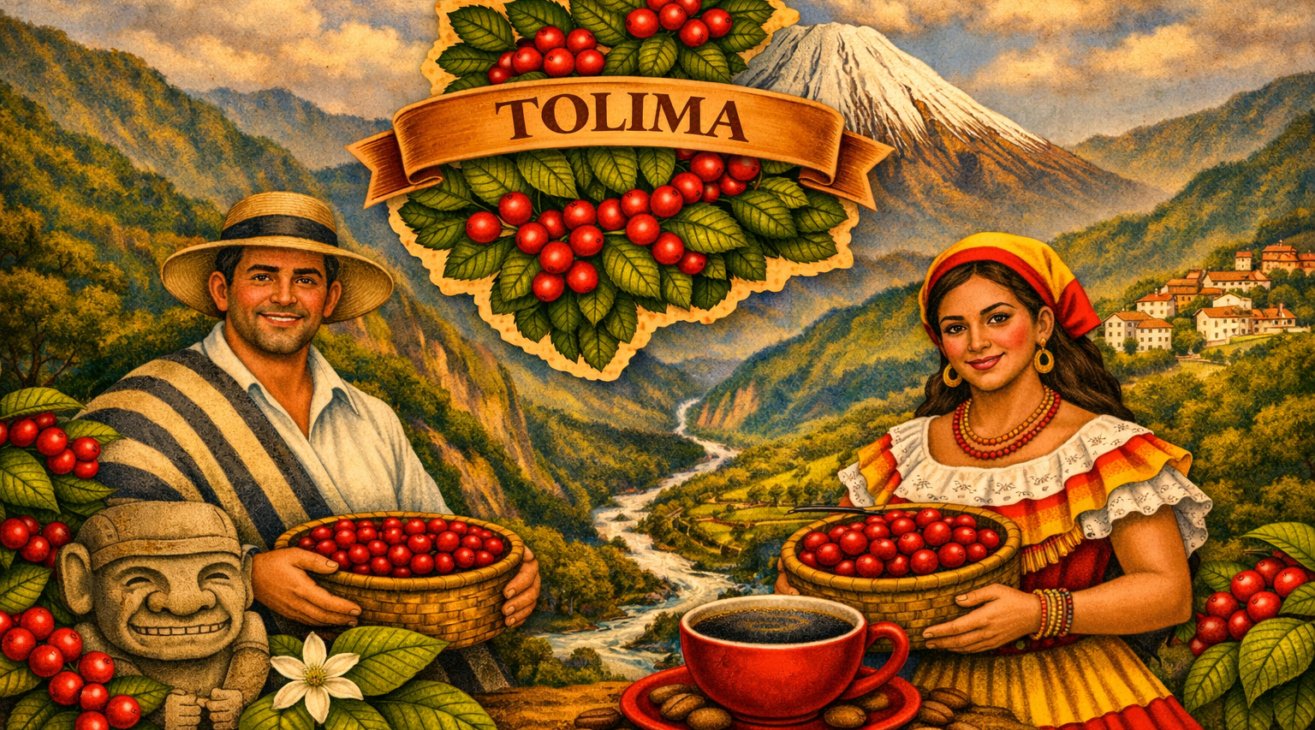
Tolima
REGION 04 OF 13
| Central Zone |
Tolima
Peace, Organics, and Layered Complexity — Reclaimed from Conflict
OVERVIEW
Tolima is Colombia’s most remarkable story of agricultural resilience. For decades, FARC occupation kept the department’s coffee-growing zones in the central Andes effectively isolated from global markets — a hardship that produced an unintended agricultural miracle. With external trade blocked and chemical inputs unavailable, Tolima’s soils remained virtually free of synthetic agrochemicals, making organic certification not only achievable but natural. When two successive peace processes reopened the region — partially in 2012 and more comprehensively in 2016 — international buyers and specialty roasters arrived to find pristine high-altitude farms producing complex, layered coffees of extraordinary character. Tolima now holds a Denomination of Origin designation and is recognized as one of Colombia’s most exciting emerging specialty origins.
COFFEE HISTORY
Coffee cultivation in Tolima dates to the 19th century, spread by settlers moving south along the Central Andes from Antioquia and Cundinamarca. The municipality of Planadas, in the far south of the department, became the earliest organized coffee zone and remains the most celebrated today. Through the mid-20th century, Tolima produced significant volumes that contributed to Colombia’s national coffee export totals. The outbreak of intense FARC activity in the 1980s and 1990s disrupted supply chains, forced displacement of producers, and made parts of the department inaccessible to commercial buyers. Remarkably, the communities that remained continued farming — their isolation preserving both organic soil quality and traditional cultivation techniques. Sustainable Harvest, a U.S.-based specialty importer, was among the first buyers to establish formal direct-trade relationships with Tolima cooperatives after 2012, helping producers bridge the gap to specialty markets.
CLIMATE & GEOGRAPHY
| Altitude | 1,200 – 2,000 m above sea level |
| Temperature | 16°C – 22°C (61°F – 72°F) |
| Rainfall | 1,500 – 2,200 mm/year; bimodal |
| Soil | Volcanic loam and clay; largely free of synthetic agrochemical residues |
| Harvest seasons | Main: October – January; Mitaca: April – June |
| Key municipalities | Planadas, Chaparral, Ataco, Rioblanco, Herrera, San Antonio |
| Coffee municipalities | 38 municipalities recognized for coffee production |
| Designations | Denomination of Origin: Café del Tolima |
Tolima’s coffee grows on the steep western and eastern flanks of the Central Andes, in heavily forested terrain where shade-grown cultivation is the norm rather than the exception. The forests — preserved partly because conflict limited deforestation — provide natural shade, habitat for migratory birds, and a closed-canopy microclimate that extends cherry maturation periods and deepens flavor complexity. The department’s position south of the main Eje Cafetero creates slightly cooler, drier conditions than Antioquia or Caldas, contributing to higher acidity and more pronounced fruit character.
COFFEE VARIETIES
- Castillo — Most prevalent; rust-resistant and productive at these altitudes
- Typica — Heirloom variety; found in oldest farms in Planadas; exceptional cup quality
- Bourbon — Heirloom; small but significant microlot production in premium programs
- Maracaturra — Bourbon × Maragogype hybrid; large-bean; complex profile; prized by specialty buyers
- Colombia variety — FNC hybrid; widely distributed through replanting programs
Many Tolima farms hold organic certification — both because of historical agrochemical absence and active certification efforts by cooperatives like ASOPEP. Organic premiums have been transformative for producer incomes in the post-conflict recovery period.
MAJOR FARMS & COLLECTIVES
- ASOPEP (Asociación de Productores Ecológicos de Planadas) — Organic-certified cooperative in Planadas; one of the most-featured Tolima producer groups in the specialty press
- APCO (Asociación de Productores de Café Orgánico) — Regional organic coffee association with members across southern Tolima
- Sustainable Harvest partner farms — A network of farms contracted through U.S. importer Sustainable Harvest (since 2015); subject of published case studies on post-conflict agriculture
- Indigenous and Afro-descendant smallholder groups — Pijao and Nasa communities in remote municipalities; increasingly organized for specialty access
NOTABLE ASSOCIATED BRANDS
- Sustainable Harvest (Portland, OR) — Pioneering importer-partner in post-conflict Tolima; publishes detailed traceability data
- Ritual Coffee Roasters (San Francisco, CA) — Features Tolima as a cornerstone single-origin
- Passenger Coffee (Lancaster, PA) — Sources Tolima for its complex, fruit-forward character
FLAVOR PROFILE
| Tasting Notes — Tolima Primary notes: Dark cocoa, plum, dried stone fruit (apricot, prune) Secondary notes: Mild spice (clove, cinnamon), panela, caramel sweetness Body: Rounded, medium-full; silky texture Acidity: Measured, soft, malic Finish: Long, layered, complex Processing: Washed and certified organic; some honey processing Distinction: The cocoa-plum-spice combination with organic depth is unlike any other Colombian region |
PHOTO

Coffee dries on raised beds at the Cuatro Vientos Siete Soles drying complex, Acevedo, Colombia — representative of the precision post-harvest infrastructure now defining Colombia’s specialty central-southern zones. Photo: Thomas O’Neill / NurPhoto via Getty Images, June 24, 2025.
Sources: Coffea Alchemy; Sustainable Harvest impact reports; Nawalee Coffee; FNC; Ritual Coffee Roasters origin notes.