
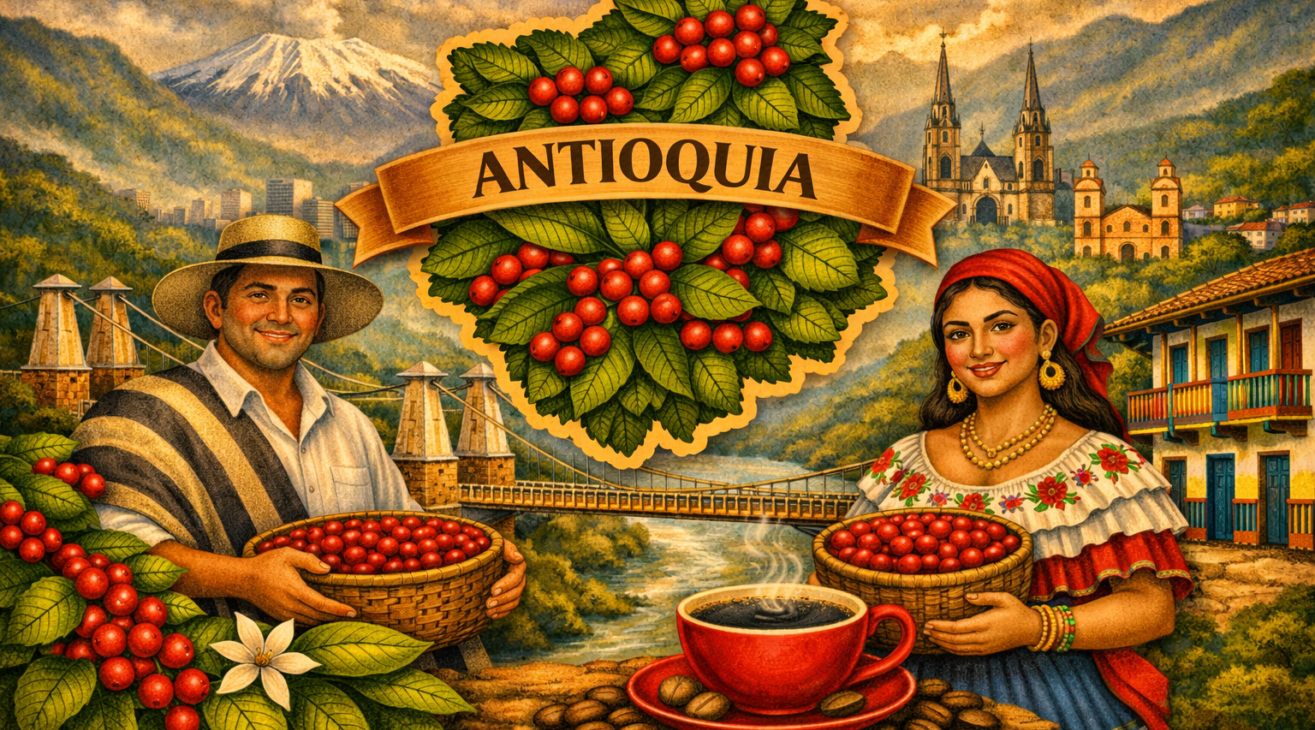
Antioquia
Region 05 of 13
Central Zone
Antioquia
The Historic Heartland — The Region That Defined Colombian Coffee
Overview
Antioquia is the foundational region of Colombian coffee culture — the birthplace of the paisa coffee identity, the wellspring of the great colonial coffee migrations that created the Eje Cafetero, and the model for the iconic Juan Valdez figure that became Colombia’s global coffee brand. With approximately 120,000 farming families working over 130,000 hectares of coffee, Antioquia is Colombia’s largest producing department by farm count. Its capital Medellín — known as the “City of Eternal Spring” for its year-round temperate climate — has emerged as a world-class coffee city, home to Pergamino Café, one of Latin America’s most acclaimed specialty roasters and cafés. The region spans everything from mass-production cooperatives supplying the commodity market to single-farm microlots competing in international Cup of Excellence competitions.
Coffee History
Coffee arrived in Antioquia through Jesuit missionaries in the late 18th and early 19th centuries, but its explosive expansion came through the massive paisa colonization movement of the 19th century — one of Latin America’s most significant internal migrations. Paisa settlers from Antioquia pushed south and southwest into what are now Caldas, Risaralda, Quindío, and northern Valle del Cauca, establishing the coffee culture of the entire Eje Cafetero region. By the 1880s, Antioquia was already Colombia’s leading coffee department, and its commercial networks in Medellín provided the financial infrastructure for the coffee export industry. The Federación Nacional de Cafeteros, founded in 1927, was shaped heavily by Antioquia’s producer class. The Juan Valdez advertising campaign — launched in the 1950s by the FNC — deliberately modeled its iconic farmer figure on the archetypal paisa coffee grower of Antioquia, embedding the region’s identity into Colombia’s global brand for decades.
Climate & Geography
| Altitude | 1,400 – 2,100 m above sea level |
| Temperature | 15°C – 22°C (59°F – 72°F) |
| Rainfall | 1,800 – 2,600 mm/year; bimodal |
| Soil | Volcanic loam; clay-rich Andean soils with high organic matter |
| Harvest seasons | Main: October – January; Mitaca: April – June |
| Key sub-regions | Jardín, Andes, Urrao, Santa Bárbara, Concordia, Fredonia, Támesis |
| Capital | Medellín (1,495 m) — “City of Eternal Spring” |
The sub-region of Jardín — a remarkably preserved colonial town in southwestern Antioquia — has become a pilgrimage destination for specialty coffee buyers. Its combination of old-growth shade trees, pristine water sources, and multi-generational farming families produces microlots with exceptional sweetness and complexity. The municipalities of Andes and Concordia, at slightly lower altitudes, produce the volume backbone of Antioquia’s coffee economy.
Coffee Varieties
- Caturra — Dominant variety; synonymous with classic Colombian cup character
- Castillo — FNC hybrid; increasingly prevalent since rust epidemic of early 2010s
- Colombia variety — FNC rust-resistant hybrid; widely distributed
- Bourbon — Heirloom; specialty microlots in Jardín and Santa Bárbara
- Tabi — FNC hybrid; large-beaned; nuanced profile; growing in specialty programs
Major Farms & Collectives
- Cooperativa de Caficultores de Antioquia — One of Colombia’s largest producer cooperatives; aggregates thousands of smallholder lots across the department
- FNC cooperatives — Multiple FNC-affiliated cooperatives in Andes, Concordia, and Fredonia municipalities
- Specialty fincas in Jardín — Dozens of individually owned micro-farms pursuing direct-trade export; many operated by younger-generation producers
- Pergamino Café (Medellín) — Founded by Australians and Colombians; celebrated urban specialty roaster and sourcing hub; direct relationships with Antioquia producers
Notable Associated Brands
- Juan Valdez / FNC — The original Antioquia brand; global café chain and export brand
- Pergamino Café — Medellín-based specialty roaster; internationally recognized; ships internationally
- Intelligentsia Coffee — Sources Jardín microlots; published detailed producer profiles
- Counter Culture Coffee — Long-standing Antioquia relationships; Jardín micro-lot features
Flavor Profile
Tasting Notes — Antioquia
Primary notes: Chocolate (milk and dark), hazelnut, toasted almonds
Secondary notes: Mild citrus (orange, lemon), panela sweetness, brown sugar
Body: Medium; smooth, rounded
Acidity: Soft, gentle, approachable — the most accessible acidity in Colombia
Finish: Clean, sweet, warm
Processing: Washed (dominant)
Distinction: The classic, benchmark Colombian cup profile — consistently approachable, reliably sweet, universally enjoyed
Photo
Sources: Nawalee Coffee; The Coffee Routes (thecoffeeroutes.com); ExpertCafe; Barista Hustle; FNC; Pergamino Café.