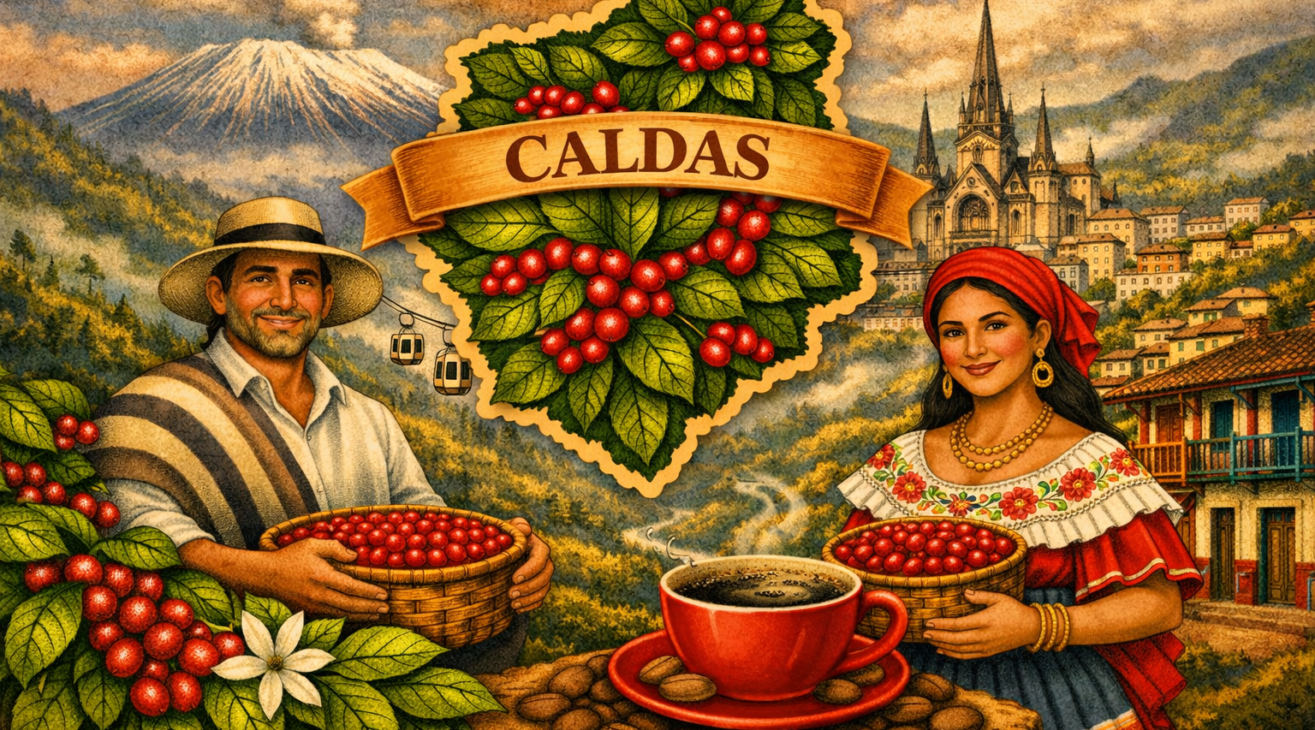
Caldas
Region 06 of 13
Central Zone — Eje Cafetero
Caldas
Anchor of the UNESCO Coffee Triangle — Where Colombian Coffee Culture Was Codified
Overview
Caldas anchors the northern point of the UNESCO Coffee Cultural Landscape of Colombia — a World Heritage designation awarded in 2011 to the coffee-growing landscapes of Caldas, Risaralda, Quindío, and northern Valle del Cauca. The department’s capital Manizales, perched at 2,153 meters in the Central Andes, became one of Colombia’s most important coffee export hubs in the late 19th and early 20th centuries, connected to Atlantic ports by aerial cable cars and mountain roads that were engineering marvels of their era. The Federación Nacional de Cafeteros, founded in 1927, has deep institutional roots in Caldas, whose producer class was instrumental in establishing the national organization. Caldas produces the benchmark “balanced Colombian cup” — the profile most associated with Colombian coffee worldwide.
Coffee History
Coffee arrived in Caldas through the paisa colonization of the 19th century — the great southward migration of Antioqueño settlers who pushed into the rugged Andean ranges and established small-farm coffee culture as the economic backbone of their new communities. By 1870, coffee was established in the fertile slopes around Manizales. The opening of the Ferrocarril de Caldas railway in the early 20th century — combined with the remarkable aerial cable car (cable aéreo) that transported coffee sacks over the Andes to the Magdalena River — transformed Caldas into a coffee export powerhouse. Manizales’s Bolsa Nacional Agropecuaria (National Agricultural Exchange) became a key price-setting institution for Colombian coffee. The 2011 UNESCO World Heritage designation recognized the cultural landscape that paisa settlers created — its bamboo-framed fincas, wax palm forests, and multigenerational coffee farming communities — as an outstanding example of living cultural heritage.
Climate & Geography
| Altitude | 1,200 – 1,800 m above sea level |
| Temperature | 14°C – 24°C (57°F – 75°F); “Andean Rainforest” climate |
| Rainfall | 2,000 – 3,000 mm/year; bimodal; high cloud cover |
| Soil | Volcanic loam; volcanic ash from Nevado del Ruiz and Santa Isabel |
| Harvest seasons | Main: October – January; Mitaca: April – June |
| Key municipalities | Salamina, Aguadas, Filadelfia, Pácora, Neira, Villamaría |
| Capital | Manizales (2,153 m) — historic coffee export center |
| Designations | UNESCO Coffee Cultural Landscape (2011) — core department |
Coffee Varieties
- Caturra — Traditional dominant variety; the classic Caldas cup
- Castillo — FNC hybrid; widely replanted after coffee leaf rust (roya) epidemic
- Colombia variety — FNC rust-resistant hybrid; significant presence
- Bourbon — Heirloom; small-volume microlot production in heritage farms
Major Farms & Collectives
- Cooperativa de Caficultores de Manizales — One of Colombia’s oldest and largest producer cooperatives; manages export logistics for thousands of members
- FNC cooperatives — Salamina, Aguadas, Filadelfia — Departmental FNC-affiliated groups; quality-control and technical-support nodes
- Fincas in Valle de la Samaria — Smaller specialty operations; producing premium lots for direct-trade buyers
- Hacienda El Chocho (Villamaría) — Historic estate farm near Manizales; agritourism and specialty production
Notable Associated Brands
- Juan Valdez / FNC — Caldas is core FNC territory; the Juan Valdez brand is deeply rooted here
- Café de Colombia — The FNC’s umbrella origin brand, strongly associated with Caldas and the Eje Cafetero
- Specialty micro-lot exporters — Multiple smaller exporters operating from Manizales ship to U.S. and European specialty markets
Flavor Profile
Tasting Notes — Caldas
Primary notes: Balanced sweetness, roasted nuts (hazelnut, almond), caramel
Secondary notes: Mild stone fruit, brown sugar, gentle citrus
Body: Medium; smooth, even
Acidity: Moderate, clean, pleasant
Finish: Clean, sweet, consistent
Processing: Washed (nearly universal)
Distinction: The quintessential balanced Colombian cup — the profile most familiar to the global specialty consumer; reliable and crowd-pleasing
Photo
Sources: Wikipedia (Colombian coffee growing axis); Colombia Travel; FNC; UNESCO World Heritage documentation (2011); Cooperativa de Caficultores de Manizales.