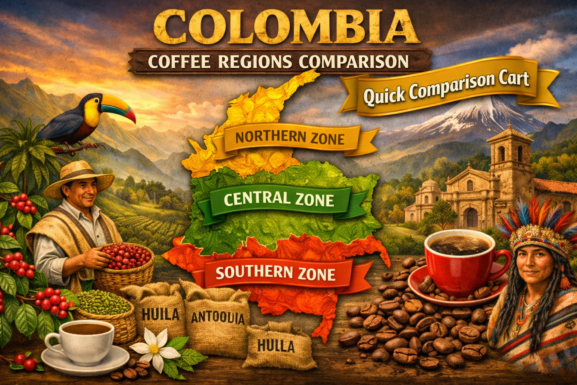
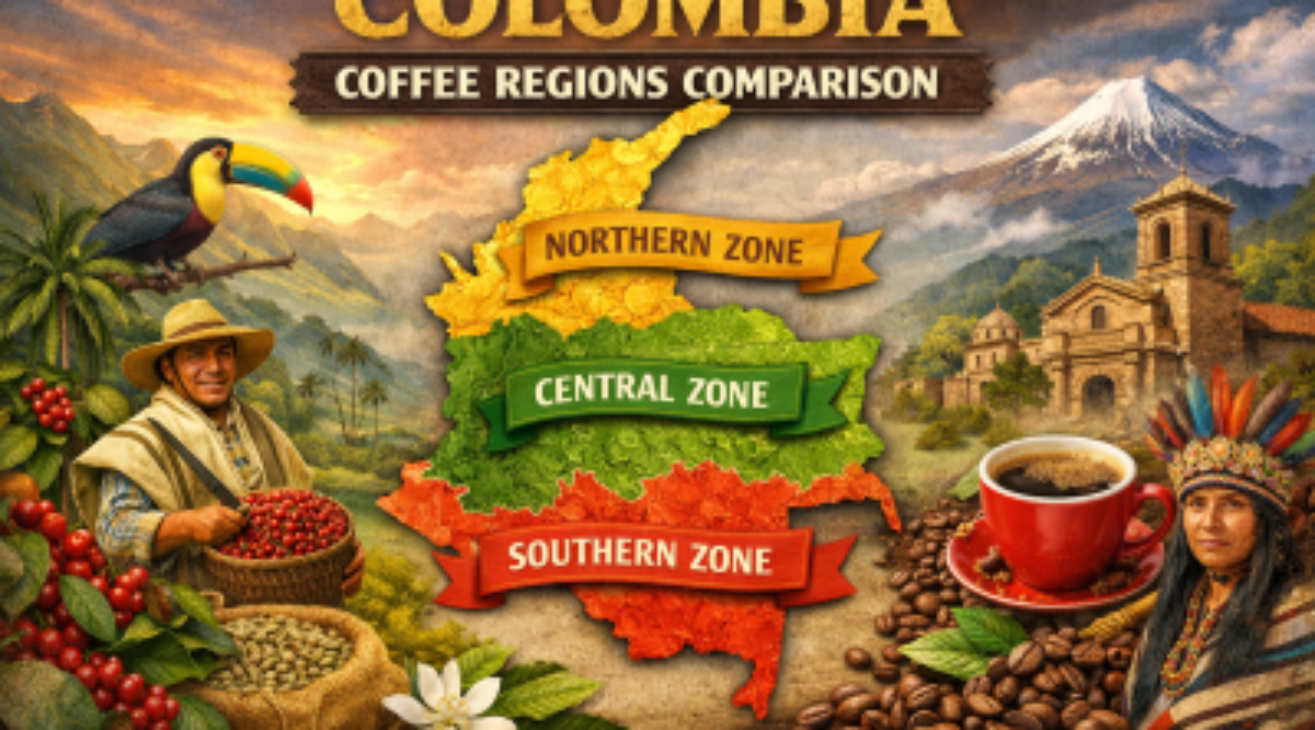
Coffee Regions Comparison
Comparative Quick Reference
All 13 Colombian coffee-growing regions compared across key parameters
| Region | Zone | Altitude (m) | Key Varieties | Flavor Notes | Processing | Harvest Season |
|---|---|---|---|---|---|---|
| Huila | Southern | 1,200 – 2,200 | Castillo, Caturra, Tabi, Bourbon, Gesha | Citrus, cherry, jasmine, caramel, brown sugar | Washed; natural & honey microlots | Oct–Jan (main); Apr–Jun (mitaca) |
| Nariño | Southern | 1,500 – 2,300 | Typica, Caturra, Castillo | Bergamot, red berries, dark chocolate, panela | Washed (dominant) | Nov–Feb (main); May–Jul (mitaca) |
| Cauca | Southern | 1,700 – 2,100 | Caturra, Castillo, Colombia, Bourbon | Jasmine, peach, apricot, citrus, honey | Washed; honey growing | Oct–Dec (main); Apr–Jun (mitaca) |
| Tolima | Central | 1,200 – 2,000 | Castillo, Typica, Bourbon, Maracaturra | Dark cocoa, plum, spice, panela, stone fruit | Washed, certified organic | Oct–Jan (main); Apr–Jun (mitaca) |
| Antioquia | Central | 1,400 – 2,100 | Caturra, Castillo, Colombia, Bourbon | Chocolate, hazelnut, citrus, panela | Washed | Oct–Jan (main); Apr–Jun (mitaca) |
| Caldas | Central / Eje Cafetero | 1,200 – 1,800 | Caturra, Castillo, Colombia | Balanced, nuts, caramel, mild fruit | Washed | Oct–Jan (main); Apr–Jun (mitaca) |
| Quindío | Central / Eje Cafetero | 1,200 – 1,800 | Caturra, Castillo, Colombia | Caramel, mild citrus, brown sugar, balanced | Washed | Oct–Jan (main); Apr–Jun (mitaca) |
| Risaralda | Central / Eje Cafetero | 1,200 – 1,800 | Caturra, Castillo, Colombia | Smooth caramel, mild citrus, toffee, balanced | Washed | Oct–Jan (main); Apr–Jun (mitaca) |
| Valle del Cauca | Central | 1,000 – 2,000 | Caturra, Castillo, Typica, Bourbon | Tropical fruit, bright citrus, chocolate | Washed; honey growing | Oct–Jan (main); Apr–Jun (mitaca) |
| Cundinamarca | Central | 900 – 2,200 | Caturra, Castillo, Typica, Colombia | Cocoa, caramel, mild citrus, red fruit | Washed | Oct–Dec (main); Apr–Jun (mitaca) |
| Santander | Northern | 1,300 – 1,800 | Caturra, Castillo, Typica | Dark chocolate, hazelnut, caramel, gentle citrus | Washed; honey & natural emerging | Oct–Jan (main); Mar–May (secondary) |
| Norte de Santander | Northern | 900 – 1,600 | Castillo, Tabi, Cenicafé 1, Typica, Caturra | Chocolate & citrus (washed); red fruits, wine (natural) | Washed; natural/anaerobic | Oct–Dec (main); Apr–May (mitaca) |
| Sierra Nevada / Magdalena | Northern | 900 – 1,600 | Typica (dominant), Caturra | Honey, malic acidity, jasmine, structured depth | Washed (traditional) | Nov–Mar (main); May–Aug (secondary) |
Glossary of Key Terms
Definitions of varieties, processes, organizations, and terms used throughout this guide
Agroforestry — A land-use system that integrates trees, shrubs, and crops within the same farming unit. In Colombian coffee, this typically means coffee plants grown under a canopy of shade trees such as guamo, avocado, plantain, and native forest species. Agroforestry systems provide biodiversity habitat, erosion control, microclimate regulation, and carbon sequestration — and are particularly prevalent in Santander and the Sierra Nevada.
Bourbon — An heirloom Arabica variety descended from Typica, originating on the island of Réunion (formerly Bourbon). It produces small, dense beans with complex sweetness and fruit notes. Bourbon is genetically susceptible to coffee leaf rust (roya) and typically lower-yielding than FNC hybrids, which is why it is restricted to premium microlot programs in Colombia. Flavor signature: stone fruit, caramel, complex sweetness.
Castillo — A rust-resistant Arabica hybrid developed by Cenicafé (the research center of the FNC) through crossing the Colombia variety with Caturra. Castillo was introduced commercially in 2005 and became the dominant Colombian coffee variety after the 2008–2012 coffee leaf rust epidemic. Well-adapted to a wide altitude range; when grown at high altitude with selective picking, produces specialty-quality cups. Multiple regional sub-varieties exist (Castillo El Rosario, Castillo Naranjal, etc.) adapted to specific terroirs.
Caturra — A natural mutation of Bourbon discovered in Brazil in the early 20th century. Compact, high-yielding, and well-adapted to steep Colombian terrain. Caturra was the dominant Colombian variety before Castillo’s introduction and remains prevalent in older farms across the Eje Cafetero and southern regions. Known for bright acidity and clean cup character; susceptible to coffee leaf rust without fungicide management.
Cenicafé 1 — The newest FNC-developed rust-resistant variety (released 2016), created from crossing multiple Arabica genetics with the Timor Hybrid. Shows improved cup quality over earlier FNC hybrids; increasingly adopted in Norte de Santander and other northern regions.
Denomination of Origin (DO) — A legal protection (equivalent to the European Union’s Appellation d’Origine Contrôlée / AOP system) that restricts use of a geographic name on coffee to producers within a defined region who meet specific quality and production standards. Colombia has awarded DOs to: Café del Huila (2013), Café de Nariño, Café de Cauca, Café del Tolima, and others. A DO is not merely a marketing tool — it carries legal enforcement power and verifiable quality requirements.
Eje Cafetero — Literally “Coffee Axis” or “Coffee Triangle.” The geographic and cultural term for the coffee-growing axis formed by the departments of Caldas, Risaralda, and Quindío in Colombia’s Central Andes. Settled through paisa migration in the 19th century, the Eje Cafetero became the cultural heartland of Colombian coffee. Its landscape was designated a UNESCO World Heritage Site in 2011 as the “Coffee Cultural Landscape of Colombia.”
FNC (Federación Nacional de Cafeteros de Colombia) — The National Federation of Coffee Growers of Colombia, founded in 1927. The FNC is a non-profit organization representing over 540,000 coffee-farming families. It operates Juan Valdez cafés and brand internationally, conducts coffee research through Cenicafé, manages Colombia’s Coffee Fund (Fondo Nacional del Café), provides extension services and technical support to producers, and negotiates international market conditions. The FNC is one of the most powerful and effective agricultural producer organizations in the world.
Gesha (Geisha) — An Arabica variety originally from the Gori Gesha forest in Ethiopia, first developed commercially in Panama (Hacienda La Esmeralda) in the early 2000s. Characterized by extraordinary floral complexity (jasmine, bergamot), stone fruit, and delicate citrus. Commands the highest prices in specialty coffee auctions worldwide. Grown in limited quantities as microlot production in Colombia’s highest-altitude zones, particularly Huila.
Honey Process — A post-harvest processing method in which the outer cherry skin is removed but some or all of the mucilage (the sticky sugar-rich layer surrounding the parchment) is left on the bean during drying. The more mucilage retained, the more body and sweetness in the cup. Honey processing is classified as Yellow Honey (less mucilage), Red Honey, or Black Honey (more mucilage, longer drying). Growing in Colombia, particularly in Valle del Cauca and Norte de Santander.
Mamos — The spiritual and community leaders of the Arhuaco, Kogui, Wiwa, and Kankuamo indigenous peoples of the Sierra Nevada de Santa Marta. Mamos hold ancestral ecological knowledge transmitted through oral tradition over centuries. They guide community agricultural decisions — including coffee farming — according to principles of ecological balance (el equilibrio) with Mother Earth. Their stewardship of the Sierra Nevada’s slopes is recognized as a key factor in the region’s ecological integrity.
Maracaturra — A hybrid variety resulting from a cross between Maragogype (an Ethiopian Typica mutation producing exceptionally large beans) and Caturra. Combines the large bean size of Maragogype with the productivity of Caturra; produces a complex, nuanced cup. Found in specialty microlot programs in Tolima.
Mitaca — The secondary coffee harvest season in Colombia’s bimodal-rainfall regions. While most countries have a single annual harvest, Colombia’s equatorial location and geographic variation produce two distinct flowering and fruiting cycles per year in most departments. The main harvest (cosecha) typically runs October–January; the mitaca (also called the “fly crop” or traviesa) runs approximately April–June. The mitaca is generally smaller in volume but can produce exceptional quality microlots.
Natural Process — The oldest coffee processing method, in which whole harvested coffee cherries are dried intact — fruit, mucilage, parchment, and seed together — on raised beds or patios under direct sun. The cherry’s sugars and fruit ferment into the bean over 3–6 weeks, producing coffees with intense fruit character, heavy body, and wine-like complexity. Emerging in Norte de Santander, Huila, and Cauca microlot programs; rare in Colombia’s traditionally washed-process culture.
Paisa — The cultural identity of the people of the Antioquia, Caldas, Risaralda, and Quindío region — descendants of the Basque, Spanish, and Sephardic Jewish settlers who colonized the Colombian Andes from the 17th century onward. Paisa culture is characterized by entrepreneurialism, strong regional identity, Catholic faith, and, most significantly for coffee, the tradition of smallholder family farming. The paisa colonization movement of the 19th century created the entire Eje Cafetero coffee landscape.
SCA Score — The 100-point quality evaluation score developed by the Specialty Coffee Association (SCA) to assess green and roasted coffee. Coffees scoring 80+ points are classified as “specialty coffee.” Scores of 84–86 represent “very good” specialty; 87–89 “excellent specialty”; 90+ “outstanding” (rare). SCA cupping protocols evaluate fragrance/aroma, flavor, aftertaste, acidity, body, balance, uniformity, clean cup, sweetness, and overall impression. Colombian competition lots regularly score 86–92+.
Specialty Coffee — Coffee that scores 80 or above on the SCA 100-point scale, produced with traceable provenance from identified farms or cooperatives, and marketed based on quality and origin characteristics rather than commodity price. Specialty coffee represents approximately 15% of global coffee volume but commands prices 2–10× above commodity rates. Colombia’s specialty sector has grown dramatically since 2005 and now includes hundreds of microlot producers across all 13 regions profiled in this guide.
Tabi — An FNC-developed Arabica variety created by crossing Typica, Bourbon, and Timor Hybrid. “Tabi” means “good” in the Guambiano indigenous language. Tabi is characterized by large beans (requiring longer roast times), disease resistance, and exceptional cup quality at altitude — a combination of the nuance of Typica/Bourbon genetics with practical rust resistance. Grown in Huila and Norte de Santander for premium specialty programs.
Typica — The oldest and most genetically diverse Arabica variety in the Americas, descending from the original Arabica plants brought from Yemen to India and then to the New World via Amsterdam’s botanical gardens in the 17th–18th centuries. Typica is tall-growing, low-yielding, and highly susceptible to coffee leaf rust, which is why it has been largely replaced by FNC hybrids across most of Colombia. It survives in its most pristine and genetically diverse form in geographically isolated regions — particularly the Sierra Nevada de Santa Marta and the oldest farms of Norte de Santander. Flavor signature: clean, delicate, complex; malic acidity; exceptional clarity.
Washed / Wet Process — The dominant coffee processing method in Colombia and the basis for Colombia’s reputation for “clean cup” character. In the washed process, coffee cherries are depulped (skin removed) immediately after harvest, then fermented in water tanks for 12–48 hours to break down the mucilage, then washed with fresh water and sun-dried on raised beds or patios. The process produces coffees with high clarity, bright acidity, and well-defined terroir expression — the characteristics most associated with Colombian coffee internationally.
Bibliography
All sources cited in this guide, listed alphabetically by organization or author. Accessed June 2026 unless otherwise noted.
Acquired Coffee. “Huila, Colombia: Origin Profile.” Acquired Coffee Origins. acquiredcoffee.com.
AFP / Getty Images. “An Arhuaco Indigenous Person Dries Coffee at the Sierra Nevada de Santa Marta, Colombia, February 11, 2024.” Photograph. Raul Arboleda / AFP via Getty Images. gettyimages.com.
Algrano AG. “La Peligrosa Farm — Norte de Santander, Colombia.” Algrano Green Coffee Platform. algrano.com.
Algrano AG. “Santander Coffee Cluster — Regional Profile.” Algrano Origins. algrano.com.
Barista Hustle. “Colombian Coffee Regions: A Complete Guide.” baristahustle.com.
Blue Bottle Coffee. “Colombia Nariño — Single Origin Feature.” Blue Bottle Origins. bluebottlecoffee.com.
C8th.com. “Sierra Nevada de Santa Marta — Indigenous Coffee Origin.” c8th.com.
Cafe Colombian Roast. “Colombia’s 13 Coffee-Growing Regions — Department Profiles.” cafecolombiasroast.com.
Caffelleria News. “Norte de Santander: The Birthplace of Colombian Coffee.” caffelleria.com.
Cenicafé (Centro Nacional de Investigaciones de Café). “Variedades de Café en Colombia.” Cenicafé Technical Bulletins. federaciondecafeteros.org/cenicafe.
Coffea Alchemy. “Tolima, Colombia — Origin Review.” coffeaalchemy.com.
Coffee Geography Magazine. “Nariño: Colombia’s Highest Coffee.” coffeegeography.com.
Colombia My Way. “Quindío — Coffee Region Travel Guide.” colombiamyway.com.
Colombia Travel (ProColombia). “Coffee Cultural Landscape of Colombia — UNESCO Heritage.” colombia.travel.
Confederación Indígena Tayrona (CIT). “Arhuaco Coffee Production — Organizational Documentation.” Sierra Nevada de Santa Marta, Colombia.
Counter Culture Coffee. “Annual Sustainability Report.” Counter Culture Coffee Direct Trade. counterculturecoffee.com.
Crema.co. “Colombia Cundinamarca — Region Overview.” crema.co.
Federación Nacional de Cafeteros de Colombia (FNC). “Colombian Coffee Regions — Departmental Profiles.” federaciondecafeteros.org.
Fundación Pro-Sierra Nevada de Santa Marta. “Coffee and Conservation in the Sierra Nevada.” prosierra.org.
George Howell Coffee. “Colombia Huila — Farm Profiles.” georgehowellcoffee.com.
Intelligentsia Coffee. “Direct Trade: Colombia Huila.” intelligentsiacoffee.com.
Kazemi, Kaveh. “A Day at a Coffee Plantation — Pereira, Colombia.” Getty Images, January 14, 2014. gettyimages.com.
LATAM Coffee Trip. “Cauca, Colombia — Coffee Region Guide.” latamcoffeetrip.com.
Marca País Colombia (Colombia Country Brand). “Café de Colombia — Regional Denominations of Origin.” colombia.co.
Monserrate Nº1. “Norte de Santander Specialty Coffee — Micro-lot Program.” monserrate.coffee.
Nawalee Coffee. “Colombian Coffee Growing Regions — Comprehensive Profiles.” nawaleecoffee.com.
Nespresso. “AAA Sustainable Quality Program — Colombia Sierra Nevada.” nespresso.com/pro.
Nimmica Specialty Coffee Journal. “Sierra Nevada de Santa Marta: Sacred Coffee.” nimmica.com.
O’Neill, Thomas. “Colombian Coffee Production — Finca Costa Rica, Santa María, Huila.” NurPhoto via Getty Images, June 22–24, 2025. gettyimages.com.
Onyx Coffee Lab. “Colombia Huila Microlots — Origin Notes.” onyxcoffeelab.com.
Orange Brown Imports. “Nariño, Colombia — Green Coffee Origin Profile.” orangebrownimports.com.
Pergamino Café. “Direct Sourcing — Antioquia Producers.” pergaminocafe.com.
Ritual Coffee Roasters. “Colombia Tolima — Single Origin.” ritualcoffee.com.
Roasters Map. “Valle del Cauca — Coffee Region.” roastersmap.com.
Specialty Coffee Association (SCA). “SCA Cupping Protocols and Standards.” SCA Technical Standards. sca.coffee.
Stumptown Coffee Roasters. “Colombia Origins — Producer Stories.” stumptowncoffee.com.
Sustainable Harvest. “Colombia Tolima — Post-Conflict Coffee Origin.” sustainableharvest.com.
The Coffee Routes. “Jardín, Antioquia — Coffee Sub-Region Guide.” thecoffeeroutes.com.
Torres Hernandez, Natalia. “Valle de Cocora, Quindío — Wax Palm Sanctuary.” Anadolu Agency via Getty Images, June 5, 2019. gettyimages.com.
Torres, Juancho. “Coffee Fields, Eje Cafetero — Santa Rosa de Cabal.” Anadolu via Getty Images, October 27, 2023. gettyimages.com.
Trabocca BV. “Cauca — Cencoic Cooperative: Long-Term Partner Origin.” Trabocca Origin Reports. trabocca.com.
UNESCO. “Coffee Cultural Landscape of Colombia — World Heritage Documentation.” UNESCO World Heritage List. whc.unesco.org, 2011.
UNESCO. “Sierra Nevada de Santa Marta — Biosphere Reserve.” UNESCO Man and the Biosphere Programme. unesco.org, 1979.
Verve Coffee Roasters. “Colombia Nariño — Single Origin.” vervecoffee.com.
Wikipedia. “Colombian Coffee Growing Axis.” en.wikipedia.org/wiki/Colombian_coffee_growing_axis.
Wikipedia. “History of Coffee in Colombia.” en.wikipedia.org/wiki/History_of_coffee_in_Colombia.
Colombia Coffee Regions: A Complete Guide · Compiled June 2026 · 13 Regions Documented · For educational and professional reference use · All photographs credited to original creators and distributed under editorial/commercial licenses as note