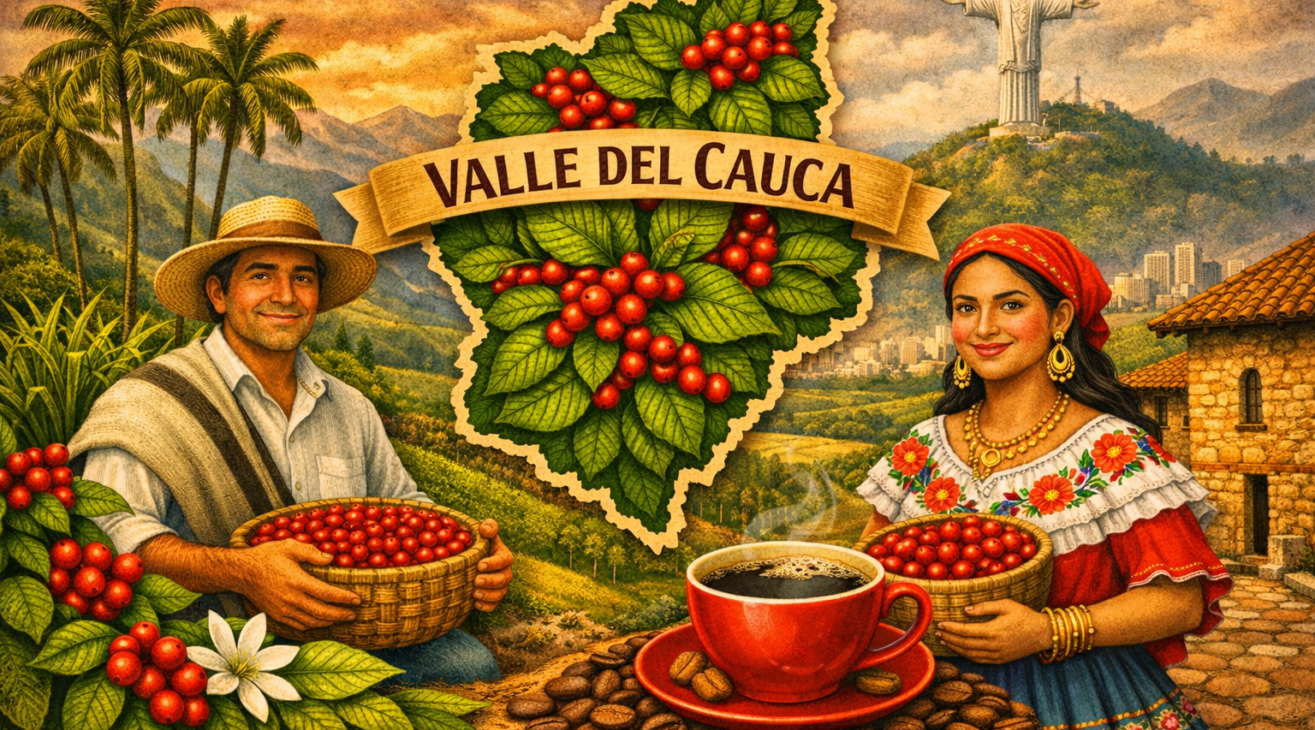
Valle del Cauca
Region 09 of 13
Central Zone
Valle del Cauca
Pacific Influence and Indigenous Roots — From Coastal Lowlands to High Andean Ranges
Overview
Valle del Cauca is a study in dramatic contrasts — spanning from Pacific coastal lowlands to high Andean ranges, its coffee-growing zones occupy the mountain corridors where Pacific Ocean moisture collides with Andean altitude to create a distinctive terroir found nowhere else in Colombia. The department’s northern section is included in the UNESCO Coffee Cultural Landscape, linking it to the broader Eje Cafetero heritage. Its Andean coffee communities — particularly those of Nasa indigenous and Afro-descendant heritage — have navigated a history of narcotics-trade disruption with extraordinary resilience, using coffee as a pathway to economic legitimacy and international market access. The Pacific coastal influence brings higher humidity and slightly more tropical fruit expression to Valle del Cauca’s cup profile compared to its Andean neighbors.
Coffee History
Coffee arrived in Valle del Cauca through two pathways: the paisa migration from the north, which established coffee culture in the mountainous eastern part of the department; and independent adoption by Pacific coastal communities seeking cash crops compatible with their existing agroforestry systems. The city of Cali — Colombia’s third-largest — became an important coffee processing and logistics hub. During the height of the Cali Cartel’s dominance in the 1980s and 1990s, coffee farming in rural Valle del Cauca was severely disrupted as narcotics money distorted land markets. The recovery of coffee farming in the post-cartel era was supported by FNC infrastructure, FAIRTRADE certification programs, and international specialty buyers who valued the region’s unique terroir. The northern municipalities of Valle del Cauca were incorporated into the UNESCO Coffee Cultural Landscape designation in 2011.
Climate & Geography
| Altitude | 1,000 – 2,000 m above sea level (coffee zones) |
| Temperature | 16°C – 24°C (61°F – 75°F); Pacific-influenced humidity |
| Rainfall | 1,800 – 3,000 mm/year; bimodal with Pacific-driven humidity |
| Soil | Volcanic loam and rich alluvial deposits; organic-rich coastal-influenced soils |
| Harvest seasons | Main: October – January; Mitaca: April – June |
| Key municipalities | Trujillo, El Cairo, Versalles, Argelia, El Águila, La Unión (coffee zone) |
| Capital | Cali (995 m) — Colombia’s salsa capital and third-largest city |
| Designations | Northern section: UNESCO Coffee Cultural Landscape (2011) |
Coffee Varieties
- Caturra — Traditional dominant variety; well-suited to the humid Pacific climate
- Castillo — FNC hybrid; increasingly prevalent
- Typica — Heirloom; found in older indigenous and agroforestry farms
- Bourbon — Heirloom; microlot production in premium programs
Honey processing has gained significant traction in Valle del Cauca, with the naturally higher humidity enabling more controlled mucilage retention. Honey-process Valle del Cauca lots are characterized by enhanced sweetness, fuller body, and elevated tropical fruit notes that distinguish them sharply from the department’s washed offerings.
Major Farms & Collectives
- Café Pacífico cooperative — Pacific-focused producer cooperative; organizes smallholder farmers in high-altitude Pacific-facing valleys
- Asociación de Caficultores de Valle del Cauca — Departmental coffee association; technical support and quality programs
- Cencoic Cooperative — Spans both Cauca and Valle del Cauca; indigenous and smallholder member base
- Nasa community farms — Indigenous community farms continuing traditions of agroforestry and minimal-intervention cultivation
Notable Associated Brands
- Specialty roasters and European importers — German, Dutch, and UK specialty importers increasingly source Valle del Cauca for its Pacific-influenced profiles
- UNESCO heritage coffee tourism — The World Heritage designation provides marketing infrastructure that benefits Valle del Cauca producers in premium market positioning
Flavor Profile
Tasting Notes — Valle del Cauca
Primary notes: Tropical fruit (mango, pineapple, guava), bright citrus, dark chocolate
Secondary notes: Brown sugar, caramel, mild spice
Body: Medium; fruity, refreshing
Acidity: Vibrant, citric, lively
Finish: Fruity, clean, refreshing
Processing: Washed (dominant); honey process adds sweetness and body
Distinction: The Pacific Ocean influence delivers tropical fruit notes absent in more inland Colombian regions; honey-process lots are particularly distinctive
Photo
Sources: Trabocca; Roasters Map; Colombia Travel; Wikipedia; FNC; UNESCO Coffee Cultural Landscape documentation.