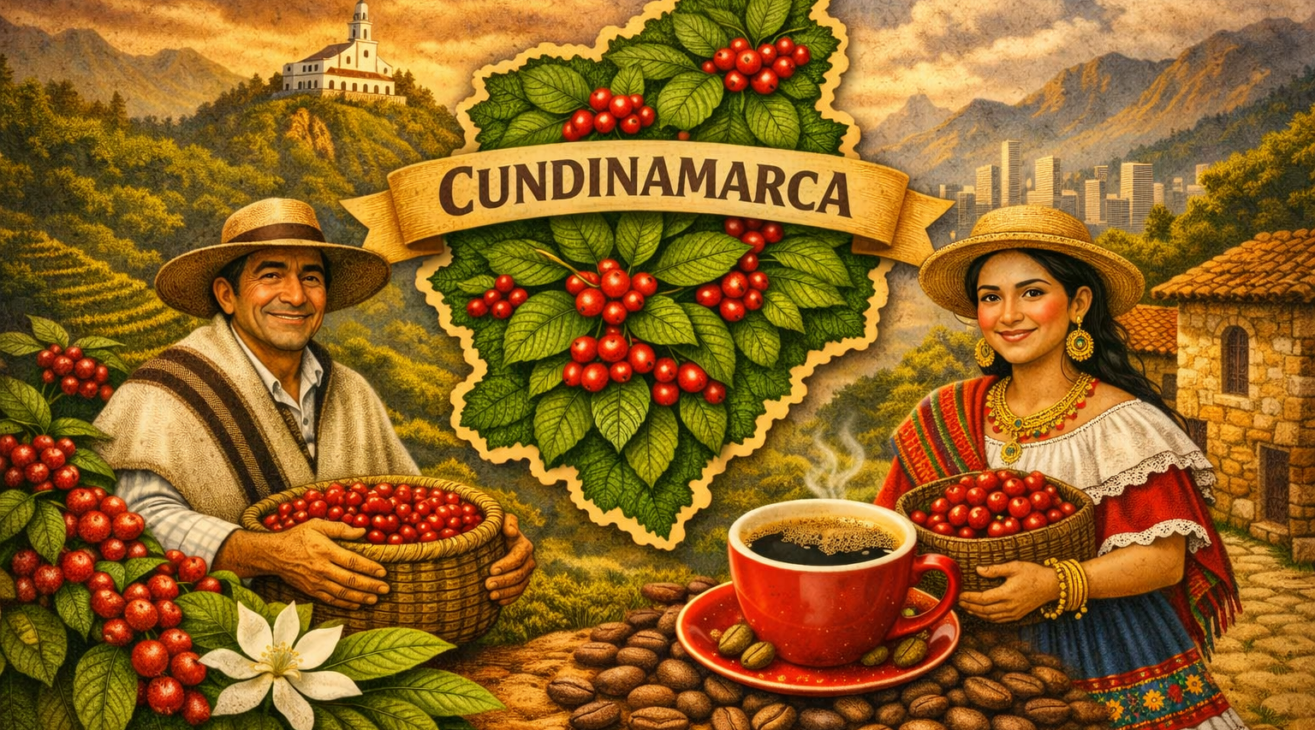
Cundinamarca
Region 10 of 13
Central Zone
Cundinamarca
Land of the Condor — Colombia’s Capital Coffee Region and Historic Hacienda Heartland
Overview
Cundinamarca — whose name derives from the Quechua for “land of the condor” — surrounds Colombia’s capital Bogotá and holds a historically significant but often underappreciated position in the national coffee narrative. It was on Cundinamarca’s large haciendas that Colombia’s commercial coffee industry first took organized shape in the 19th century, with some estates planting over a million coffee trees. Today, after civil strife and price instability fragmented those great estates into smallholder farms, Cundinamarca’s producers focus increasingly on quality improvement and specialty market access, leveraging their proximity to Bogotá’s growing specialty café culture and the logistical advantages of Colombia’s main transportation hub.
Coffee History
Coffee cultivation in Cundinamarca dates to approximately 1860–1870, when large hacienda owners introduced the crop on a commercial scale along the western slopes descending toward the Magdalena River. Some haciendas in the Viotá municipality — the historic core of Cundinamarca coffee — planted more than a million trees in a single estate, representing the largest concentrations of coffee in 19th-century Colombia. By 1932, Cundinamarca produced approximately 452,000 bags per year — a substantial share of national output. The civil conflicts of the early 20th century, including La Violencia of the 1940s–1950s, combined with market instability, broke up many of these large estates through forced displacement and agrarian reforms. The resulting smallholder structure, while economically fragmented, preserved agricultural diversity and enabled the quality improvements of the specialty era.
Climate & Geography
| Altitude | 900 – 2,200 m above sea level (coffee zones on western slopes) |
| Temperature | Average 21°C (70°F); 75% average humidity |
| Rainfall | 1,400 – 2,000 mm/year; bimodal |
| Soil | Volcanic loam and clay; Andean western-slope soils with high organic matter |
| Harvest seasons | Main: October – December; Mitaca: April – June |
| Key municipalities | Viotá (historic core), Fusagasugá, Arbeláez, La Mesa, Anapoima, Nocaima |
| Capital | Bogotá (2,625 m) — Colombia’s capital; major specialty café market |
Coffee Varieties
- Caturra — Most widely cultivated variety; classic profile
- Castillo — FNC hybrid; prevalent in replanted farms
- Typica — Heirloom; found in oldest farms in Viotá; exceptional heritage lots
- Colombia variety — FNC hybrid; widespread
Major Farms & Collectives
- Cooperativa de Caficultores de Cundinamarca — Departmental cooperative; quality standards and export coordination
- Smallholder associations — Fusagasugá and Arbeláez — Producer groups pursuing specialty market access; benefit from proximity to Bogotá buyers and roasters
- FNC cooperatives — Viotá — Historic municipality; heritage Typica lots available through FNC networks
- Individual haciendas — Viotá — Several surviving historic estates now producing specialty microlots from century-old trees
Notable Associated Brands
- Bogotá specialty café scene — The proximity to Colombia’s capital means Cundinamarca coffees are frequently featured by Bogotá’s growing community of specialty roasters and café operators
- International specialty buyers — Less branded internationally than Huila or Nariño but valued by informed buyers for dependable quality and unique Viotá heritage lots
Flavor Profile
Tasting Notes — Cundinamarca
Primary notes: Cocoa, caramel, mild citrus (lemon, orange)
Secondary notes: Subtle red fruit (cherry, plum), brown sugar
Body: Medium; versatile, balanced
Acidity: Moderate, clean, structured
Finish: Clean, smooth, reliable
Processing: Washed (dominant)
Distinction: A dependable, versatile Colombian cup; Viotá Typica heritage lots offer exceptional complexity for their price point
Photo
Sources: Nawalee Coffee; Barista Hustle; Crema.co; Wikipedia; FNC; Café de Colombia departmental profiles.