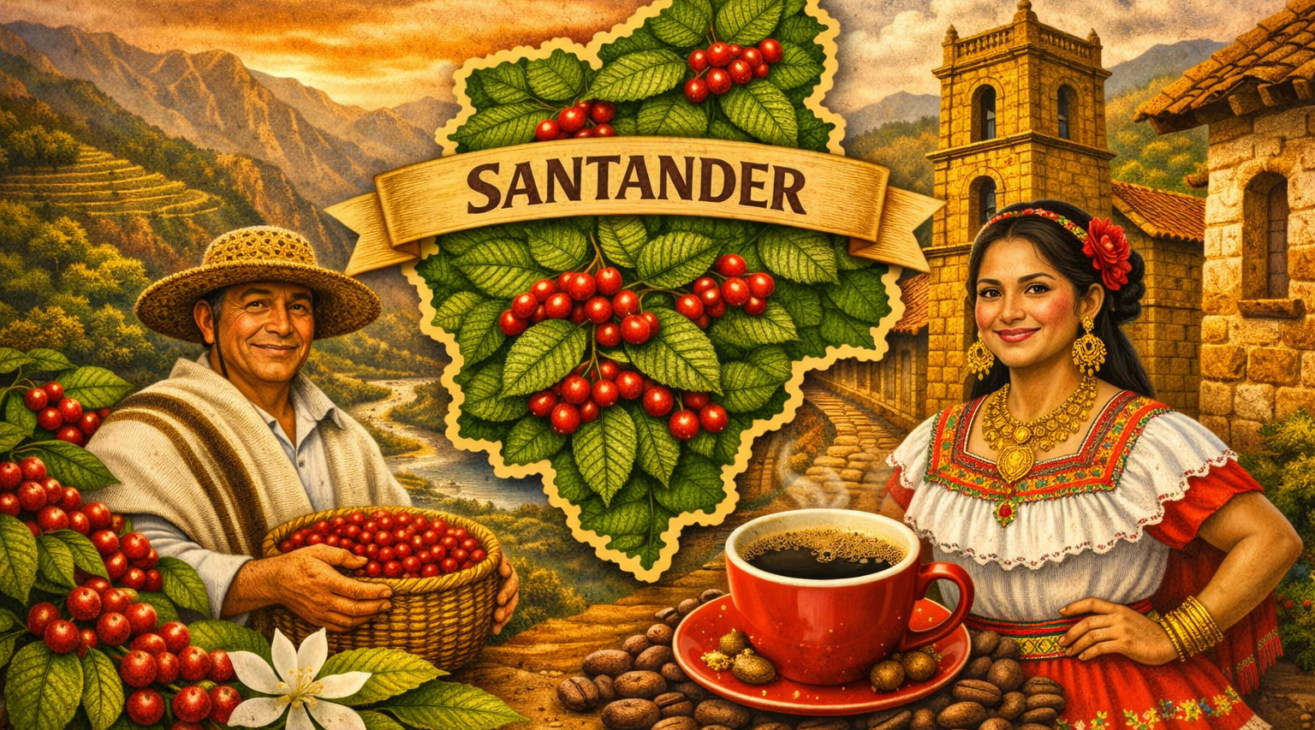
Santander
Region 11 of 13
Northern Zone
Santander
Shade-Grown Heritage and Organic Tradition — Colombia’s Northeast Coffee Stronghold
Overview
Santander is one of Colombia’s oldest and most distinctive coffee regions — a northeast Andean department where shade-grown cultivation under a canopy of avocado, banana, guamo, calapo, and citrus trees is not a premium practice but simply the way coffee has always been grown. With approximately 37,000 farms and 32,000 producing families spread across the Eastern Andes, Santander’s coffee culture is defined by organic practices, ecological integration, and a warm, round cup profile that has made it the preferred origin for espresso-focused European roasters. In 2016, the Santander Coffee Cluster — organized through the Bucaramanga Chamber of Commerce — was established to formally reconnect this historically significant region with international specialty markets after decades of relative obscurity.
Coffee History
Coffee production in Santander dates to the 19th century, developed alongside the department’s significant commercial infrastructure centered on Bucaramanga — one of Colombia’s most important colonial trade cities. The region’s coffee industry was severely set back by the Guerra de los Mil Días (Thousand Days’ War, 1899–1902), Colombia’s most devastating civil conflict, which disrupted agricultural production and export logistics across the country. The recovery of Santander’s coffee industry was supported by the FNC’s post-1927 organizational structure and, critically, by the discovery that the region’s ecology — particularly its diverse shade canopy — naturally suppressed the coffee leaf rust (roya) that periodically devastated sun-grown farms. The 2016 formation of the Santander Coffee Cluster marked the beginning of a concerted effort to brand Santander as a distinct specialty origin, yielding results in European specialty markets where Santander lots now attract significant buyer interest.
Climate & Geography
| Altitude | 1,300 – 1,800 m above sea level |
| Temperature | 18°C – 24°C (64°F – 75°F); stable Eastern Andes climate |
| Rainfall | 1,500 – 2,000 mm/year; single main season |
| Soil | Limestone and volcanic soils; mineral-rich; well-draining |
| Harvest seasons | Main: October – January; secondary harvest March – May |
| Shade trees | Avocado, plátano, guamo, calapo, citrus — universal shade canopy |
| Capital | Bucaramanga (956 m) — “City of Parks”; major commercial center |
The combination of limestone and volcanic soils in Santander contributes mineral complexity to the cup that coffee scientists and buyers note as a consistent regional signature. The shade-grown standard — across 37,000 farms — creates one of the largest contiguous agroforestry coffee landscapes in Colombia, providing critical habitat for migratory birds and biodiversity conservation.
Coffee Varieties
- Caturra — Dominant traditional variety; well-adapted to shade-grown conditions
- Castillo — FNC hybrid; prevalent in newer plantings
- Typica — Heirloom; found in oldest farms; valued for cup quality in heritage lots
Honey and natural processing are emerging in Santander as younger-generation producers experiment with post-harvest methods to differentiate their lots in specialty markets. The high shade cover and mild temperature swings create ideal conditions for slow, controlled natural fermentation.
Major Farms & Collectives
- Finca La Esperanza (Joaquín Díaz) — One of the most-cited individual farms in Santander specialty literature; known for meticulous hand-sorting and shade-grown Typica
- Finca Hoyo Frío — Specialty micro-farm; featured on Algrano green coffee platform
- Santander Coffee Cluster members — Network of producers organized through the Bucaramanga Chamber of Commerce for collective marketing and export support
Notable Associated Brands
- Algrano (Zurich, Switzerland) — Swiss green coffee B2B platform; features Santander lots prominently; connecting Santander producers directly with European specialty roasters
- European specialty buyers — German, UK, and Scandinavian specialty roasters have increasingly featured Santander as a distinctive espresso-suitable origin
Flavor Profile
Tasting Notes — Santander
Primary notes: Dark chocolate, hazelnut, caramel
Secondary notes: Gentle citrus (orange peel), mild spice, panela
Body: Round, full, structured — excellent for espresso
Acidity: Gentle, smooth, citric
Finish: Long, warm, composed
Processing: Washed (dominant); honey and natural emerging
Distinction: The shade-grown agroforestry character delivers a round body and mineral complexity that makes Santander exceptional for espresso blending and single-origin espresso
Photo
Sources: Nawalee Coffee; Cafe Colombian Roast; Algrano (algrano.com); Santander Coffee Cluster documentation; FNC.