Sierra Nevada de Santa Marta
Region 13 of 13
Northern Zone
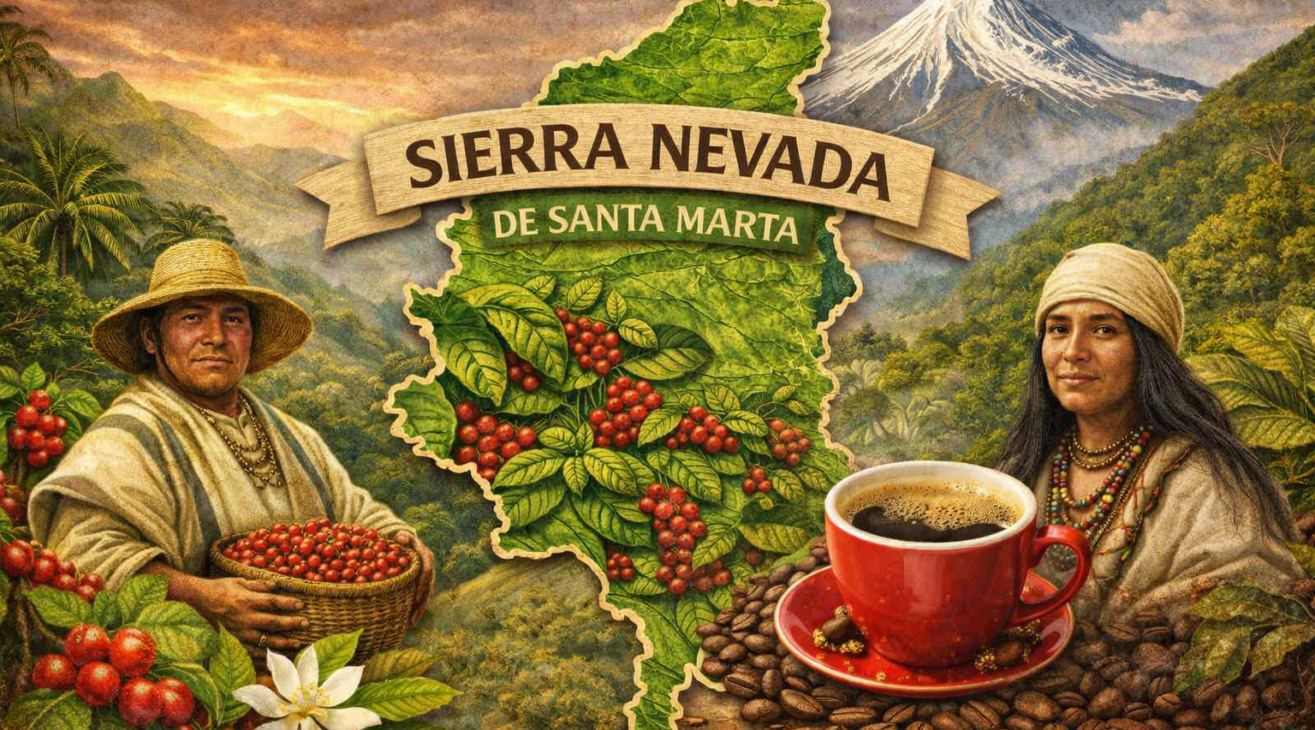
Sierra Nevada de Santa Marta
The Sacred Mountain — The World’s Highest Coastal Range, Stewarded by Ancient Indigenous Hands
Overview
The Sierra Nevada de Santa Marta is unlike any other coffee origin on earth. It is the world’s highest coastal mountain range — rising from Caribbean sea level to glaciated peaks at 5,775 meters within just 40 kilometers of horizontal distance, the most dramatic altitude gradient of any mountain system on the planet. Four indigenous nations have stewarded this landscape since long before coffee: the Arhuaco (Iku), Kogui, Wiwa, and Kankuamo. These communities have maintained continuous agricultural civilization on the Sierra’s slopes for over a thousand years, guided by ancestral wisdom transmitted through their spiritual leaders, the mamos. For the Arhuaco — who represent approximately 70% of the Sierra Nevada’s coffee growers — coffee is not merely an economic crop but a spiritual covenant with Mother Earth (Aluna), cultivated according to ecological principles rooted in pre-Columbian cosmology. UNESCO designated the Sierra Nevada a Biosphere Reserve in 1979. The resulting cup — grown at 900–1,600 meters under dense native shade, subject to the unique microclimate of warm Caribbean air meeting mountain cool — is unlike any other Colombian coffee.
Coffee History
Coffee was introduced to the Sierra Nevada in the early 20th century, but rather than being imposed as a colonial cash crop, it was adopted by indigenous communities as an addition to their existing agroforestry systems. The Arhuaco integrated coffee into their traditional productive landscape alongside cacao, plantain, and native forest species in a way that aligned with their ecological philosophy of maintaining balance (el equilibrio) with the natural world. The Confederación Indígena Tayrona (CIT) — the governing body of the Arhuaco people — organized collective coffee production and established export relationships as a means of economic self-determination while preserving cultural and territorial integrity. International attention intensified after the early 2000s specialty coffee movement identified the Sierra Nevada’s combination of extraordinary provenance, ecological purity, and genuinely unique flavor profile as among the most compelling stories in global specialty coffee. Nespresso’s inclusion of Sierra Nevada indigenous-farmed lots in its AAA Sustainable Quality Program brought significant international commercial validation.
Climate & Geography
| Altitude | 900 – 1,600 m above sea level (coffee zones) |
| Mountain height | 5,775 m — world’s highest coastal mountain range |
| Temperature | 18°C – 25°C (64°F – 77°F); stable, Caribbean-influenced |
| Rainfall | 2,000 – 3,500 mm/year; distributed by Caribbean trade winds |
| Soil | Ancient Precambrian rock-derived soils; minimal agrochemical impact; among the most pristine coffee soils in Colombia |
| Harvest seasons | Main: November – March; secondary: May – August |
| Shade trees | Guamo, walnut, avocado, carbonero, native forest species — dense native shade universal |
| Designations | UNESCO Biosphere Reserve (1979); Tayrona National Park adjacent |
The Sierra Nevada’s microclimate is truly unique: warm, moist Caribbean trade winds rise up the mountain’s northern face, providing the humidity and warmth needed for Arabica cultivation, while the altitude moderates temperature to the range ideal for slow cherry maturation. The result is a prolonged growing season that concentrates sugars and develops the Sierra Nevada’s signature malic acidity and honey-like sweetness. The absence of synthetic inputs — mandated by indigenous ecological principles rather than certification requirements — means the Sierra Nevada’s soils retain their full natural fertility.
Coffee Varieties
- Typica — The dominant variety by far; the oldest Arabica genetics in Colombia, preserved through geographic isolation; this is what Colombian coffee grown in its most ancestral form looks like
- Caturra — Small presence in more recent plantings; less prevalent than in other regions
The Sierra Nevada’s Typica represents some of the oldest and least-hybridized Arabica genetics in Colombia — preserved because the geographic isolation and cultural autonomy of the indigenous communities limited the introduction of FNC hybrid varieties that transformed other regions. The result is a genetic heritage of exceptional value to seed banks and specialty buyers.
Major Farms & Collectives
- Confederación Indígena Tayrona (CIT) — Arhuaco farms — The governing body of the Arhuaco nation organizes collective coffee production across dozens of indigenous communities in the Sierra Nevada; all coffee grown according to traditional ecological principles guided by mamos
- Kogui community farms — Among the most isolated and least commercially connected; known for exceptional ecological purity
- Wiwa community farms — Located on the southern and eastern slopes; washed and natural processing
- Kankuamo community farms — Southeastern Sierra communities; increasingly organized for specialty export
- Fundación Pro-Sierra Nevada de Santa Marta — Conservation and development foundation supporting indigenous coffee programs and ecological protection
Notable Associated Brands
- C8th.com — Specialty roastery with direct organizational connection to Sierra Nevada indigenous farming communities; exports and showcases this origin internationally
- Nespresso AAA Sustainable Quality Program — Has sourced indigenous Sierra Nevada lots; brought international commercial validation and infrastructure investment to the region
- Nordic and U.S. specialty importers — Multiple importers specifically sourcing indigenous-farmed Sierra Nevada lots for single-origin offerings
Flavor Profile
Tasting Notes — Sierra Nevada de Santa Marta
Primary notes: Honey-like sweetness, malic acidity, subtle tropical fruit
Secondary notes: Clean jasmine florals, mild caramel, dried fruit
Body: Silky, medium; structured and layered
Acidity: Malic, gentle, persistent; the defining characteristic — depth rather than brightness
Finish: Long, clean, lingering sweet-floral
Processing: Washed (traditional method of indigenous communities)
Distinction: Unlike any other Colombian region — the combination of Caribbean microclimate, ancient Typica genetics, pristine soils, and indigenous spiritual stewardship produces a cup of structured, layered depth that specialists describe as the most distinctive in Colombia
Photo
Sources: C8th.com; Marca País Colombia; Nimmica Specialty Coffee Journal; AFP/Getty Images; UNESCO Biosphere Reserve documentation (1979); Confederación Indígena Tayrona (CIT); Nespresso AAA Program.